New Delhi, August 24, 2026: India’s national security landscape is undergoing a significant transformation as traditional military threats increasingly overlap with cyberattacks, artificial intelligence, digital fraud and cross-border security challenges. While the armed forces continue to focus on conventional defence preparedness, government agencies are simultaneously strengthening India’s ability to protect critical digital infrastructure and citizens from increasingly sophisticated online threats.
The shift comes at a time when conflicts around the world are accelerating demand for defence technology, surveillance systems, air defence and electronic warfare capabilities. For India, the challenge is not only to strengthen its military capabilities but also to ensure that the country’s rapidly expanding digital infrastructure remains resilient against hostile cyber activity.
Cybersecurity Becomes a National Security Priority
The scale of cyber threats facing India has increased considerably in recent years. According to data presented by the government, CERT-In tracked 15,92,917 cybersecurity incidents in 2023 and 20,41,360 incidents in 2024. The government has said that protecting central government platforms and citizen-facing digital services has become a major priority.
The growing use of artificial intelligence has added another layer to the challenge. AI can help defenders detect suspicious activity faster, but the same technology can also allow attackers to automate reconnaissance, discover vulnerabilities and create highly convincing phishing or impersonation campaigns.
A recent government assessment noted that AI-enabled attacks can lower the cost of cyber operations while making them faster and more difficult to detect. CERT-In has therefore been conducting cybersecurity exercises focused on AI-driven threats and vulnerability assessment.
AI and Deepfakes Add a New Dimension
Artificial intelligence is also changing the nature of information warfare. Deepfake audio, video and synthetic text can be used to impersonate public figures, spread false information or manipulate individuals and organisations.
The Ministry of Electronics and Information Technology has highlighted deepfakes as an emerging cybersecurity challenge and pointed to existing provisions under the Information Technology Act and IT Rules that can be applied to unlawful online activity. CERT-In has also issued guidance related to deepfake threats and online safety.
For national security agencies, the concern is broader than individual online fraud. A sophisticated deepfake campaign could potentially create confusion during an emergency, damage public trust or falsely attribute statements to political and military leaders.
This means that future security preparedness will increasingly require cooperation between intelligence agencies, armed forces, technology companies and cybersecurity researchers.
Government Steps Up Cyber Defence
The Centre has expanded its institutional response through organisations including the Indian Cyber Crime Coordination Centre (I4C) and CERT-In. The National Cyber Crime Reporting Portal provides a mechanism for citizens to report cybercrime, while the government has introduced additional systems aimed at disrupting malicious digital infrastructure.
In August, the government also highlighted a campaign against a WhatsApp-based fraud technique targeting corporate executives and finance professionals. According to the Ministry of Home Affairs, more than 58,000 potential victims had been alerted through SMS, while action through the Sahyog platform helped protect more than 10,000 Indians from the identified campaign.
The episode demonstrates how cybersecurity is no longer limited to protecting government networks. Private companies, financial institutions and individual users are increasingly becoming part of the national security equation.
Defence Industry Benefits From Global Demand
India’s defence manufacturing sector is also seeing opportunities from the growing demand for military equipment around the world.
Indian defence company Paras Defence and Space Technologies expects its export revenue to approximately double in the 2026-27 financial year, driven partly by increased international demand linked to geopolitical tensions. The company expects exports to reach around ₹120-130 crore, compared with approximately ₹50-60 crore in the previous financial year.
The company supplies products including electro-optical systems, infrared components and anti-drone technologies. Its business illustrates how India’s defence industry is increasingly looking beyond domestic procurement and attempting to establish itself as an exporter of specialised military technology.
The broader trend is significant because countries are seeking to diversify their defence supply chains amid uncertainty surrounding global conflicts and traditional suppliers.
Anti-Drone Technology Gains Importance
One of the most rapidly developing areas of modern warfare is counter-drone technology. Unmanned aerial systems have become increasingly important in conflicts because they can provide surveillance and strike capabilities at relatively low cost.
For India, anti-drone systems are particularly relevant because drones can be used for surveillance, smuggling and other cross-border activities. Defence companies and government agencies are therefore investing in technologies capable of detecting, tracking and neutralising hostile unmanned systems.
The growth of drone warfare also highlights why India’s defence strategy increasingly needs to combine traditional platforms with artificial intelligence, electronic warfare and autonomous systems.
Regional Security Remains Important
India’s strategic environment continues to be shaped by developments across Asia. The country’s relationships with China, Pakistan and other regional powers remain central to its defence planning.
At the same time, uncertainty surrounding US security policy in Asia is being closely watched in New Delhi. Recent changes in Washington’s approach toward North Korea and military exercises with South Korea have raised questions among several US allies about the future reliability of American security commitments in the region. India is also assessing the implications for its broader strategic relationship with Washington.
China’s expected participation in the upcoming BRICS summit in New Delhi could also create an important diplomatic opportunity. Chinese President Xi Jinping is expected to attend the September summit, although his participation has not yet been officially confirmed. India and China continue to manage unresolved border issues despite recent efforts to stabilise bilateral relations.
The Future of Indian Security
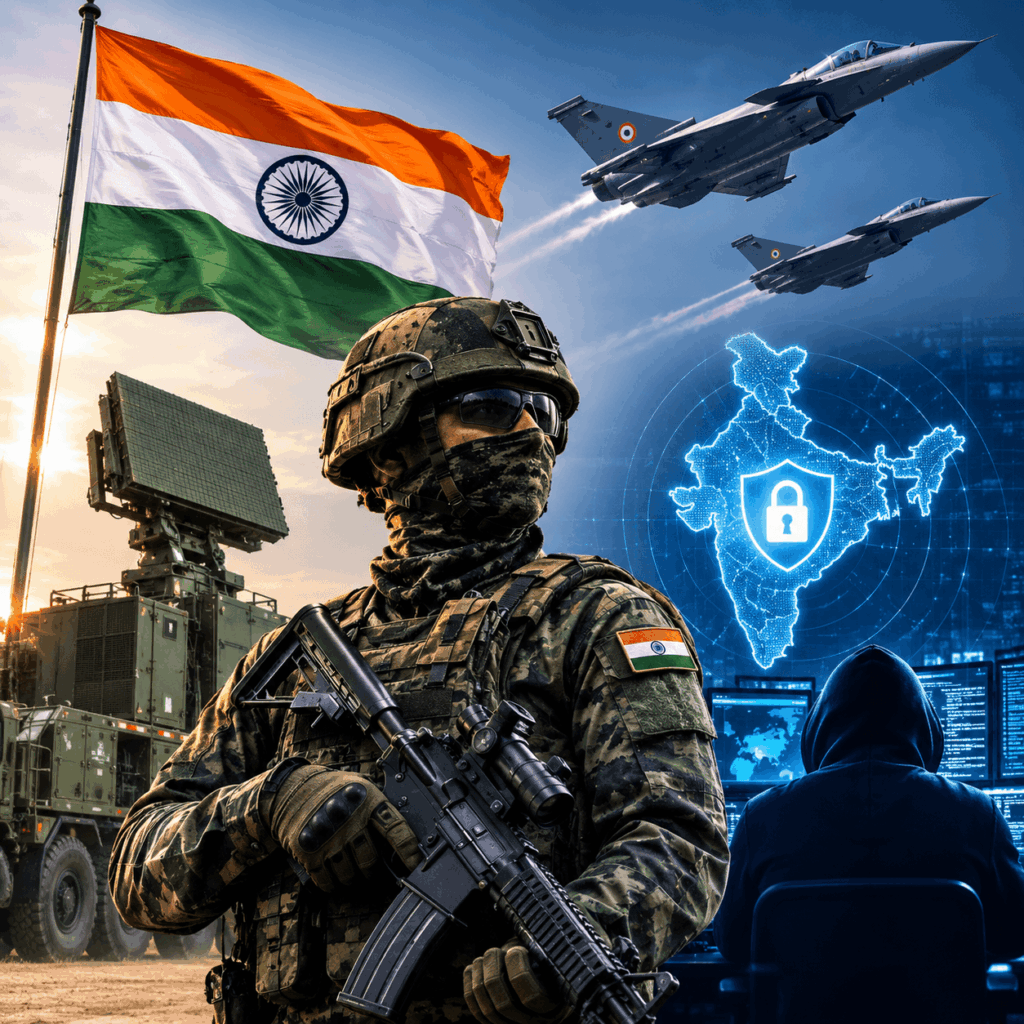
India’s security priorities are clearly expanding beyond conventional military preparedness. The modern security environment includes cyberattacks, drones, artificial intelligence, disinformation, satellite systems and critical infrastructure protection alongside traditional threats.
This transformation is forcing India to invest simultaneously in military modernisation and technological resilience. The ability to detect threats early, protect digital networks and respond rapidly could become just as important as conventional battlefield strength.
As geopolitical tensions continue to reshape global defence spending, India has an opportunity to strengthen both its armed forces and domestic defence industry. However, the country will also need sustained investment in cybersecurity professionals, advanced research, AI safety and indigenous defence technologies.
India’s next major security challenge may not always arrive across a physical border. Increasingly, it could appear on a computer screen, inside a digital network or through an autonomous machine in the sky. Preparing for that future is becoming a central part of India’s national defence strategy.