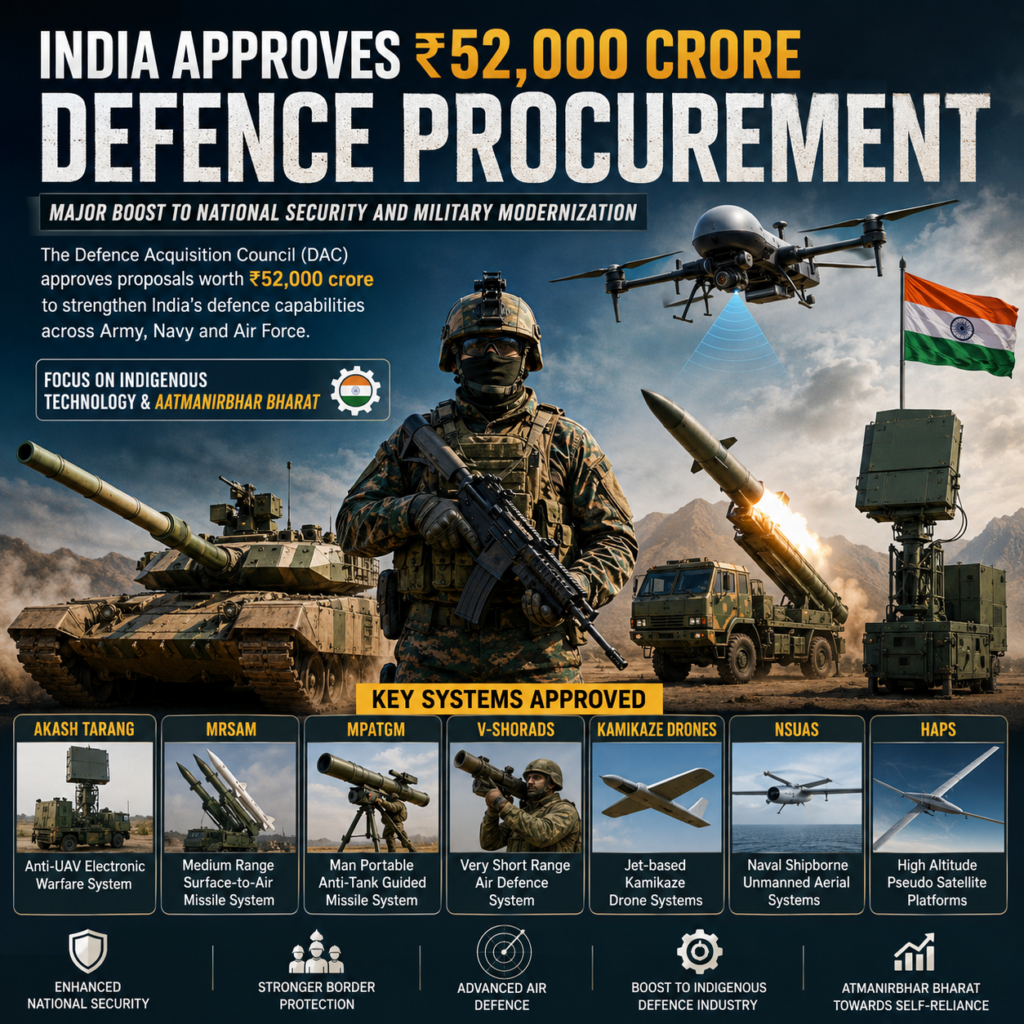
India has taken another significant step toward strengthening its defence capabilities with the approval of defence acquisition proposals worth ₹52,000 crore. The decision, cleared by the Defence Acquisition Council (DAC) under the chairmanship of Defence Minister Rajnath Singh, reflects the country’s growing emphasis on military modernization, indigenous defence manufacturing, and preparedness against evolving security challenges.
As geopolitical tensions continue to shape the global security landscape, nations across the world are investing heavily in advanced military technologies such as drones, hypersonic weapons, artificial intelligence, and integrated air defence systems. India’s latest procurement package aligns with this global trend while reinforcing the country’s commitment to self-reliance under the “Aatmanirbhar Bharat” initiative.
Why This Defence Procurement Matters
The ₹52,000 crore defence package is one of the most comprehensive military modernization efforts approved in recent months. It focuses on enhancing the operational readiness of the Indian Army, Indian Navy, and Indian Air Force through the acquisition of next-generation weapon systems capable of addressing both conventional and emerging threats.
The package includes several high-priority systems designed to improve battlefield effectiveness, border security, and strategic deterrence. These acquisitions will significantly enhance India’s capability to counter drone attacks, strengthen missile defence, and improve survivability during modern warfare.
Key Defence Systems Approved
Among the most notable approvals is the Akash Tarang Anti-UAV Electronic Warfare System, which has been developed to detect, track, and neutralize hostile drones. With drone warfare becoming increasingly common in modern conflicts, this system is expected to play a critical role in protecting military installations and forward operating bases.
The Defence Acquisition Council also approved the procurement of:
- Medium Range Surface-to-Air Missile (MRSAM) Weapon Systems
- Man Portable Anti-Tank Guided Missile (MPATGM) Systems
- Very Short Range Air Defence System (V-SHORADS)
- Active Protection Systems for battle tanks
- Jet-based Kamikaze Drone Systems
- Naval Shipborne Unmanned Aerial Systems (NSUAS)
- High Altitude Pseudo Satellite (HAPS) platforms for enhanced surveillance
These technologies collectively strengthen India’s air defence network, precision strike capability, intelligence gathering, and battlefield mobility.
Rising Importance of Counter-Drone Technology
Recent global conflicts have demonstrated how inexpensive drones can inflict significant damage on critical infrastructure and military assets. Countries worldwide are rapidly investing in counter-drone solutions to defend against surveillance drones, loitering munitions, and swarm attacks.
India’s investment in Akash Tarang highlights the military’s recognition that future battlefields will rely heavily on unmanned systems. By integrating electronic warfare with advanced detection capabilities, India aims to neutralize aerial threats before they can compromise operational security.
The growing importance of drone defence also supports India’s broader strategy of building layered air defence systems capable of handling threats ranging from small UAVs to advanced missile attacks.
Boost to Indigenous Defence Manufacturing
One of the biggest highlights of the procurement package is its focus on promoting India’s domestic defence industry. Several of the approved systems have been developed by Indian defence organizations and private sector partners, reducing dependence on foreign imports.
The emphasis on indigenous production supports the government’s long-term objective of transforming India into a global defence manufacturing hub. Domestic production not only strengthens supply chain resilience but also generates employment opportunities, encourages research and development, and increases export potential for Indian defence companies.
Self-reliance in defence technology has become a strategic necessity as geopolitical uncertainties continue to impact global supply chains.
Strengthening National Security
India faces multiple security challenges, including border tensions, maritime security concerns in the Indian Ocean Region, cyber threats, and the rapid evolution of military technologies among neighboring countries.
The newly approved acquisitions improve India’s preparedness across multiple domains:
- Enhanced border surveillance
- Better protection against drone incursions
- Stronger air defence capabilities
- Improved anti-tank warfare
- Greater battlefield survivability
- Expanded maritime reconnaissance
- Advanced electronic warfare capabilities
Collectively, these improvements contribute to a more integrated and technology-driven defence posture.
Defence Modernization in a Global Context
India is not alone in accelerating defence modernization. Around the world, major military powers are investing heavily in next-generation technologies.
Recently, the United Kingdom awarded a £20 million contract under Project Bowline to develop hypersonic target systems that will strengthen missile defence capabilities in partnership with the United States and Australia through the AUKUS framework.
Similarly, the United States is preparing to return the USS Zumwalt to active service after upgrading it with hypersonic missile launch capability, making it the first surface warship in the U.S. Navy equipped with such weapons.
These developments demonstrate that advanced missile defence, hypersonic weapons, electronic warfare, and unmanned systems are becoming defining features of modern military strategy. India’s latest procurement reflects its determination to remain technologically competitive in this rapidly evolving security environment.
Looking Ahead
The approval of ₹52,000 crore worth of defence acquisitions marks another important milestone in India’s long-term military modernization strategy. While procurement approvals represent only the beginning of the acquisition process, they lay the foundation for future capability enhancement across all three armed services.
As defence technologies continue to evolve at an unprecedented pace, investments in indigenous innovation, advanced missile systems, drone defence, and electronic warfare will remain essential for safeguarding India’s national interests.
With a strong focus on modernization, self-reliance, and technological advancement, India is steadily building a more capable, resilient, and future-ready defence force prepared to address both conventional and emerging security challenges in the decades ahead.