
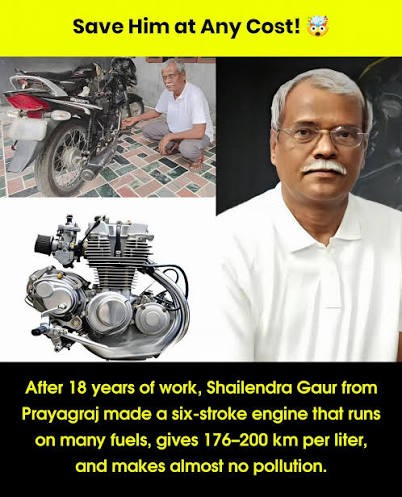
Innovation often begins with a simple question: Can we build a better engine? While the automobile industry is rapidly shifting toward electric vehicles, one Indian inventor chose a different path. After nearly 18 years of continuous research and experimentation, Shailendra Gaur from Prayagraj, Uttar Pradesh, claims to have developed a revolutionary 6-stroke internal combustion engine capable of delivering an impressive 176 km per liter of fuel under test conditions.
His work has attracted significant attention across social media and engineering communities, with many praising his determination and innovative thinking. Although some of the performance claims still await independent large-scale verification, the concept has reignited discussions about improving fuel efficiency through mechanical innovation.
The Man Behind the Innovation
Shailendra Gaur is an independent Indian innovator with a passion for automotive engineering. Without the backing of a major automobile manufacturer, he dedicated almost two decades to designing, testing, modifying, and refining his engine.
His journey reflects what innovation truly demands—countless failures, continuous improvements, and unwavering persistence. Instead of accepting the limitations of traditional engines, Gaur focused on extracting more energy from every drop of fuel while reducing wastage.
What Is a 6-Stroke Engine?
Most motorcycles and cars today use either 2-stroke or 4-stroke engines.
A conventional 4-stroke engine completes four stages:
- Intake
- Compression
- Power
- Exhaust
A 6-stroke engine adds two additional strokes designed to recover energy that normally goes to waste. Depending on the design, these extra strokes may:
- Utilize leftover heat inside the cylinder
- Improve combustion efficiency
- Reduce fuel consumption
- Lower engine temperature
- Minimize harmful emissions
Various 6-stroke engine concepts have been developed worldwide over the years, but they differ in engineering design. Shailendra Gaur’s version reportedly introduces modifications aimed at maximizing thermal efficiency while maintaining compatibility with existing fuel systems.
The Claim of 176 km Per Liter
The most talked-about aspect of Gaur’s invention is the reported fuel efficiency of 176 km per liter.
If independently validated under standardized testing conditions, such efficiency would represent a remarkable improvement over conventional petrol motorcycles, which typically deliver between 45 and 70 km/l, depending on engine size and riding conditions.
However, it’s important to understand that real-world mileage depends on numerous factors, including:
- Vehicle weight
- Riding style
- Road conditions
- Speed
- Engine tuning
- Testing methodology
As of now, there is no publicly available certification from major automotive testing agencies confirming the 176 km/l figure, so the claim should be viewed as preliminary until independently verified.
Why a 6-Stroke Engine Matters
Even as electric vehicles gain popularity, internal combustion engines will continue serving millions of vehicles across developing countries for many years.
Innovations that improve fuel efficiency could provide several benefits:
Lower Fuel Costs
Higher mileage directly reduces fuel expenses for daily commuters, delivery riders, and commercial vehicle owners.
Reduced Carbon Emissions
Burning less fuel generally produces lower CO₂ emissions, contributing to environmental sustainability.
Better Thermal Efficiency
Traditional engines waste a significant portion of energy as heat. Recovering part of this energy can improve overall efficiency.
Extended Engine Performance
Some 6-stroke concepts reduce engine temperature, potentially increasing engine lifespan and reducing wear.
The Challenge of Commercialization
Creating a working prototype is only the beginning.
For any new engine technology to reach consumers, it must successfully pass several stages:
- Long-term durability testing
- Safety certification
- Emission compliance
- Manufacturing optimization
- Cost analysis
- Industry partnerships
- Government approvals
Large automobile companies invest billions in engine development because even small engineering changes require extensive testing under various environmental and operating conditions.
This is why many promising inventions take years before reaching the market.
Innovation Requires Patience
Perhaps the most inspiring aspect of Shailendra Gaur’s story is not the mileage figure itself but the dedication behind the project.
Spending 18 years refining a single engineering idea demonstrates remarkable perseverance. Many successful inventors experience repeated failures before achieving meaningful breakthroughs.
Whether or not every technical claim is ultimately validated, Gaur’s work encourages young engineers to think creatively rather than accepting existing technology as final.
India’s Growing Innovation Ecosystem
India has increasingly become a hub for engineering innovation. From electric mobility and hydrogen fuel research to AI-driven transportation systems, Indian engineers are contributing solutions to global mobility challenges.
Independent innovators like Shailendra Gaur demonstrate that meaningful ideas can emerge outside large corporations. With proper support, funding, and collaboration with research institutions, such innovations can evolve into commercially viable technologies.
Government initiatives promoting startups, research grants, and innovation competitions have also made it easier for inventors to showcase their work and seek industrial partnerships.
The Future of Engine Technology
The automotive industry is moving toward multiple technologies rather than relying on a single solution. Future transportation may include:
- Electric vehicles (EVs)
- Hybrid powertrains
- Hydrogen fuel cells
- Sustainable biofuels
- Advanced internal combustion engines
- Alternative combustion technologies
While EV adoption is accelerating worldwide, improving traditional engines remains valuable, particularly in regions where charging infrastructure is still developing.
If concepts like Shailendra Gaur’s 6-stroke engine prove commercially practical and independently validated, they could complement existing transportation systems by offering improved efficiency and lower operating costs.
Final Thoughts
Shailendra Gaur’s 6-stroke engine represents more than an engineering experiment—it symbolizes determination, curiosity, and the relentless pursuit of innovation. His reported achievement of developing an engine capable of delivering exceptional fuel efficiency after 18 years of research has captured the imagination of people across India.
Although the claimed 176 km/l mileage still requires independent verification through standardized testing, the project highlights the importance of supporting homegrown inventors and encouraging unconventional engineering solutions.
In a world searching for cleaner, more efficient transportation, innovations like these remind us that progress often begins with one individual’s willingness to challenge conventional thinking. Whether this engine becomes a commercial success or inspires future breakthroughs, Shailendra Gaur’s journey stands as a testament to the power of persistence and innovation.