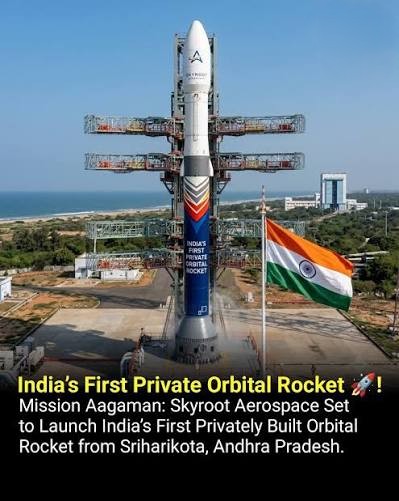
India is preparing to witness another historic milestone in its rapidly growing space ecosystem. Skyroot Aerospace, one of the country’s leading private space startups, has officially announced that its Vikram-1 orbital launch vehicle is fully assembled and ready for launch. Scheduled to lift off from the Satish Dhawan Space Centre between July 12 and August 4, the mission represents a defining moment for India’s private space ambitions.
Following the successful suborbital launch of Vikram-S in 2022, Skyroot Aerospace has steadily advanced toward developing India’s first privately built orbital rocket. The upcoming Vikram-1 mission is expected to demonstrate the country’s ability to build reliable, cost-effective launch vehicles through private innovation, complementing the achievements of the Indian Space Research Organisation (ISRO).
A New Chapter in India’s Space Journey
For decades, India’s space achievements have been driven primarily by ISRO, which has earned global recognition through missions like Chandrayaan, Mangalyaan, and the PSLV launch program. However, recent policy reforms encouraging private participation have opened the doors for startups to contribute significantly to the nation’s space capabilities.
Skyroot Aerospace has emerged as one of the pioneers of this transformation. Founded in 2018 by former ISRO engineers, the Hyderabad-based startup aims to make satellite launches more affordable, flexible, and accessible to customers worldwide.
The Vikram-1 mission symbolizes India’s transition from a government-led space program to a collaborative ecosystem where private companies play a major role in innovation and commercialization.
What Is Vikram-1?
Vikram-1 is a three-stage orbital launch vehicle designed to carry small satellites into Low Earth Orbit (LEO). The rocket has been developed using advanced engineering techniques, lightweight composite materials, and modern propulsion systems to improve efficiency while reducing launch costs.
Unlike traditional heavy-lift launch vehicles, Vikram-1 is specifically designed for the rapidly growing small satellite market, where demand has increased due to Earth observation, communication, scientific research, and commercial applications.
The vehicle is capable of delivering payloads to orbit with greater flexibility, allowing satellite operators to avoid waiting for shared launches on larger rockets.
Launch Timeline
Skyroot Aerospace has confirmed that Vikram-1 is fully integrated and prepared for launch.
The mission is expected to take place from the Satish Dhawan Space Centre in Sriharikota, India’s premier launch facility, during the launch window between July 12 and August 4.
As with every space mission, the exact launch date will depend on technical readiness, weather conditions, and final regulatory approvals.
Why This Mission Is Historic
If successful, Vikram-1 will become India’s first privately developed orbital rocket to reach space.
This achievement would mark a significant milestone for the country’s startup ecosystem, demonstrating that Indian private companies can independently design, manufacture, test, and launch sophisticated space vehicles.
It would also strengthen India’s position in the rapidly expanding global commercial launch market, where demand for small satellite launches continues to grow.
Growing Opportunities in the Space Economy
The global space industry is undergoing a major transformation.
Thousands of satellites are expected to be launched over the next decade to support:
- High-speed internet
- Earth observation
- Climate monitoring
- Navigation services
- Scientific research
- Defense applications
- Internet of Things (IoT)
This expanding market creates enormous opportunities for launch service providers capable of offering reliable and affordable missions.
Skyroot Aerospace aims to position India as a competitive destination for these commercial launches.
Innovation Behind Vikram-1
One of the defining features of Skyroot Aerospace is its focus on advanced manufacturing technologies.
The company has incorporated innovations such as:
- Carbon composite rocket structures
- 3D-printed rocket engine components
- Modular launch vehicle architecture
- Advanced avionics systems
- Modern propulsion technologies
These innovations help reduce manufacturing time, improve reliability, and lower operational costs.
Such technological advancements allow private companies to compete effectively in the global launch industry.
Boost for India’s Startup Ecosystem
The success of Vikram-1 would extend beyond the aerospace sector.
It would reinforce India’s reputation as a global hub for deep-tech innovation, encouraging greater investment in startups focused on advanced engineering, robotics, artificial intelligence, manufacturing, and space technology.
The mission also demonstrates how collaboration between government institutions and private enterprises can accelerate technological progress.
Recent reforms by the Indian government have enabled private companies to access testing facilities, launch infrastructure, and regulatory support previously available only to government agencies.
Challenges Ahead
Despite the excitement, launching an orbital rocket remains one of the most complex engineering challenges in the world.
Every mission involves thousands of components working in perfect synchronization.
Key challenges include:
- Engine performance
- Stage separation
- Navigation accuracy
- Thermal protection
- Flight software reliability
- Weather conditions
Even experienced space agencies occasionally face launch failures, making rigorous testing and quality assurance essential.
Regardless of the outcome, the Vikram-1 mission represents a significant step forward for India’s private space capabilities.
The Future of Indian Private Space
India’s private space sector is growing rapidly, with startups working on launch vehicles, satellite manufacturing, propulsion systems, space robotics, and downstream applications.
As global demand for affordable launch services increases, companies like Skyroot Aerospace have the opportunity to establish India as a major player in the commercial space economy.
The Vikram-1 mission is expected to inspire a new generation of engineers, entrepreneurs, and innovators while showcasing the country’s growing technological capabilities on the global stage.
Conclusion
The upcoming launch of Vikram-1 is more than just another rocket mission—it represents the beginning of a new era for India’s private space industry. Built by Skyroot Aerospace, the country’s first private orbital launch vehicle demonstrates how innovation, entrepreneurship, and government support can work together to create world-class technological achievements.
If the mission succeeds, it will not only strengthen India’s position in the global space economy but also inspire countless startups to pursue ambitious goals in science and technology. As the countdown begins, Vikram-1 carries with it the aspirations of an entire nation eager to shape the future of space exploration.