
June 29, 2026
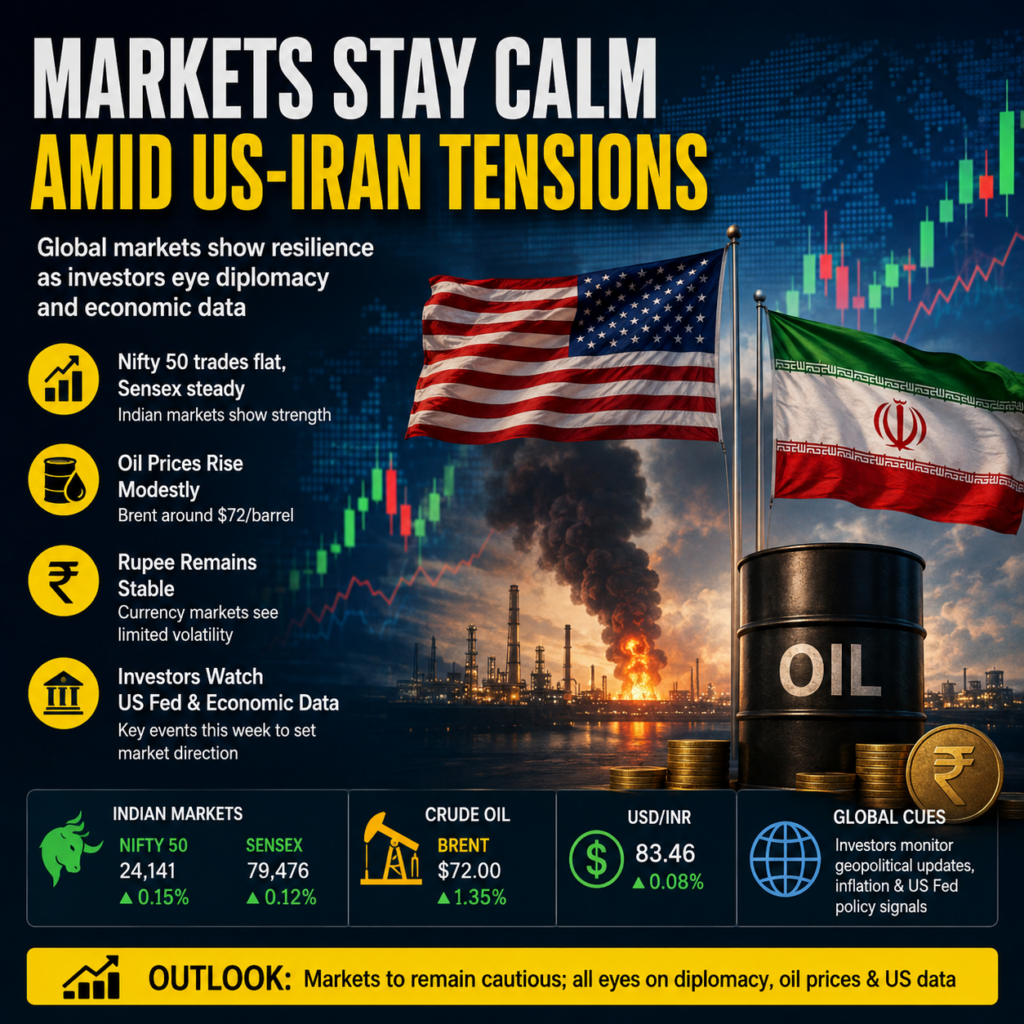
Global financial markets began the week with a cautious yet surprisingly resilient tone as investors closely monitored renewed tensions between the United States and Iran. While geopolitical conflicts typically trigger sharp sell-offs across equity markets and significant spikes in oil prices, Monday’s trading session painted a different picture. Investors largely avoided panic selling, believing that diplomatic negotiations could still prevent a wider regional conflict.
Indian benchmark indices also remained relatively stable, reflecting confidence that the current geopolitical situation may not escalate into a prolonged disruption of global energy supplies.
Markets Show Measured Reaction
Although fresh military exchanges between the US and Iran over the weekend briefly increased uncertainty, financial markets refrained from a full-scale risk-off move.
The key reason was the expectation that both countries are still engaged in diplomatic back-channel discussions, reducing the probability of an extended conflict.
Market Highlights
- Nifty 50 traded near flat with only limited volatility.
- Sensex also remained largely unchanged during early trade.
- Most Asian equity markets recorded only modest declines.
- US stock futures moved slightly higher.
- Investors continued rotating towards defensive sectors rather than exiting equities entirely.
The calm market response indicates that institutional investors currently view the conflict as manageable unless major oil infrastructure or shipping routes face prolonged disruption.
Oil Prices Rise, But Panic Buying Is Missing
Crude oil remains the most sensitive asset whenever Middle East tensions intensify.
On Monday:
- Brent crude traded around $72 per barrel.
- WTI crude remained above $70 per barrel.
- Oil gained modestly compared to last week but stayed well below the panic highs seen earlier during the conflict.
The world’s attention continues to focus on the Strait of Hormuz, through which nearly one-fifth of global seaborne oil supplies pass.
Any disruption in this region has the potential to rapidly increase fuel prices worldwide.
However, traders currently believe that both Washington and Tehran have strong incentives to prevent a complete shutdown of shipping lanes, limiting speculative buying in crude oil.
Why Indian Markets Remained Strong
Despite geopolitical uncertainty, several domestic factors continue supporting Indian equities.
Positive Drivers
- Stable foreign institutional investment (FII) inflows.
- Improving inflation outlook.
- Expectations that crude prices may remain under control.
- Strong domestic consumption.
- Continued optimism around India’s long-term economic growth.
Banking, financial services and select infrastructure stocks continued to attract investor interest.
Broader market participation also remained healthy, with mid-cap and small-cap indices trading largely unchanged.
Currency Market Remains Stable
The Indian Rupee showed limited weakness despite global uncertainty.
Currency dealers expect the rupee to remain within a relatively stable trading range as long as crude oil does not witness another sharp rally.
A stronger US Dollar continues to create some pressure on emerging market currencies, but India’s improving macroeconomic fundamentals are helping cushion excessive volatility.
Bond markets also remained relatively calm as investors balanced geopolitical concerns with expectations regarding future central bank policy.
Investors Now Watching the US Federal Reserve
Apart from geopolitical developments, markets are equally focused on upcoming US economic data.
This week’s major events include:
- US employment report
- Manufacturing data
- Consumer confidence numbers
- Inflation indicators
These reports will heavily influence expectations regarding future Federal Reserve interest rate decisions.
Higher interest rates generally strengthen the US Dollar while creating pressure on emerging market equities and currencies.
Technology Stocks Face Fresh Questions
Another important theme influencing global markets is the growing debate around AI-related valuations.
Technology companies have delivered exceptional returns over the past year, but investors are increasingly asking whether current valuations fully justify future earnings growth.
As a result:
- Profit booking continues in several AI-related stocks.
- Investors are rotating toward healthcare, financials and industrial companies.
- Market leadership is becoming broader rather than concentrated in large technology firms.
This shift may create healthier market conditions over the long term.
What Investors Should Watch Ahead
Financial markets remain highly sensitive to headlines coming from the Middle East.
Key developments that could influence markets this week include:
- Progress in US-Iran diplomatic negotiations.
- Any disruption to oil transportation through the Strait of Hormuz.
- Crude oil price movement above or below current levels.
- US Federal Reserve policy expectations.
- Foreign investment flows into emerging markets.
- Indian macroeconomic indicators including manufacturing and industrial production.
Outlook
Monday’s market action demonstrates an important principle of investing: markets often react more to expectations than to headlines.
While renewed military tensions between the United States and Iran certainly increased uncertainty, investors appear confident that diplomacy may still prevent a broader regional conflict. Consequently, equity markets have avoided panic selling, oil prices have risen only moderately, and the Indian market continues to display resilience.
However, the situation remains fluid. Any escalation affecting energy infrastructure or shipping routes could quickly change investor sentiment. Until then, market participants are expected to maintain a cautious but optimistic approach, balancing geopolitical risks with strong economic fundamentals and expectations of steady global growth.