
Introduction
After more than four years of war, the Russia-Ukraine conflict has once again become the center of global politics as a temporary ceasefire and renewed diplomatic talks raise cautious hopes for peace. Russian President Vladimir Putin recently suggested that the war may be “coming to an end,” while the United States continues to push for negotiations between Moscow and Kyiv.
The latest developments have attracted worldwide attention because the war has reshaped global alliances, weakened Europe’s economy, changed NATO’s military strategy, and increased geopolitical tensions between Russia and the West. Although the current ceasefire remains fragile, many world leaders see this moment as one of the most important diplomatic turning points since the conflict began in 2022.
Temporary Ceasefire Raises Global Attention
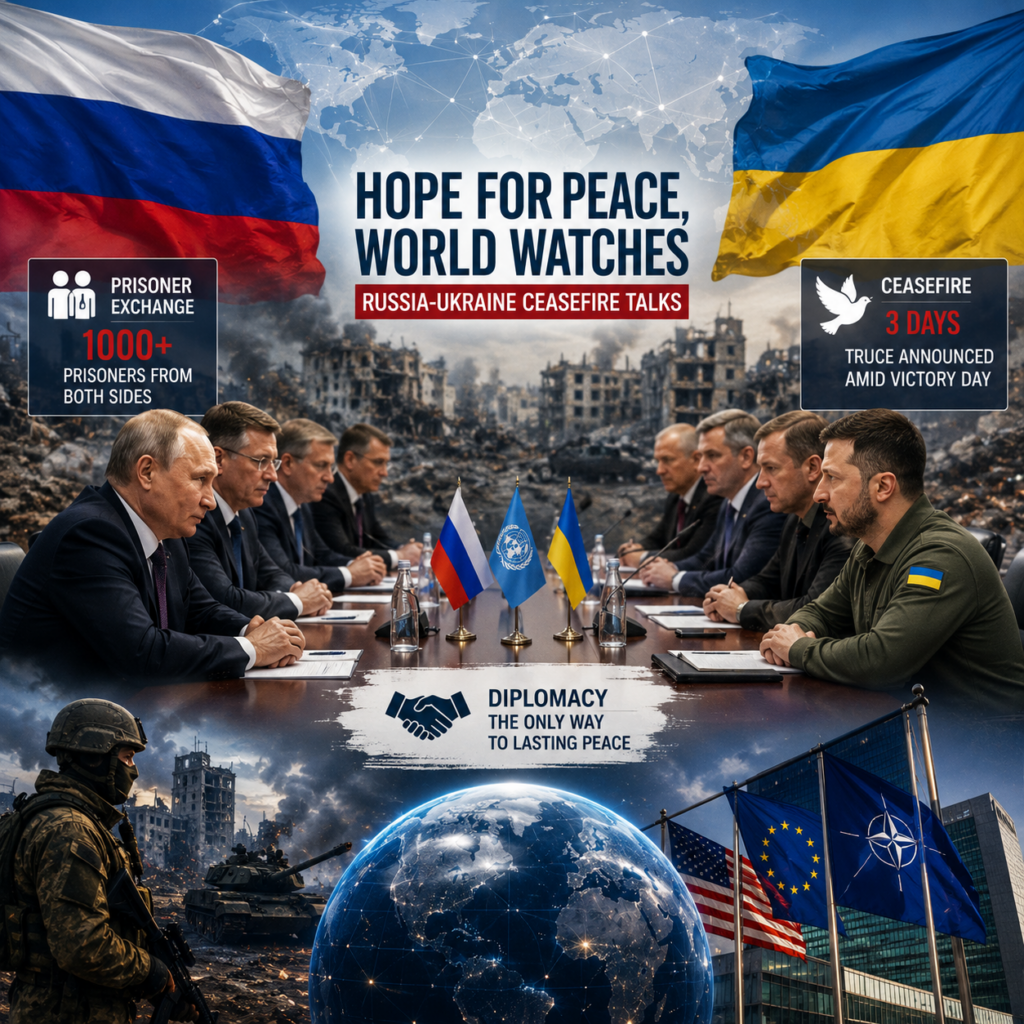
A three-day ceasefire between Russia and Ukraine came into effect this week during Russia’s Victory Day commemorations. The truce also included plans for a large prisoner exchange involving nearly 1,000 prisoners from each side.
However, despite the ceasefire announcement, both countries accused each other of violating the agreement through drone attacks and artillery strikes in frontline regions. Ukrainian officials reported continued Russian assaults, while Moscow claimed Kyiv also launched attacks during the truce period.
Even with these accusations, international observers noted that the level of violence temporarily decreased compared to previous months.
Putin Signals Possibility of Ending the War
One of the biggest global headlines came when Vladimir Putin stated that he believes the Ukraine war is “heading toward an end.” The statement surprised many analysts because Russia had previously maintained a much harder public position regarding negotiations.
Putin also signaled openness to broader European security discussions and possible future negotiations involving European intermediaries. At the same time, he continued criticizing NATO expansion and Western military support for Ukraine.
Political experts believe Russia may now be looking for a diplomatic strategy after years of military and economic pressure.
The United States Expands Peace Efforts
The United States has played a major role in pushing both sides toward negotiations. Former US President Donald Trump recently announced that Washington is ready to send a high-level delegation to Moscow to help accelerate peace discussions.
Earlier this year, the US, Russia, and Ukraine also held rare trilateral meetings in Abu Dhabi and Geneva, marking the first direct multi-party diplomatic talks since the war began.
Although these meetings did not produce a breakthrough agreement, they reopened communication channels between the three countries.
Europe Faces Growing Pressure
European countries continue to face major political and economic consequences from the war.
The conflict has:
- Increased defense spending across Europe
- Strengthened NATO cooperation
- Triggered energy supply challenges
- Increased inflation and economic uncertainty
- Created refugee and humanitarian crises
Several European leaders now support stronger peace negotiations because prolonged conflict is placing pressure on European economies and political stability.
France, Germany, and the United Kingdom are also discussing long-term security guarantees for Ukraine if future peace agreements are reached.
NATO and Russia Still Deeply Divided
Despite renewed diplomacy, tensions between NATO and Russia remain extremely high.
Russia continues to oppose NATO’s expansion toward Eastern Europe and accuses Western countries of using Ukraine as a geopolitical tool. Meanwhile, NATO members argue that supporting Ukraine is necessary to maintain European security and international law.
Military analysts believe that even if a temporary peace deal is achieved, distrust between Russia and Western powers could continue for years.
Global Economy Closely Watching the Situation
Financial markets and global energy sectors are also monitoring the conflict carefully.
The Russia-Ukraine war has heavily affected:
- Oil and gas prices
- Global food supply chains
- Grain exports
- Defense industries
- International trade routes
Any major escalation or breakdown in ceasefire talks could once again increase market volatility and energy prices worldwide.
Many developing countries, especially in Asia and Africa, are hoping for a stable peace agreement because the war has contributed to inflation and rising import costs globally.
Can Diplomacy Finally End the Conflict?
While the latest ceasefire and diplomatic efforts have created cautious optimism, experts warn that a final peace agreement still faces major obstacles.
Key unresolved issues include:
- Control of occupied territories
- Ukraine’s future security guarantees
- NATO relations
- Economic sanctions on Russia
- Long-term military arrangements in Eastern Europe
Political analysts say both sides remain deeply divided on core demands, making any permanent settlement extremely difficult.
Conclusion
The Russia-Ukraine war has become one of the defining geopolitical conflicts of the modern era. The latest ceasefire and renewed negotiations may offer a small opportunity for diplomacy, but the road toward lasting peace remains uncertain.
As global leaders continue pushing for dialogue, the world is watching closely to see whether diplomacy can finally reduce tensions — or whether another phase of confrontation lies ahead.