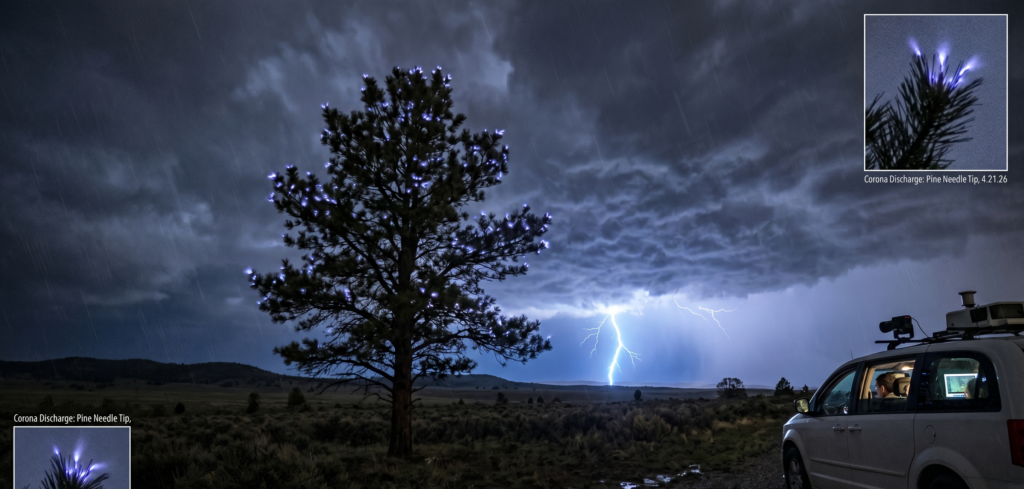
BOULDER, Colorado — In a breakthrough that bridges the gap between atmospheric physics and botany, scientists have captured the first visual evidence of trees “glowing” with electricity during thunderstorms. The findings, published today, April 21, 2026, provide a literal look at a phenomenon long theorized but never before seen in nature: corona discharges emanating from living flora.
The “Retrofit” Discovery
The discovery was made by a team of atmospheric researchers using a mobile laboratory—a retrofitted minivan equipped with ultra-high-speed, low-light cameras and sensitive electromagnetic sensors. While chasing a localized cell of severe thunderstorms across the plains of eastern Colorado, the cameras recorded faint, shimmering blue-violet glows dancing atop the canopies of several isolated pine trees.
Known as corona discharges or “St. Elmo’s Fire” when seen on ship masts or aircraft wings, these glows occur when the intense electric field of a thunderstorm pulls electrons away from air molecules, ionizing the air and creating a visible plasma.
Cracking a Century-Old Mystery
For decades, scientists have suspected that trees play a massive role in balancing the Earth’s electrical circuit. Because trees are pointed and grounded, they act as natural lightning rods. However, it was unclear how much “silent” electricity they leaked into the atmosphere before a lightning strike even occurred.
“We’ve seen this in the lab with metal needles for a hundred years,” said Dr. Elena Vance, lead researcher on the project. “But seeing it on a living, breathing organism in the wild changes our understanding of the ‘Global Electrical Circuit.’ Trees aren’t just passive observers of storms; they are active electrical conduits.”
Key Findings of the Study
The data collected during today’s event revealed several startling details:
- Pointed Efficiency: Coniferous trees (like pines) produced significantly more electrical discharge than broad-leafed trees, likely due to the sharp, needle-like shape of their leaves which concentrates electric fields.
- Chemical Impact: The corona discharges appear to trigger localized chemical reactions, producing small amounts of ozone ($O_3$) and hydroxyl radicals ($OH$) around the canopy. These chemicals are crucial for “cleaning” the atmosphere of pollutants.
- Pre-Strike Warning: The glow intensified roughly 30 seconds before a cloud-to-ground lightning strike occurred within a 2-kilometer radius, suggesting the trees were “priming” the path for the bolt.
Implications for Climate and Tech
This discovery has immediate implications for climate modeling. By understanding how much ozone and hydroxyl radicals are produced by “electrified” forests during storm seasons, meteorologists can more accurately predict atmospheric self-cleaning processes.
Furthermore, engineers are already looking at the “biomimicry” potential. The way trees manage high-voltage stress without sustaining tissue damage could lead to new designs for lightning protection systems and more resilient power grid components.
A Rare Sight
While the glow is now verified, it remains nearly invisible to the naked human eye under most conditions. The researchers noted that the phenomenon is usually drowned out by the rain and the flash of lightning itself.
“Nature has been putting on this light show for millions of years,” Dr. Vance remarked. “We just finally got the right camera to see it.”