
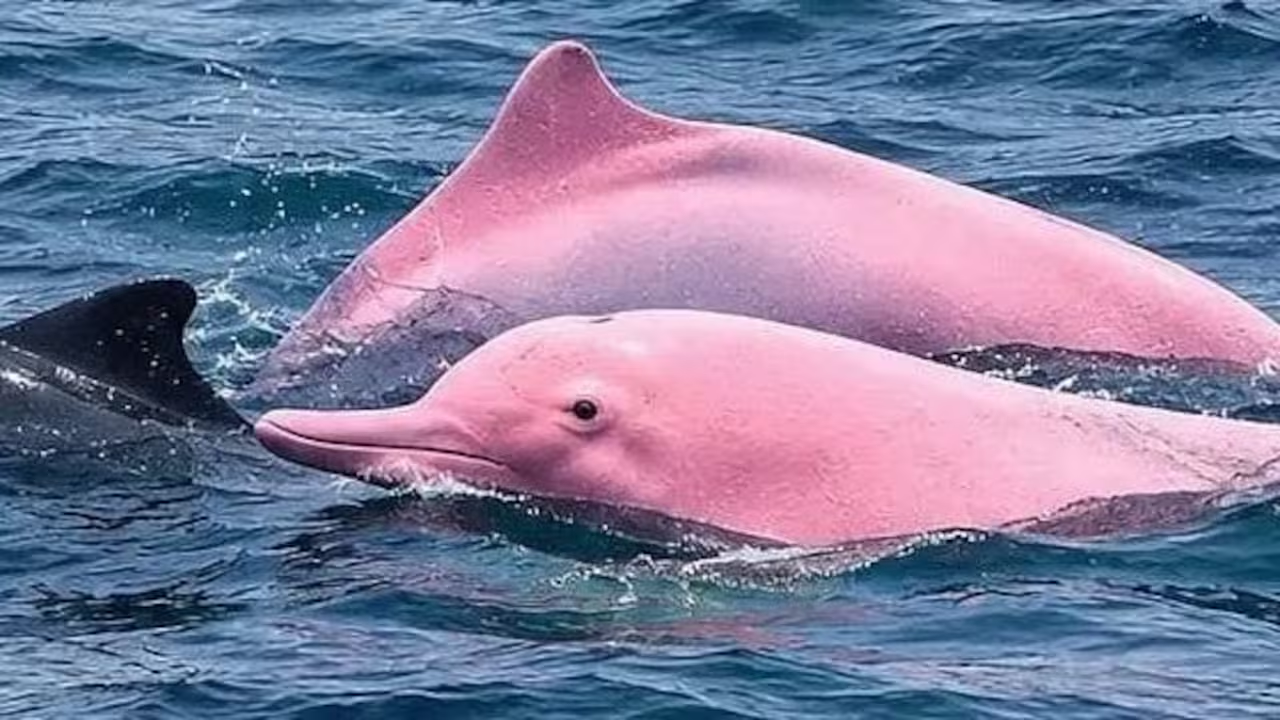
A rare dolphin with a striking pinkish-white appearance has captured worldwide attention after being spotted swimming off the coast of Muscat, Oman. The unusual marine animal was seen near Qantab Beach alongside darker-coloured dolphins, with footage of the encounter spreading across social media and sparking questions about its identity, natural colouring and the marine biodiversity of the Arabian Sea region.
The sighting, reported on October 21, 2026, has attracted interest from wildlife enthusiasts and marine observers. While pink dolphins are known in certain parts of the world, the appearance of one off Oman’s coastline has made the encounter particularly intriguing. However, experts have not yet conclusively identified the animal or established why its skin appears pink.
Where Was the Pink Dolphin Spotted?
The unusual dolphin was reportedly seen near Qantab Beach in Muscat, the capital of Oman. Located along the Gulf of Oman, the coastal region is home to a variety of marine species, including several types of dolphins and whales.
People who witnessed the encounter captured footage showing a pale, pinkish-looking dolphin swimming alongside darker dolphins. The contrast between the animals made the unusual individual stand out, prompting viewers to share the footage online.
The sighting quickly attracted attention because pink dolphins are more commonly associated with freshwater rivers in South America or particular coastal dolphin populations in Asia.
However, a dolphin’s colour alone cannot establish its species. The original footage has not provided enough independently verified information to settle the animal’s identity, and claims circulating online should therefore be treated cautiously.
Is It an Amazon River Dolphin?
One of the first questions raised by the sighting is whether the animal could be an Amazon river dolphin, commonly known as the pink river dolphin or boto.
Amazon river dolphins are freshwater mammals found in the Amazon and Orinoco river systems of South America. They are famous for their pinkish appearance, although their colour varies considerably between individuals.
Adult males can develop particularly pronounced pink colouring, influenced by factors including blood circulation, age and accumulated skin scarring. These dolphins are adapted to life in rivers and flooded forests, rather than the open marine environment.
Oman’s coastline, by contrast, lies beside the Gulf of Oman and the Arabian Sea. An Amazon river dolphin would therefore be an extraordinary explanation for the sighting, and there is no verified evidence establishing that the animal in the footage belongs to this South American freshwater species.
The distinction matters because viral photographs can encourage people to apply familiar labels to animals that have not been scientifically identified.
Could It Be a Risso’s Dolphin?
One possibility raised in local commentary is that the animal could be a Risso’s dolphin, scientifically known as Grampus griseus.
Risso’s dolphins are marine mammals found in temperate and tropical waters around the world. They have robust bodies, rounded heads and distinctive dorsal fins. Unlike bottlenose dolphins, they generally lack a clearly defined beak.
Their appearance changes substantially as they age. Young animals are generally darker, while adults often become increasingly pale because of the accumulation of scratches and scars, many associated with interactions with other dolphins.
Older individuals can appear almost white, sometimes with contrasting darker marks. Depending on lighting, the condition of the skin and the quality of a photograph or video, a pale dolphin could appear pinkish.
An Omani commentator who examined the footage suggested that its physical features were more consistent with Risso’s dolphins than with the pink Indo-Pacific humpback dolphins frequently shown in online posts.
However, this remains a preliminary interpretation rather than a confirmed scientific identification. A reliable conclusion would require examination of the original footage and, ideally, additional observations by qualified marine specialists.
Why Do Some Dolphins Appear Pink?
Pink colouring in dolphins can have several different explanations. It does not necessarily indicate that an animal belongs to a species famous for its pink appearance.
In some dolphins, the colour may result partly from blood vessels close to the skin’s surface. Increased blood flow can make the skin appear pinker, and the intensity of the colour may vary with an animal’s physiological condition.
In other cases, age-related changes and scarring can make the skin lighter. Lighting conditions, reflections from the surrounding water and camera processing can also influence how an animal appears in a video.
Another possible explanation is a pigmentation abnormality. Albinism, which affects melanin production, can result in unusually pale skin and light-coloured eyes. Leucism can also cause reduced pigmentation, although its effects differ from those of albinism.
Neither condition has been established in the dolphin seen in Oman. It would therefore be inaccurate to describe the animal as albino or to claim that scientists have determined the cause of its colour.
The most important distinction is between what the footage visibly shows and what researchers can scientifically establish from it.
Why Oman’s Marine Environment Matters
Oman occupies an important position between the Gulf of Oman and the Arabian Sea, providing marine habitats for a diverse range of wildlife.
The country’s waters support several dolphin species, including spinner dolphins, common dolphins, bottlenose dolphins and humpback dolphins. Other marine mammals, including whales, also occur in the wider region.
These waters form part of a broader marine ecosystem influenced by ocean currents, seasonal conditions and the movement of prey species.
Dolphins play an important role in marine food webs, feeding on fish, squid and other marine animals, depending on the species. Their presence can also provide information about the condition of local ecosystems, although a single sighting is not enough to determine whether an ecosystem is healthy or changing.
Oman’s marine wildlife has attracted growing interest from researchers, conservation organisations and ecotourism operators. Responsible wildlife observation can help increase public awareness while supporting conservation efforts.
The pinkish dolphin sighting is a reminder that even familiar marine environments can produce encounters that raise new questions and encourage closer scientific observation.
Social Media Attention and the Need for Verification
The viral spread of the footage demonstrates how quickly an unusual wildlife encounter can become an international story.
Images of rare-looking animals often attract considerable attention because they offer viewers something unexpected. However, viral coverage can also blur important distinctions between different species, locations and original recordings.
In this case, some online posts have associated the Omani sighting with Indo-Pacific humpback dolphins filmed in Thailand. These are separate observations, and footage from one location should not be presented as evidence of what was seen in another.
Indo-Pacific humpback dolphins are coastal marine mammals found in parts of the Indian and western Pacific oceans. Some populations are known for developing pale or pinkish skin as adults. Nevertheless, this characteristic does not prove that the animal seen near Muscat belongs to that species.
Accurate reporting requires preserving the original footage, confirming its location and date, and distinguishing verified observations from interpretations.
Further analysis by marine researchers could help establish the animal’s identity and determine whether its appearance represents an unusual example of a known species or something that deserves additional investigation.
How People Should Respond to Rare Dolphin Sightings
Wildlife encounters can provide valuable opportunities for observation, but the safety of the animals should remain a priority.
People who encounter dolphins should avoid chasing them, attempting to touch them or approaching too closely in boats. Loud noises and repeated attempts to attract an animal’s attention can disturb its natural behaviour.
Photographs and videos taken from a safe distance can help researchers document unusual sightings. Recording the location, date and surrounding conditions may also make the evidence more useful for scientific assessment.
If a dolphin appears injured, stranded or in distress, observers should contact the relevant local wildlife or environmental authorities rather than attempting to handle the animal themselves.
Responsible observation is particularly important when an unusual sighting attracts large numbers of people or vessels.
Conclusion: A Rare Sighting Still Waiting for Answers
The pinkish dolphin spotted near Qantab Beach in Muscat has become an intriguing wildlife story, drawing attention to the marine life found along Oman’s coastline.
Although the animal’s unusual appearance has encouraged comparisons with pink dolphins elsewhere in the world, its exact species and the cause of its colouring remain unconfirmed. A Risso’s dolphin whose skin has become lighter with age is one possibility raised in local commentary, but further expert assessment is needed before a definitive conclusion can be reached.
The sighting ultimately highlights the importance of combining public curiosity with scientific verification. Whether the dolphin’s colour results from natural ageing, blood circulation, pigmentation or another factor, careful documentation will be essential to understanding what observers witnessed.
For now, the encounter offers a fascinating glimpse of marine wildlife in Omani waters—and a reminder that the most compelling wildlife stories are not only about what appears unusual, but also about the questions that science can help answer.