Paris is famous for its charming outdoor cafés, historic architecture, busy boulevards, and relaxed coffee culture. For many visitors, enjoying a drink at a sidewalk café while watching the city move around them is an essential part of the Parisian experience. Yet, a striking scene near the city’s iconic Arc de Triomphe offered a very different picture of everyday life in the French capital.
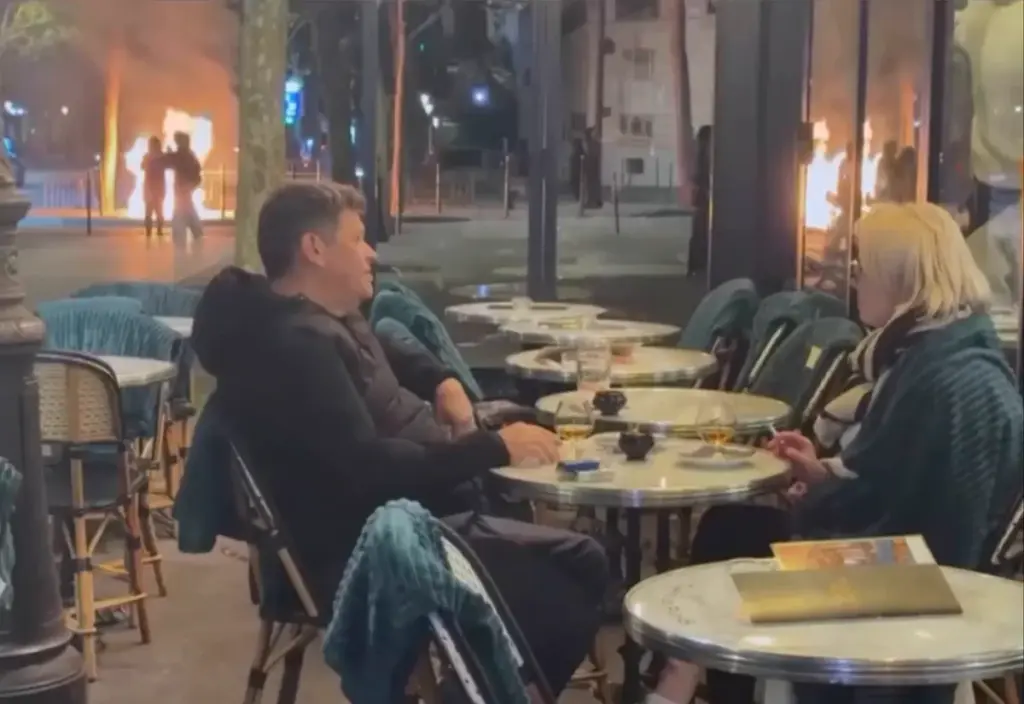
A couple was filmed sitting at an outdoor café, sipping drinks and continuing their conversation while flames from a burning trash bin illuminated the street just steps away. The unusual moment unfolded on a Saturday amid unrest linked to demonstrations over rising prices, economic inequality, and public spending.
While the surrounding streets were affected by tension and disorder, the pair appeared remarkably unfazed by the scene nearby. Their seemingly ordinary café visit stood in sharp contrast to the flames and unrest unfolding around them.
The footage attracted attention because of its unusual combination of calmness and chaos. It captured two very different scenes within a single frame: people continuing with an everyday activity and a public space experiencing a moment of disruption.
Although the video offers only a brief glimpse of the incident, it raises broader questions about how people respond to unexpected events, how public unrest changes the atmosphere of a city, and why ordinary moments can become powerful images during extraordinary circumstances.
1. A Calm Café Conversation Amid the Flames
The most striking element of the footage is the couple’s apparent composure.
Outdoor cafés are a familiar feature of Parisian streets. People gather at small tables to enjoy coffee, have conversations, meet friends, read, or simply take a break from their daily routines. These spaces often remain connected to the surrounding street, allowing customers to experience the city’s movement and atmosphere firsthand.
In this case, however, the atmosphere outside the café was far from peaceful.
Flames from a burning trash bin lit up the nearby street, creating a dramatic backdrop to the couple’s conversation. Despite the unusual circumstances, the pair appeared to continue sipping their drinks rather than immediately reacting to the situation.
The contrast was visually striking. At one point, the scene could have resembled an ordinary afternoon or evening at a Parisian café. Yet, the fire nearby transformed the same setting into something much more unsettling.
The footage does not establish whether the couple fully understood what was happening, how close they believed the danger was, or whether they eventually moved away. Their apparent calmness should therefore not automatically be interpreted as indifference, bravery, or deliberate disregard for the situation.
People respond differently when confronted with unexpected events. Some immediately seek safety, while others pause to understand what is happening before deciding how to react. Familiar surroundings can also make unusual situations feel less urgent at first.
Whatever the couple’s reasons, their continued conversation became the defining feature of the scene.
2. Why the Arc de Triomphe Makes the Scene Even More Striking
The location adds another layer of significance to the footage.
The Arc de Triomphe is one of Paris’s most recognisable landmarks. Situated at the western end of the Champs-Élysées, it is associated with French history, national identity, tourism, and the busy urban life surrounding one of the city’s most famous avenues.
The area regularly attracts visitors, photographers, shoppers, and residents. Cafés and restaurants form part of the wider street culture, making the surroundings familiar to people who associate Paris with elegant architecture, leisurely meals, and lively public spaces.
Against this backdrop, images of flames and street unrest create a sharp contrast with the city’s usual tourist-friendly image.
Paris, like other major cities, is not defined by a single atmosphere. It can be a destination for art, fashion, food, and tourism while also serving as a place where citizens express concerns about economic conditions and government decisions.
The footage illustrates how quickly the appearance of a familiar location can change when public disorder enters the picture.
A street that normally hosts people enjoying food and drinks can suddenly become a scene of uncertainty. The same urban environment can accommodate everyday social interactions and, at other moments, demonstrations, tension, and emergency responses.
This contrast is part of what makes the clip so visually powerful. It does not simply show a burning trash bin. It places an ordinary human activity against a backdrop that viewers would not normally associate with a relaxed café visit.
However, the available description does not establish the exact café, the precise time of the incident, the identities of the people shown, or the full sequence of events. Those details should not be assumed without independent verification.
3. The Wider Context: Demonstrations Over Economic Pressure
The scene reportedly unfolded amid unrest linked to demonstrations concerning rising prices, inequality, and public spending.
These issues have become important topics in political and economic discussions across many countries, including France. Changes in the cost of everyday necessities can affect how households manage their budgets, while debates over public spending can influence discussions about government priorities and the distribution of economic resources.
The pressure of rising prices
When the cost of food, housing, transportation, energy, and other necessities increases, households may find it harder to maintain their usual standard of living.
Even when wages rise, they may not always keep pace with expenses. People can consequently feel that their purchasing power is shrinking, particularly when several essential costs increase at the same time.
Economic pressure can affect different groups in different ways. Students, lower-income households, workers, pensioners, and small-business owners may face distinct challenges depending on their circumstances.
When financial concerns become widespread, they can influence public discussions about wages, taxes, social benefits, and government assistance.
Inequality and public frustration
Economic inequality is another issue that can contribute to public dissatisfaction.
People may become concerned when they believe that economic opportunities, public services, or the benefits of growth are distributed unevenly. Such concerns can lead to debates about taxation, employment, housing affordability, and the effectiveness of social support systems.
Demonstrations provide a way for citizens to express their views, draw attention to grievances, and demand political action.
However, peaceful demonstrations and violent incidents are not the same thing. A crowd’s presence at a protest does not establish that every participant supports property damage or disorder.
Similarly, a burning trash bin does not, by itself, explain the causes of the wider unrest or establish who was responsible for starting the fire.
Understanding the broader context requires reliable reporting on the demonstration, its organisers, the demands being made, and the responses from public authorities.
Public spending and political debate
Public spending is often a subject of intense debate because governments must balance competing priorities.
Investment in healthcare, education, infrastructure, transport, public safety, and social support can affect millions of people. Decisions about funding, taxation, and public services can therefore become politically sensitive, especially during periods of economic uncertainty.
The reported connection between the demonstrations and these issues provides context for the scene, but the footage alone cannot establish the precise motivations of everyone involved.
The important distinction is that the couple’s café visit was one small moment occurring within a much larger public situation. Their behaviour does not explain the protests, and the protests do not necessarily explain the couple’s reaction.
4. Why People React Differently to Unexpected Situations
One reason the footage attracts attention is that viewers may expect people to react immediately when flames appear nearby.
In reality, human reactions to unexpected events vary considerably. People may freeze briefly, observe their surroundings, seek help, move away, or continue an activity while trying to understand the situation.
A short video rarely provides enough information to explain an individual’s response.
The role of awareness
A person’s reaction may depend partly on what they can see, hear, and understand.
Someone who notices a fire immediately may interpret the situation differently from someone who sees only a small amount of smoke or does not realise how close the flames are.
Street noise, conversations, traffic, and activity elsewhere can also make it difficult to understand what is happening.
The camera’s perspective may not reflect the couple’s perspective. Something that looks alarming to viewers watching the clip may have appeared less threatening from the couple’s table, or they may have been unaware of the wider circumstances.
Familiar surroundings and routine
People often rely on familiar routines to structure their day. Sitting at a café, talking with a companion, and enjoying a drink are activities that can feel ordinary even when the surrounding environment changes.
That does not mean people are incapable of recognising danger. It simply means that a brief moment of unusual behaviour cannot tell us everything about their awareness or decision-making.
The couple may have been surprised, concerned, distracted, or fully aware of the situation. Without their own account, it would be speculative to claim that they felt nothing or intentionally ignored the danger.
Why observers interpret the scene differently
Viewers bring their own expectations and experiences to what they see.
Some may interpret the couple’s apparent composure as a sign of calmness under pressure. Others may question whether remaining nearby was sensible. Still others may focus on the broader social conditions surrounding the demonstrations.
These differing interpretations help explain why a brief visual moment can generate extensive discussion.
Nevertheless, it is important to distinguish what the footage visibly shows from what viewers assume about the people in it.
5. The Power of Viral Footage in the Digital Age
Short videos have become a major part of how people encounter news and current events.
A clip lasting only a few seconds can travel across social media platforms, reaching audiences far beyond the place where the event occurred. Images that combine an unexpected setting with unusual human behaviour are particularly likely to attract attention.
The Paris café footage contains several elements that make it memorable: a globally recognised landmark, a familiar everyday activity, visible flames, and the apparent contrast between the couple’s behaviour and the surrounding unrest.
Together, these details create a scene that viewers can understand almost instantly.
A single image can tell multiple stories
One viewer might see a story about people remaining calm during an unexpected event. Another might see a symbol of the contrast between ordinary life and social disorder. Someone else might focus on the economic concerns associated with the demonstrations.
The same footage can therefore prompt different conversations, even when everyone is watching the same few seconds.
This is one of the defining features of visual news in the social media era. Images often communicate an emotional impression before viewers have learned the details behind an event.
The importance of context
The speed at which videos spread also creates challenges.
A short clip may omit what happened immediately before or after the recorded moment. Captions can simplify complicated events, while reposts may remove information about the original source, location, or date.
Viewers may consequently draw conclusions that the footage cannot support.
In this case, the video can establish a striking visual contrast, but it cannot independently confirm the couple’s thoughts, the complete circumstances of the fire, the scale of the unrest, or the precise motivations of all the demonstrators.
Responsible coverage should preserve that distinction.
Rather than treating the scene as proof of any particular social or political argument, it is more useful to view it as a brief snapshot of an unusual moment during a period of public tension.
6. Safety Lessons: When an Ordinary Street Becomes Dangerous
Beyond its visual impact, the scene offers a practical reminder about personal safety in public spaces.
A burning object near a pavement or café can create risks that extend beyond the visible flames. Heat, smoke, falling debris, nearby combustible materials, and the possibility of the fire spreading can make the immediate area unsafe.
During demonstrations, additional risks may include sudden crowd movement, blocked roads, damaged property, and difficulties accessing emergency services.
A situation that initially appears manageable can change quickly.
Prioritising distance and awareness
If a fire or other immediate hazard appears nearby, moving away from the danger is generally safer than remaining close to observe it. People should avoid touching burning objects, attempting to extinguish fires without appropriate training, or entering areas where emergency responders are working.
Following instructions from emergency personnel and moving towards a safe location can help reduce unnecessary exposure to danger.
It is also important to avoid blocking escape routes or emergency access points when crowds gather.
Avoiding unnecessary risks for photographs or videos
The popularity of social media can encourage people to record unusual situations. While documenting public events can have informational value, filming should never take priority over personal safety.
A dramatic photograph or video is not worth remaining in a potentially dangerous location.
The Paris scene is memorable because the couple appears to continue an ordinary activity while flames burn nearby. It should not be interpreted as evidence that staying close to a fire during unrest is safe or advisable.
The circumstances visible in a short clip are not a reliable guide to what another person should do in a similar situation.
7. What This Moment Reveals About Urban Life
Modern cities bring together people with different routines, responsibilities, priorities, and experiences.
On the same street, one person may be commuting to work, another may be meeting friends, a business owner may be trying to protect a shop, and demonstrators may be expressing concerns about economic or political decisions.
These activities can coexist until an unexpected event changes the environment.
The café footage captures this complexity in a simple visual contrast. The couple’s apparent routine continues while the surrounding street takes on a more uncertain atmosphere.
It reminds viewers that cities are not static places with a single identity. They are living environments where leisure, work, politics, culture, and public safety intersect.
Paris’s reputation as a destination for tourism and café culture does not mean its streets are immune to tension. Equally, a scene of unrest does not define the entire city or represent the everyday experiences of everyone who lives there.
A balanced understanding recognises both realities.
The footage also highlights how quickly an ordinary moment can become a subject of public discussion. The people shown may have experienced only a brief interruption to their day, yet the visual contrast has the potential to reach audiences around the world.
That transformation—from an everyday street scene into widely discussed footage—is itself a feature of contemporary digital culture.
Conclusion: One Moment, Two Very Different Realities
The footage of a couple sipping drinks at an outdoor café near the Arc de Triomphe, while flames from a burning trash bin illuminate the nearby street, presents a striking contrast between ordinary life and public unrest.
The scene reportedly unfolded amid demonstrations linked to rising prices, inequality, and public spending. While the surrounding circumstances were tense, the couple appeared to continue their conversation, creating an unusual image that captured viewers’ attention.
Its significance lies not only in the visible flames but also in the contrast between the familiar routine of a café visit and the unpredictability of the surrounding environment.
The moment encourages reflection on how people react to unexpected events, how public spaces can change during unrest, and how short videos shape the way audiences understand news.
At the same time, it is important not to assume what the couple was thinking or to draw sweeping conclusions about the protests from a single clip. The footage provides a glimpse of one moment, not a complete explanation of the people or events involved.
Ultimately, the scene is a reminder that everyday life and unexpected disruption can exist side by side. A simple conversation over drinks can become a striking image when the world outside the café takes an unexpected turn.
Sometimes, a single moment captures the contrast between normal life and a city in turmoil.
Frequently Asked Questions (FAQs)
1. Where was the couple filmed sipping drinks during the unrest?
The couple was reportedly filmed at an outdoor café near the Arc de Triomphe in Paris, France.
2. What was happening near the café?
A trash bin was burning nearby amid unrest linked to demonstrations over rising prices, economic inequality, and public spending.
3. Why has the footage attracted attention?
The video presents a striking contrast between the couple’s apparently calm café conversation and the flames visible just steps away.
4. Do we know why the couple appeared unfazed?
No. The footage does not establish what the couple knew, how they felt, or why they continued their conversation. Any explanation of their reaction would be speculative.
5. What should people do if they encounter a similar situation?
They should prioritise safety, move away from fires and other hazards, avoid interfering with emergency responders, and follow official instructions.
6. Does the video explain the causes of the demonstrations?
No. It provides a visual snapshot of a reported incident but does not independently establish the causes, scale, or full circumstances of the wider unrest.