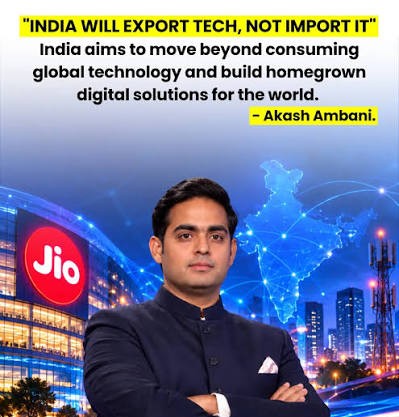
India is rapidly transforming into one of the world’s most important technology hubs. From digital payments and telecommunications to artificial intelligence, cloud computing, and digital infrastructure, Indian companies are increasingly demonstrating their ability to develop innovative solutions for a global audience. Among the companies contributing to this transformation is Reliance Jio, which has played a significant role in reshaping India’s digital landscape.
Under the leadership of Akash Ambani, Jio is associated with a broader vision of strengthening India’s technological capabilities and expanding the reach of homegrown innovation. The idea of exporting technology rather than depending heavily on imported solutions reflects a growing ambition among Indian businesses: to move beyond being consumers of global technology and become creators, developers, and exporters of it.
This vision represents an important opportunity for India. By investing in research, developing digital infrastructure, and building scalable technological products, Indian companies can strengthen their domestic presence while competing in international markets.
The central message is clear: Build in India, innovate for the world, and compete globally.
1. Jio’s Role in India’s Digital Transformation
India’s digital transformation has accelerated significantly over the past decade. Affordable internet connectivity, widespread smartphone adoption, digital payment platforms, and online public services have changed how millions of people communicate, work, learn, and conduct business.
Reliance Jio has been an important participant in this transformation. Its entry into the telecommunications market in 2016 introduced highly competitive mobile data offerings and contributed to the rapid expansion of affordable internet access across the country.
Greater connectivity has helped individuals access online education, businesses reach customers, and communities participate in the digital economy. Small businesses that previously depended on physical storefronts can now use online platforms to promote products and connect with buyers across different regions.
However, connectivity is only one part of the digital revolution. The next stage involves developing the underlying technology that supports digital services, including telecommunications equipment, cloud infrastructure, artificial intelligence systems, enterprise software, and secure digital platforms.
This is where India’s technological ambitions become particularly significant. Instead of relying entirely on solutions developed elsewhere, Indian companies can invest in creating technologies suited to domestic requirements and capable of serving international customers.
Jio’s broader digital ecosystem provides an example of how connectivity, digital services, and infrastructure can work together to support this ambition.
2. Akash Ambani’s Vision: Exporting Technology, Not Just Consuming It
For many years, technology imports have helped countries access advanced equipment, software, and digital services. While importing technology can accelerate development, excessive dependence on external suppliers can create challenges involving cost, customization, supply chains, and technological independence.
The idea of exporting technology instead of importing it represents a different approach.
It encourages Indian companies to develop intellectual property, build their own platforms, invest in engineering talent, and create products that can compete internationally.
Akash Ambani, associated with Jio’s leadership, represents a younger generation of business leaders operating in an increasingly digital and interconnected economy. The broader vision associated with India’s technology ambitions is to transform the country into a source of globally competitive digital solutions.
This transition requires more than assembling products locally. It involves developing core technologies, improving research capabilities, training skilled professionals, and building products that meet international standards.
For example, an Indian company could develop telecommunications software for domestic networks and subsequently offer it to operators in other countries. Similarly, a cloud platform designed to support Indian businesses could potentially serve customers across Asia, Africa, and other emerging markets.
The potential benefits extend beyond revenue. Technology exports can create skilled employment, encourage research and development, attract investment, and strengthen India’s reputation as an innovation-driven economy.
The real opportunity is to create technology that solves meaningful problems and earns the trust of customers worldwide.
3. Digital Infrastructure: The Foundation of Global Competitiveness
Every successful digital economy depends on reliable infrastructure. Telecommunications networks, data centres, cloud platforms, fibre-optic connections, and computing systems provide the foundation on which modern digital services operate.
Without this infrastructure, businesses struggle to process information efficiently, deliver online services, and scale their operations.
India’s growing digital economy has increased the importance of infrastructure investment. As more people use digital payments, online marketplaces, streaming platforms, enterprise applications, and AI-powered services, demand for computing capacity and reliable connectivity continues to grow.
Jio’s involvement in telecommunications and digital services places it within this larger infrastructure transformation.
The development of advanced networks, including 5G, can support applications requiring high bandwidth, low latency, and greater network capacity. Potential use cases include connected manufacturing equipment, industrial automation, remote monitoring, smart logistics, and advanced healthcare systems.
Cloud computing and data centres are equally important. They allow businesses to store information, run applications, and access computing resources without building every component themselves.
Artificial intelligence adds another dimension to this infrastructure. AI systems require substantial computing power, reliable data pipelines, and secure platforms. Companies that can provide these capabilities efficiently may find opportunities in both domestic and international markets.
However, infrastructure alone does not guarantee success. It must be supported by effective management, cybersecurity, reliable service, competitive pricing, and continuous innovation.
India’s opportunity lies in building an integrated technological ecosystem that enables businesses to develop, deploy, and export digital solutions at scale.
4. Why India Has the Potential to Become a Global Technology Exporter
India already has several advantages that can support its ambitions in the global technology market.
A large talent pool: India produces substantial numbers of engineers, software developers, data professionals, and technology graduates. With continued investment in practical training and research, this talent can contribute to the development of globally competitive products.
A growing domestic market: India’s large population and expanding digital economy provide companies with opportunities to test products, understand user requirements, and improve services before entering international markets.
A strong software industry: Indian technology companies have extensive experience in software development, IT services, consulting, and enterprise solutions. This foundation can help support the transition from service delivery toward greater ownership of technology products and intellectual property.
A growing startup ecosystem: Startups across India are developing solutions in fintech, healthcare, education, logistics, cybersecurity, and artificial intelligence. Their work demonstrates the potential for locally developed solutions to address problems shared by customers in other countries.
Cost-conscious innovation: Indian businesses often operate in environments where affordability and efficiency are important. Solutions developed under these conditions may appeal to international markets seeking reliable technology at competitive prices.
Nevertheless, these advantages must be converted into commercially successful products. International customers evaluate technology based on reliability, security, performance, support, compliance, and long-term value—not simply where it was developed.
India’s next challenge is to transform its talent and market size into a sustained advantage in research, product development, and exports.
5. Opportunities in Telecommunications and 5G Technology
Telecommunications is one of the most important areas in which India can strengthen its technological capabilities.
Modern communication networks rely on a combination of hardware, software, network management tools, security systems, and specialized infrastructure. Developing competitive solutions in these areas could create opportunities for Indian companies to serve telecom operators worldwide.
The expansion of 5G has increased interest in technologies that support industrial connectivity, smart infrastructure, connected devices, and advanced communication services.
Potential export opportunities include network management software, telecom automation tools, cybersecurity solutions, and software-defined networking technologies.
India can also explore opportunities in open and interoperable network architectures, which aim to give operators greater flexibility in selecting equipment and software from different suppliers.
For Jio and other Indian technology businesses, international competitiveness will depend on product maturity, successful deployments, interoperability, and the ability to provide reliable technical support.
Entering global telecommunications markets is not easy. Established international suppliers have significant experience, and telecom infrastructure purchases often involve rigorous testing and lengthy procurement processes.
Nevertheless, developing competitive domestic capabilities can create a foundation for international expansion.
If Indian-developed telecommunications technologies demonstrate strong performance and commercial value, they could contribute to a future in which India exports not only connectivity services but also the technologies that make connectivity possible.
6. Artificial Intelligence and Cloud Computing: The Next Growth Areas
Artificial intelligence and cloud computing are reshaping the global technology industry.
Businesses increasingly use AI to automate repetitive tasks, analyse large datasets, improve customer service, and support decision-making. Meanwhile, cloud computing enables organizations to deploy applications and scale computing resources according to their requirements.
These developments create opportunities for Indian technology companies to build services for domestic and international customers.
For example, AI-powered tools can help manufacturers identify equipment failures, retailers forecast demand, logistics companies optimize routes, and financial institutions detect suspicious transactions.
Cloud platforms can provide the infrastructure required to run these applications securely and efficiently.
India’s large technology workforce and expanding digital market could support the development of solutions tailored to different industries.
However, building globally competitive AI and cloud products requires investment in computing infrastructure, skilled researchers, data governance, cybersecurity, and responsible AI practices.
Companies must also address concerns involving data privacy, intellectual property, model accuracy, and regulatory compliance.
The opportunity is not limited to creating the largest AI models. Indian companies can also develop specialized applications that solve real business problems at affordable prices.
For Jio and the wider Indian technology sector, combining connectivity, computing infrastructure, and practical digital services could create opportunities across multiple industries.
7. How Technology Exports Can Benefit the Indian Economy
The expansion of technology exports could generate economic benefits that extend beyond individual companies.
First, it can create employment opportunities for software engineers, researchers, cybersecurity professionals, network specialists, product designers, and technical support teams.
Second, international sales can help Indian companies diversify their revenue sources. Businesses that serve multiple markets may become less dependent on demand within a single country, although international expansion also introduces new risks.
Third, exporting technology can encourage greater investment in research and development. Companies competing internationally must continually improve their products, introduce new capabilities, and protect their intellectual property.
Fourth, successful technology exports can strengthen India’s position in global supply chains. Instead of participating only through outsourced services or low-value manufacturing, Indian businesses can develop and own technologies that other companies rely on.
Finally, technology exports can improve the country’s global reputation. When products developed in India become trusted internationally, they can encourage further partnerships, investment, and collaboration.
These benefits are not automatic. They depend on strong institutions, supportive policies, skilled workers, access to capital, and the ability of businesses to compete fairly in international markets.
Still, the potential is significant. A stronger technology export industry could become an important contributor to India’s long-term economic development.
8. Challenges India Must Overcome
Despite its opportunities, India faces several challenges in becoming a major global technology exporter.
Research and development: Developing original technology often requires years of investment before commercial returns become visible. Companies need to invest consistently in research rather than focus exclusively on short-term results.
Global competition: Indian businesses compete with established technology companies from the United States, China, Europe, South Korea, and other markets. Competing successfully requires differentiated products, strong engineering, and continuous improvement.
Intellectual property: Protecting patents, proprietary software, designs, and trade secrets is essential for companies seeking to commercialize original innovations.
Cybersecurity and trust: International customers expect secure, reliable products. Data protection, system resilience, and transparent security practices are essential for building long-term relationships.
International regulations: Technology exporters must understand the laws, standards, certifications, and data protection requirements of the countries they serve.
Access to advanced components: Some technology sectors depend on specialized semiconductors, manufacturing equipment, and other components that may be difficult or expensive to source domestically.
Commercial execution: Even technically impressive products can struggle if companies fail to understand customer needs, offer competitive pricing, provide dependable support, or establish effective distribution channels.
Addressing these challenges will require collaboration among businesses, universities, research institutions, investors, and policymakers.
India’s technological future will depend not only on the ambition to compete globally but also on the ability to execute consistently.
9. The Importance of the ‘Build in India, Compete Globally’ Approach
The principle of building in India and competing globally reflects an important change in how the country’s technology sector can approach growth.
Traditionally, companies in developing markets have often adopted technologies created elsewhere and adapted them for local use. While this approach remains valuable, the next stage of development involves creating original products that can succeed in multiple countries.
This does not mean that India should stop importing technology. International collaboration and access to global technologies remain important for innovation. Instead, the objective is to reduce unnecessary dependence while increasing domestic capabilities and developing products with export potential.
The approach can be understood through three priorities.
First, build strong technological foundations through research, infrastructure, engineering, and skills development.
Second, develop products that solve real problems and deliver measurable value to customers.
Third, design those products for international markets from the beginning, considering different languages, regulations, technical standards, and business requirements.
Jio’s broader digital ambitions fit within this national conversation about technological capability and global competitiveness.
The ultimate goal is to establish India as a country that does not merely adopt global technological trends but also helps shape them.
10. What This Vision Means for Young Indians
India’s technology ambitions also create opportunities for students, developers, entrepreneurs, and early-career professionals.
Young people can contribute by learning software development, cloud computing, artificial intelligence, cybersecurity, electronics, data analytics, and product management.
However, learning a technology is only the first step. Building useful products, solving practical problems, collaborating with teams, and understanding customer needs are equally important.
Students can develop projects that address challenges in manufacturing, agriculture, healthcare, logistics, education, and small-business operations.
Entrepreneurs can identify problems in local industries and build affordable solutions that may also work in international markets.
Engineers can contribute to open-source projects, participate in research, and develop expertise in specialized areas where demand is growing.
The broader lesson is that innovation does not happen only in large corporations. Startups, universities, independent developers, and small businesses can all contribute to India’s technology ecosystem.
If the country continues to invest in skills, infrastructure, and research, the next generation of Indian innovators could play an important role in creating globally relevant products.
11. Looking Ahead: India’s Place in the Global Technology Economy
The global technology industry is entering a period of significant change. Artificial intelligence, advanced telecommunications, cloud computing, automation, and digital infrastructure are creating new markets while transforming existing ones.
Countries that develop strong domestic capabilities may be better positioned to participate in these changes and capture greater economic value.
India has an opportunity to strengthen its role through a combination of digital infrastructure, skilled professionals, entrepreneurship, research, and internationally competitive products.
Companies such as Jio can contribute by developing infrastructure, investing in digital capabilities, and exploring opportunities beyond the domestic market.
However, long-term success will depend on measurable achievements: technologies developed, products adopted by customers, international contracts secured, research capabilities strengthened, and sustainable jobs created.
The vision of exporting technology rather than relying primarily on imports is therefore best understood as a long-term objective rather than an outcome that can be achieved overnight.
India has the talent, market scale, and entrepreneurial energy to pursue this ambition. The challenge is to translate those strengths into innovation that consistently meets global standards.
Conclusion
Jio’s place in India’s digital transformation highlights the growing importance of homegrown technology and digital infrastructure. The broader ambition associated with Akash Ambani and India’s technology sector is to move toward a future in which Indian companies can develop competitive solutions and offer them to customers around the world.
From telecommunications and cloud computing to artificial intelligence and enterprise software, the opportunities are extensive. Realizing them will require sustained research, skilled talent, strong cybersecurity, reliable products, and a clear understanding of international markets.
For India, the next stage of digital development is not simply about connecting more people or consuming more technology. It is also about creating products, developing intellectual property, and building businesses that can compete internationally.
The message is simple but powerful: India’s future in technology will be shaped not only by what the country adopts, but also by what it creates and shares with the world.
As Indian innovation continues to evolve, the vision of building in India and competing globally can become an important driver of economic opportunity, technological progress, and international collaboration.
Disclaimer: This article is for informational and educational purposes only and does not constitute investment advice or a recommendation to buy or sell any security. IPO investments and other market investments carry risks, including the potential loss of capital. Readers should carefully review the relevant offer documents and consult a qualified financial adviser before making investment decisions.