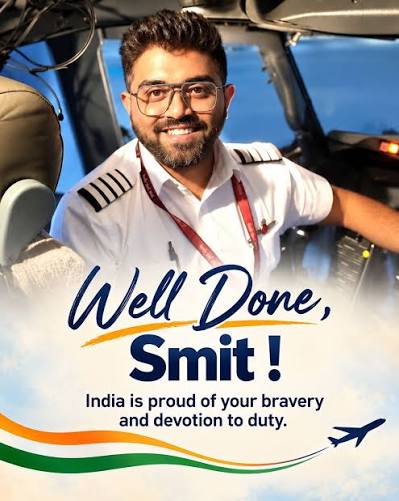
New Delhi, October 3, 2026: An Indian commercial pilot has become the focus of international attention after a dramatic cockpit incident aboard a Flydubai passenger aircraft travelling from Dubai to Tel Aviv on September 30. Captain Smit Machchhar, who was seriously injured during the incident, played a crucial role in preventing the situation from turning into a major aviation disaster.
Flight FZ1073, operated by Flydubai using a Boeing 737 MAX 8, departed Dubai at around 03:05 GMT with more than 170 people on board. The flight initially proceeded normally, but approximately two hours later the aircraft experienced a sudden and extremely steep descent while flying towards Israel. The plane eventually diverted to Saudi Arabia and landed safely at Tabuk airport.
The incident has since triggered investigations involving authorities in several countries and raised questions about cockpit security, pilot screening and how airlines should respond to threats originating from within the flight crew itself.
What happened aboard Flight FZ1073?
According to information compiled from flight-tracking data and reports from Reuters and The Indian Express, the aircraft was cruising at approximately 34,000 feet when it began a dramatic descent.
The aircraft dropped more than 16,000 feet in roughly 30 seconds, creating an extremely dangerous situation. Distress signals were subsequently transmitted from the aircraft, including the internationally recognised 7500 code associated with unlawful interference.
The crisis originated inside the cockpit.
Captain Smit Machchhar was attacked by his co-pilot, who has subsequently been identified as an Omani national. Reports initially differed over the object used in the attack, but UAE authorities later said the co-pilot allegedly attacked the captain with a crash axe. The exact circumstances remain part of the ongoing investigation.
Despite suffering serious injuries, Machchhar managed to unlock the cockpit door. This proved to be a critical moment because it enabled passengers and other crew members to enter the cockpit and intervene.
Two off-duty pilots were also travelling on the aircraft. Their presence became particularly important after the attack, as they were able to assist with controlling the aircraft and ultimately help bring it safely to the ground.
Emergency landing in Saudi Arabia
The aircraft did not continue to its original destination of Tel Aviv.
After the emergency developed, the flight diverted towards Saudi Arabia. It eventually landed at Tabuk airport, where emergency services attended to the passengers and injured crew.
The aircraft had been in the air for nearly four hours from departure to landing. Flight-tracking information reconstructed by The Indian Express shows several sharp changes in altitude during the crisis, including a descent from approximately 34,000 feet to 16,600 feet followed by further climbs and descents before the aircraft stabilised at a lower altitude.
The safe landing prevented what could have become a mass-casualty aviation accident.
Who is Smit Machchhar?
Machchhar’s story has attracted considerable attention in India because of his background and aviation career.
According to Reuters, he originally considered joining his family’s textile business but developed an interest in aviation at the age of 19. He subsequently trained in New Zealand and began his professional flying career.
He spent more than a decade with SpiceJet before joining Flydubai in 2022. Reuters reported that he has accumulated nearly 9,750 flight hours over approximately 15 years of aviation experience.
His experience became crucial during the September 30 emergency.
Even after being seriously injured, Machchhar was able to take actions that helped open access to the cockpit and allowed other people aboard the aircraft to intervene.
The Indian Embassy in the UAE later said that he was recovering and receiving medical treatment. He was transferred from Saudi Arabia to Abu Dhabi, where Indian officials visited him.
Recognition from India and abroad
The incident quickly attracted attention from senior political leaders.
Prime Minister Narendra Modi spoke with Machchhar while he was recovering in hospital and praised his actions during the emergency. The Indian government also maintained contact with authorities regarding his medical treatment and recovery.
Israeli Prime Minister Benjamin Netanyahu also praised the Indian captain’s actions.
The response has extended beyond government leaders. The pilot’s story has generated widespread public attention in India, with his actions being discussed as an example of professional responsibility during an extreme emergency.
However, while Machchhar’s actions have been widely praised, the circumstances surrounding the attack remain under investigation, and authorities have not yet established every detail of what happened inside the cockpit.
Investigation into the co-pilot
The co-pilot involved in the incident has been identified in reports as Hammam al-Hammami, an Omani national.
UAE authorities are leading an investigation into the incident, with other countries also examining aspects of the case because the aircraft involved passengers from multiple nationalities and travelled through several jurisdictions.
The UAE has described the incident as an attempted terrorist attack, while investigators continue examining the circumstances, planning and possible motive. Reuters reported on October 3 that the co-pilot had been detained and that the investigation was continuing.
Some Israeli officials have made claims regarding the co-pilot’s ideological background and possible radicalisation. Those claims remain part of the investigation, and the complete motive has not been independently established. Reuters has reported that investigators are examining the circumstances rather than treating those claims as a final determination.
New questions about aviation security
The incident has raised an unusual aviation-security question.
Modern commercial aviation has extensive procedures designed to prevent unauthorised people from entering the cockpit. Reinforced cockpit doors, access controls, identification procedures and crew screening became particularly important after major aviation security incidents in previous decades.
But the Flydubai incident involved an alleged threat from inside the cockpit itself.
That creates a different security challenge.
Authorities are now expected to examine how pilots are screened before employment, whether background checks adequately identify potential risks, how airlines continuously monitor crew members and what procedures should be followed if one member of the flight crew becomes a threat to another.
Israel has already indicated that it intends to increase checks on pilots flying into the country following the incident.
The importance of backup crew
One of the most notable details emerging from the incident is the presence of two additional pilots on board.
These were not scheduled members of the operating cockpit crew but were travelling as deadheading pilots—off-duty pilots being transported for operational reasons.
Their presence proved valuable after the cockpit crisis. Once the attacker was restrained, the additional pilots could assist with flying the aircraft and landing it safely.
The incident demonstrates how aviation relies not only on aircraft technology but also on layers of human redundancy. When something goes seriously wrong, having trained personnel available can become critical.
A story that extends beyond one flight
The Flydubai FZ1073 incident is now being examined from several perspectives: aviation safety, crew screening, cockpit security, emergency response and international cooperation.
For India, however, the episode has also placed Captain Smit Machchhar at the centre of an extraordinary national story.
The full investigation will take time, and several questions surrounding the attack remain unanswered. Investigators will need to establish exactly what happened inside the cockpit, the motive behind the alleged attack, how the co-pilot was screened, and whether any warning signs were missed before the flight.
What is already clear is that Flight FZ1073 faced a rapidly developing emergency at high altitude and ultimately reached the ground safely in Saudi Arabia.
Machchhar remains under medical care in Abu Dhabi as he recovers from his injuries. His actions during the crisis have received recognition from Indian and international leaders, while aviation authorities continue investigating the circumstances that brought the aircraft into danger.
The incident has also become a reminder of how quickly a routine commercial flight can turn into an emergency—and how critical trained crew, backup personnel, emergency procedures and decisive action can become when every second matters.