
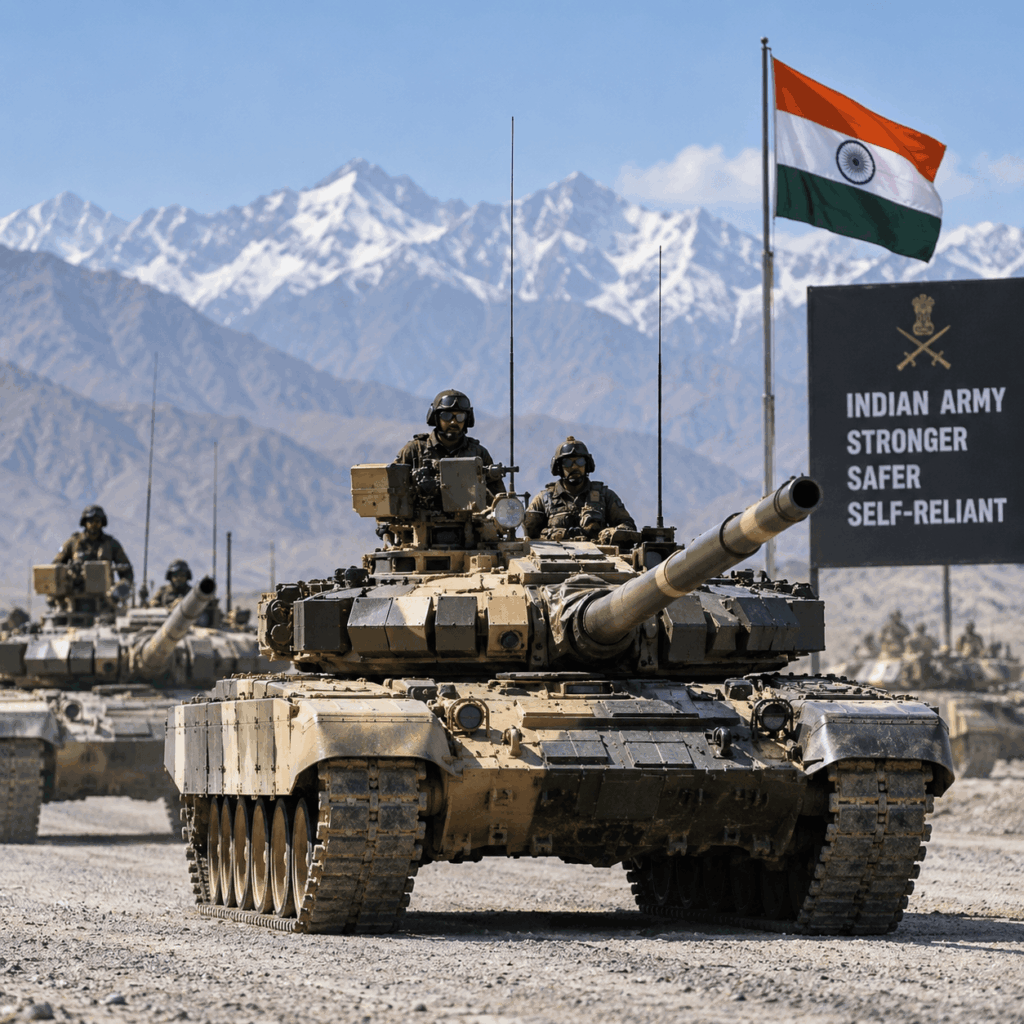
India has taken another step towards strengthening the operational capability of the Indian Army’s armoured forces with the Defence Ministry signing a ₹586 crore contract for the procurement of Auxiliary Power Units (APUs) for the Army’s T-72 and T-90 main battle tanks.
The contract was signed on September 21, 2026, with Pune-based Accurate Industrial Controls Pvt Ltd. The agreement was formalised in New Delhi in the presence of Defence Secretary Rajesh Kumar Singh. The procurement is part of India’s continuing efforts to modernise existing military platforms while improving their operational efficiency and reducing dependence on foreign systems.
The T-72 and T-90 tanks form a major part of India’s armoured capability, particularly for operations in challenging environments. The new Auxiliary Power Units are intended to improve the tanks’ efficiency and operational availability, providing an important upgrade to platforms that continue to serve with the Indian Army.
What Are Auxiliary Power Units?
An Auxiliary Power Unit, commonly known as an APU, is a secondary power system that can provide electricity and other power requirements without requiring the tank’s main engine to remain running.
For a main battle tank, this can be particularly useful when the vehicle is stationary but still needs to operate equipment such as communication systems, surveillance equipment, electronic systems and other onboard components.
Running the main engine continuously can consume significant amounts of fuel and can increase engine wear. An APU can allow certain systems to remain operational while reducing the need to run the main engine.
For the Indian Army, the integration of APUs into the T-72 and T-90 fleets is therefore expected to improve fuel efficiency and reduce unnecessary engine running during stationary operations.
Why the T-72 and T-90 Upgrade Matters
The Indian Army operates a large fleet of armoured vehicles, with the T-72 and T-90 forming an important part of its tank force.
Although the T-72 is an older tank design, India has continued to upgrade and maintain its fleet over the years. The T-90, meanwhile, represents a more modern generation of Russian-origin main battle tanks and remains an important component of India’s armoured formations.
Instead of immediately replacing every existing platform with a completely new tank, upgrades can extend the useful operational life of existing vehicles and improve their performance.
The ₹586 crore APU contract is an example of this approach.
The upgrade can potentially provide practical benefits such as improved power management, reduced fuel consumption during stationary operations and better availability of onboard systems.
Focus on Operational Efficiency
Modern military operations require armoured vehicles to operate for extended periods while using increasingly sophisticated electronics and communication equipment.
A tank is no longer dependent only on its engine, armour and main gun. Modern battlefield operations also require communications, sensors, navigation equipment and other electronic systems.
These systems need a reliable power supply even when the vehicle itself is not moving.
An APU provides an additional source of power and can allow the main engine to remain switched off when full engine power is unnecessary.
This can be especially valuable during prolonged periods of observation, waiting, tactical positioning or other situations where a tank may need to remain stationary while keeping its electronic systems operational.
Strengthening India’s Indigenous Defence Industry
The contract has also highlighted the growing role of Indian private-sector companies in defence manufacturing.
The agreement has been awarded to Pune-based Accurate Industrial Controls Pvt Ltd, demonstrating the increasing participation of domestic companies in supplying equipment for the Indian Armed Forces.
India has been pursuing greater domestic production of military equipment through its broader self-reliance initiatives.
The government has increasingly encouraged Indian companies, defence startups and established manufacturers to participate in the development and production of military systems.
Such contracts can provide Indian companies with opportunities to develop specialised technologies and manufacturing capabilities while supporting the long-term maintenance and modernisation of equipment already operated by the armed forces.
Modernisation Alongside New Defence Systems
The APU contract comes at a time when India is pursuing modernisation across all three military services.
Recent Defence Ministry announcements show procurement and development programmes covering the Army, Navy and Air Force.
On September 8, the Defence Acquisition Council cleared capital acquisition proposals worth more than ₹1.10 lakh crore for the armed forces. The proposals included equipment such as CBRN reconnaissance vehicles, high-mobility vehicles, self-propelled mechanical mine layers, Advanced Light Helicopters, trawl tanks and the Sarvatra Bridge System for the Army.
For the Navy, the proposals included Arudhra radars and the design and development of marine gas turbines.
The developments indicate that India’s military modernisation programme involves both the introduction of new platforms and the upgrading of existing equipment.
Wider Push for Technology and Modern Warfare
India’s defence establishment is also placing greater emphasis on emerging technologies.
The Combined Operational Review and Evaluation Programme 2026, held from September 14 to 18 at the Manekshaw Centre in New Delhi, brought together senior officers from the three armed services and officials from the Defence, External Affairs and Home ministries.
The programme examined contemporary security challenges, jointness between the services, modern methods of warfare, non-kinetic aspects of national security, defence production and capability development.
This broader focus reflects how military preparedness is increasingly dependent on technology, integrated operations and rapid information sharing alongside traditional platforms.
India Expands Indigenous Defence Capabilities
India is also developing and testing new domestically produced military technologies.
Recent defence developments have included indigenous drones, counter-drone systems, radar technology and other equipment designed for modern battlefield requirements.
A report published on September 20 said India’s first indigenous long-range attack drone, KAL, had been tested at Pokhran. The vehicle-launched drone reportedly has a range of around 1,000 kilometres, endurance of up to eight hours and a payload capacity of 50 kilograms.
India has also been developing counter-drone capabilities. Recent reporting highlighted the T-SHUL BEAM system, a man-portable counter-drone system designed to interfere with hostile drone command, telemetry, video and navigation links.
These developments show the growing importance of unmanned systems and electronic warfare in India’s defence planning.
Focus on Joint Operations and Military Preparedness
India is simultaneously expanding cooperation with foreign armed forces through military exercises.
The 22nd edition of the India-US exercise Yudh Abhyas 2026 included around 1,200 personnel, with approximately 600 personnel from each country. Training was conducted in Auli, Uttarakhand, and at the Mahajan Field Firing Range in Rajasthan.
During the exercise, Indian and US troops conducted building-clearance and room-intervention drills using drones, robotic dogs, canines and sniper teams. The exercise also focused on Integrated Battle Groups and operations in mountainous and semi-mountainous terrain.
India has also been conducting maritime exercises and defence engagements with partner countries. The Defence Ministry’s recent announcements include the India-Sri Lanka maritime exercise SLINEX-26 and Indian naval deployments in the Indo-Pacific region.
What the New Contract Means for the Army
The ₹586 crore APU contract is not a replacement programme for India’s tank fleet. Instead, it represents a capability and efficiency upgrade for existing T-72 and T-90 platforms.
The importance of such upgrades lies in improving the performance and sustainability of equipment already available to the armed forces.
For a large armoured fleet, even relatively specialised improvements can have a significant operational effect when implemented across many vehicles.
Better power management can help reduce unnecessary fuel consumption, support electronic equipment and potentially reduce engine wear during stationary operations.
At the same time, the contract gives an Indian defence manufacturer an opportunity to contribute to the Army’s modernisation requirements.
India’s Defence Modernisation Continues
The latest contract is part of a much wider transformation underway across India’s defence sector.
India is simultaneously upgrading legacy platforms, acquiring new weapons and sensors, developing indigenous technologies, expanding defence manufacturing and conducting joint military exercises with international partners.
The modern battlefield is increasingly shaped by drones, electronic warfare, precision weapons, advanced sensors, artificial intelligence and networked communications. However, conventional platforms such as tanks, artillery, aircraft and naval vessels continue to remain important components of military capability.
The Defence Ministry’s decision to invest in APUs for the T-72 and T-90 fleet illustrates this combination of modernisation and life-extension.
With a ₹586 crore contract now signed, the Army’s existing tank fleet is set to receive another technological upgrade aimed at improving operational efficiency and power management.
The development comes alongside India’s broader push towards a more technologically advanced and increasingly domestically supported defence ecosystem, as the country continues to strengthen military preparedness across land, air and maritime domains.