
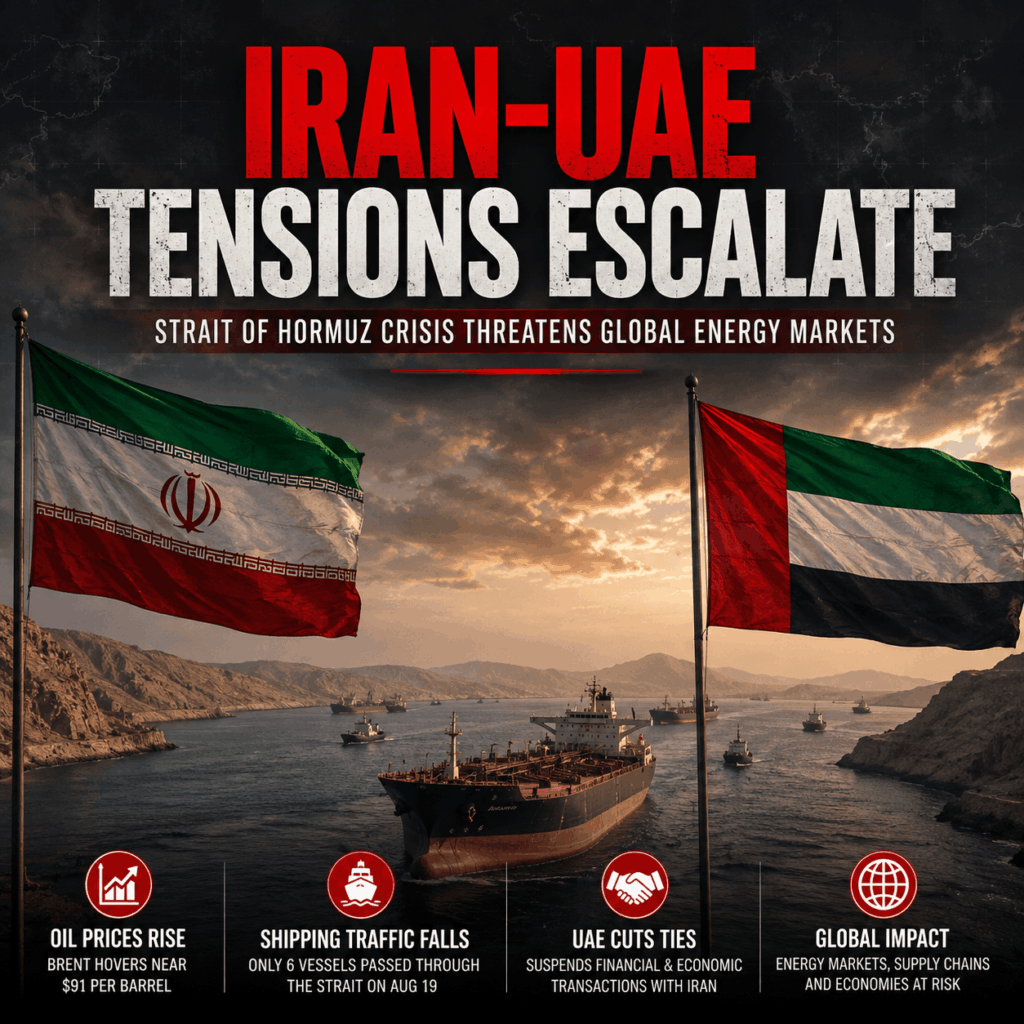
The Middle East is facing another sharp escalation as tensions between Iran and the United Arab Emirates (UAE) intensify, adding a new layer of uncertainty to an already dangerous conflict involving Iran, the United States and Israel.
On August 18, the UAE said it had detected two ballistic missiles launched from Iran toward maritime traffic. According to the UAE’s Defense Ministry, both missiles fell into the Persian Gulf and caused no reported damage. Iran has denied the accusation, calling the claim baseless.
The incident has nevertheless had immediate political and economic consequences. On August 19, the UAE announced the suspension of financial and economic transactions with Iran, significantly worsening relations between two countries that have historically maintained substantial commercial ties despite their political differences.
Why the UAE-Iran Dispute Matters
The confrontation is taking place against the backdrop of the much larger Iran-U.S. conflict and the crisis surrounding the Strait of Hormuz, one of the world’s most important energy routes.
The Strait connects the Persian Gulf with the Gulf of Oman and the wider Arabian Sea. A significant share of the world’s oil and liquefied natural gas normally passes through the waterway, meaning any prolonged disruption can quickly affect fuel prices, shipping costs and economies far beyond the Middle East.
That risk is already being reflected in global markets. On August 19, Brent crude was trading around $91 per barrel, close to its highest level in several weeks, as uncertainty surrounding shipping through Hormuz continued.
The problem is not simply whether ships are physically able to enter the strait. The bigger issue is whether commercial operators consider it safe enough to do so.
Shipping Traffic Has Fallen Dramatically
Recent shipping data shows just how severely the conflict has affected maritime traffic.
According to Kpler data cited by Reuters, only six commodity vessels passed through the Strait of Hormuz on Tuesday, compared with nine the previous day and a recent average of roughly 11 daily transits. Before the current conflict, the waterway handled vastly larger volumes of commercial shipping.
Major shipping companies have increasingly avoided the area because of the risks associated with missiles, drones and military activity.
Chinese shipping companies have also reduced their presence in the region. Reuters reported that two major Chinese state-linked shipping companies stopped operating through the Strait of Hormuz and Bab al-Mandab in late July, highlighting how the crisis is affecting some of the world’s largest energy importers.
The disruption is particularly important for countries such as China, India, Japan and South Korea, which depend heavily on energy imports from the Gulf.
Iran and the United States Remain Far Apart
The latest UAE incident comes as diplomatic efforts between Washington and Tehran appear to be struggling.
U.S. President Donald Trump said on August 18 that there were no talks currently planned with Iran, while Iran continued to insist that the Strait of Hormuz remained closed until its demands were addressed. Trump, meanwhile, maintained that the waterway was open.
The contradictory claims demonstrate the uncertainty surrounding the strait.
For international shipping companies, the issue is not simply which government is technically correct. Even if the United States declares the waterway open, companies may continue avoiding it if they believe their vessels could be attacked.
That hesitation can itself create an economic crisis.
The UAE’s Economic Decision Could Have Wider Consequences
The UAE’s decision to suspend trade and financial transactions with Iran represents a particularly important development.
The two countries have maintained significant commercial connections, with the UAE serving as an important regional trading and re-export hub for Iranian goods. Cutting those links could place additional economic pressure on Tehran at a time when Iran is already facing sanctions, military pressure and restrictions on energy exports.
At the same time, the decision could also create economic costs for the UAE.
Dubai and other UAE commercial centers have historically benefited from their position as regional hubs connecting businesses across the Middle East and Asia. A prolonged regional conflict threatens shipping, tourism, investment and trade — sectors that are central to the UAE economy.
Oil Prices Could Become the Next Major Concern
The biggest global consequence could ultimately be felt at the fuel pump.
The Strait of Hormuz normally carries a huge portion of global oil and gas shipments. When traffic slows, traders immediately begin considering the possibility of supply shortages.
Reuters reported on August 19 that oil prices were already being supported by the uncertainty surrounding the waterway, with analysts warning that continued disruption could push crude prices significantly higher.
Higher oil prices could create a chain reaction across the global economy.
Transportation becomes more expensive. Airlines face higher fuel costs. Manufacturing expenses increase. Shipping rates can rise, while governments may face renewed inflationary pressure.
For countries that import most of their energy, the consequences could be particularly serious.
What Happens Next?
The immediate question is whether diplomacy can prevent the situation from becoming a wider regional confrontation.
Oman has been involved in efforts to negotiate arrangements concerning the Strait of Hormuz, and earlier discussions had raised hopes of a possible agreement. However, those efforts have faced major obstacles as Iran and the United States continue to disagree over the terms for reopening the waterway.
Meanwhile, the UAE has emphasized its interest in dialogue even as it takes tougher economic measures against Iran. Iran, for its part, continues to deny responsibility for the missile incident and rejects accusations that it is deliberately targeting UAE interests.
For now, the situation remains highly fluid.
The most important factor for the global economy will be whether commercial shipping can safely return to the Strait of Hormuz. If traffic begins recovering, pressure on oil prices and global supply chains could ease. If attacks and political tensions continue, however, the crisis could become a much larger international economic problem.
What began as a regional military confrontation is therefore increasingly becoming a global energy and trade crisis — one that could affect fuel prices, inflation and shipping costs thousands of kilometers away from the Middle East.