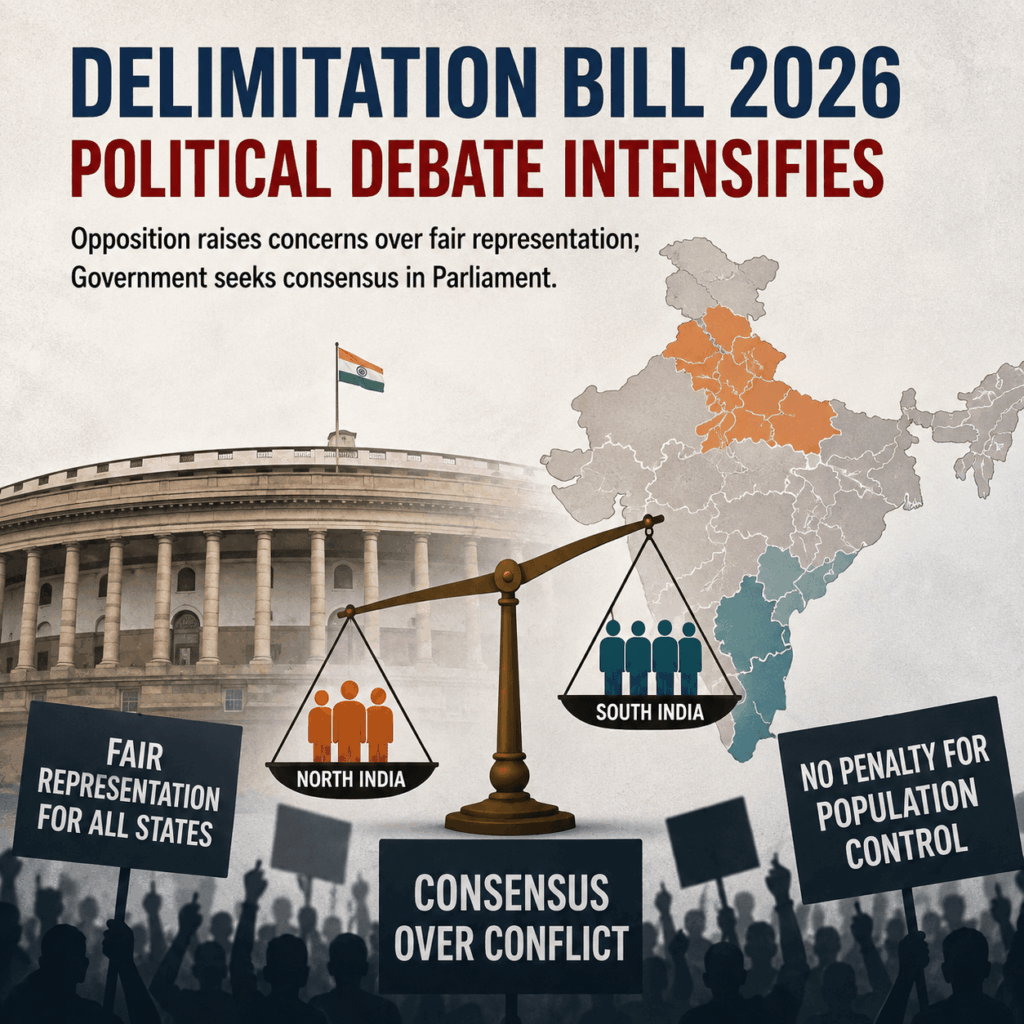
India’s Parliament is witnessing an increasingly intense political debate over a proposed Delimitation Bill, with the issue bringing questions of representation, federal balance and the future distribution of Lok Sabha seats to the centre of national politics. Opposition parties, particularly the Congress and several southern parties, have expressed serious reservations about the proposed exercise, while sections of the ruling alliance have argued that India needs to address the imbalance created by population growth and the existing distribution of parliamentary constituencies.
The controversy has become one of the most important political issues of the ongoing Monsoon Session of Parliament. With only a limited number of sittings remaining, negotiations between the government and Opposition have become increasingly important as the Centre attempts to move forward with several major legislative proposals.
What Is Delimitation?
Delimitation refers to the process of redrawing the boundaries of electoral constituencies so that parliamentary and assembly representation reflects changes in population.
In simple terms, if the population distribution of the country changes significantly over several decades, delimitation can be used to redraw constituencies and potentially alter the number of seats allocated to different regions.
The issue is particularly sensitive in India because different states have experienced very different population growth rates. Several southern states have historically implemented stronger population-control measures and consequently experienced slower population growth than many northern states.
This has created a political dilemma.
If parliamentary representation is redistributed primarily according to population, states that have experienced faster population growth could potentially gain a larger share of Lok Sabha seats. States that successfully controlled population growth fear that they could lose relative political influence despite having followed national population policies.
That is why the current debate is not simply about constituency boundaries. It is fundamentally about how political representation should be distributed in India’s federal system.
Congress Announces Strong Opposition
Congress president Mallikarjun Kharge has made it clear that his party is opposed to the proposed delimitation exercise in its current form. According to recent reports, Kharge said that Opposition parties would take a collective position on the issue and that the Congress would not accept a proposal that could disadvantage particular regions.
The Congress has argued that southern states should not be politically penalised for successfully implementing population-control policies.
This argument has particular relevance in states such as Tamil Nadu, Kerala, Karnataka, Andhra Pradesh and Telangana, where population growth has generally been slower than in several northern states.
The concern is that if seats are redistributed strictly according to current population figures, the political weight of these states could decline relative to their contribution to India’s economy and governance.
Why Southern States Are Concerned
The delimitation debate has created considerable political sensitivity in southern India.
For decades, Indian governments have encouraged population stabilisation through family-planning programmes and public-health initiatives. Southern states generally achieved better outcomes in reducing fertility rates than several northern states.
Opposition leaders therefore argue that changing parliamentary representation based primarily on population could create a situation in which states that succeeded in controlling population growth receive fewer seats relative to states where population expanded more rapidly.
This could affect not only the number of MPs representing each region but also the political influence that states have over national policy.
The issue therefore has the potential to become a major North-South political debate.
Government Faces a Difficult Political Calculation
The government is also facing a complicated political situation because the delimitation proposal requires broader political support.
Recent reporting indicates that some Opposition parties have softened their positions on certain elements involving women’s reservation and delimitation, while the Congress and several of its allies continue to resist the proposal.
There is also speculation that the government could slow down controversial legislation, including the FCRA amendment, in an effort to engage with parties whose support could become important during discussions surrounding delimitation.
This demonstrates how interconnected different legislative issues have become during the current parliamentary session.
For the BJP-led government, delimitation could represent an important opportunity to modernise India’s electoral map and address long-standing questions surrounding representation. But pushing the issue without sufficient political consensus could deepen regional tensions.
The Question of Lok Sabha Seats
One of the biggest questions surrounding the proposed exercise is how India’s total number of Lok Sabha seats could change.
The number of parliamentary constituencies has remained fixed for decades as part of the country’s effort to prevent states from being disadvantaged because of successful population-control policies.
The constitutional framework has historically placed restrictions on readjusting the allocation of seats between states based on population. The political debate now centres on what should happen when that framework is reconsidered.
An increase in the total number of Lok Sabha seats could theoretically allow the government to expand representation without directly reducing the existing number of seats in states.
However, the exact formula for distributing additional seats remains politically crucial.
If the additional representation is largely population-based, states with higher population growth could gain substantially more seats.
Why the Issue Matters Beyond Parliament
The delimitation debate could have consequences far beyond the next election cycle.
Parliamentary representation affects how states participate in national decision-making. The number of MPs from a state can influence its political bargaining power, role in coalition politics and ability to raise regional concerns in Parliament.
The issue also intersects with the women’s reservation framework, making the political calculations even more complicated. The government and Opposition must therefore consider how changes to constituency boundaries, seat numbers and reservation arrangements could interact with each other.
For voters, the debate may ultimately determine how their political representation is structured for decades.
A Major Test for Indian Federalism
The ongoing delimitation controversy is ultimately a test of India’s federal political structure.
The central question is not whether constituencies should ever be updated. Electoral boundaries inevitably need to reflect demographic and administrative changes. The more difficult question is how that change should be implemented fairly across states with very different demographic histories.
The government wants to address the representation question, while Opposition parties are demanding safeguards for states that fear losing political influence.
With the Monsoon Session approaching its final stage and political negotiations continuing, delimitation is likely to remain one of the most closely watched issues in Indian politics.
If the government and Opposition can reach a broad consensus, the process could become an important institutional reform. If they fail, however, the issue could deepen existing regional political divisions and become a major electoral issue in the years ahead.
For now, the delimitation debate has moved beyond a technical question of drawing constituency boundaries. It has become a larger discussion about population, representation, federalism and the balance of political power between different parts of India.