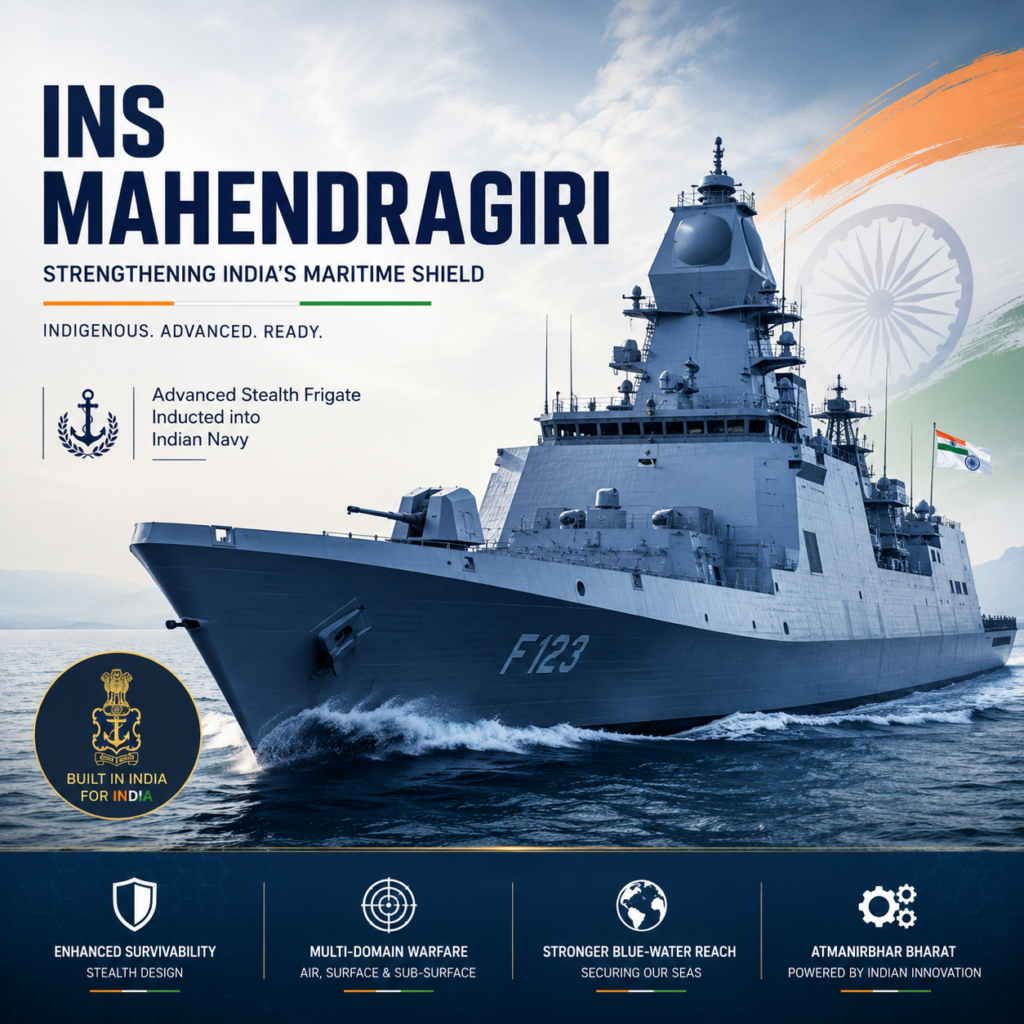
India has taken another major step towards strengthening its maritime defence capabilities with the induction of INS Mahendragiri, an indigenously built advanced stealth frigate, into the Indian Navy’s Eastern Fleet. The warship was commissioned at Visakhapatnam, Andhra Pradesh, on July 11, 2026, in the presence of Defence Minister Rajnath Singh.
The addition of INS Mahendragiri comes at a crucial time when maritime security has become increasingly important for India. With a vast coastline, major commercial ports and critical shipping routes passing through the Indian Ocean Region, the country’s security and economic interests are closely connected to its ability to maintain a strong naval presence.
INS Mahendragiri represents not only an expansion of the Indian Navy’s combat capabilities but also the country’s growing push towards self-reliance in defence manufacturing.
A New Addition to India’s Naval Power
Modern naval warfare is no longer limited to traditional battles between ships. Today’s warships are expected to operate in complex environments involving submarines, aircraft, missiles, drones and electronic warfare systems.
INS Mahendragiri has been designed for such a modern battlefield.
As an advanced stealth frigate, the warship is built to reduce its detectability while carrying sophisticated systems for different types of naval operations. According to the Ministry of Defence, the ship is capable of performing roles including fleet air defence and anti-surface warfare.
Its induction into the Eastern Fleet is particularly significant because the eastern maritime theatre is strategically important for India’s engagement with the wider Indo-Pacific region.
The Bay of Bengal and surrounding waters connect India with Southeast Asia and some of the world’s busiest maritime trade routes. A stronger naval presence in this region gives India greater capability to protect its interests, respond to emerging threats and contribute to regional maritime stability.
Why Stealth Matters in Modern Naval Warfare
Stealth technology has become increasingly important in modern military operations. The basic objective is to make a platform more difficult for an adversary to detect and track.
For a warship, this can involve its physical design, radar signature, heat emissions and other characteristics that could reveal its location.
A stealth frigate is therefore designed to improve survivability in potentially hostile environments. Combined with modern sensors, weapons and communication systems, stealth features can allow a naval vessel to operate more effectively during complex missions.
However, modern warships are not judged by a single capability. Their real strength comes from the integration of multiple systems.
A vessel may need to detect an approaching aerial threat, track hostile ships, coordinate with aircraft, communicate securely with other naval platforms and respond to submarine threats—all while operating far from the Indian coastline.
This is why the commissioning of a new advanced frigate is more than simply adding another ship to the Navy’s fleet. It expands the range of missions the Navy can undertake and strengthens the overall network of India’s maritime defence.
Strengthening India’s Presence in the Indian Ocean
The Indian Ocean Region has become one of the most strategically important areas in the world.
A significant share of global trade and energy supplies moves through maritime routes connected to the region. For India, these waters are especially important because much of the country’s international trade depends on secure sea lanes.
Any major disruption caused by conflict, piracy, terrorism or geopolitical instability can have serious economic consequences.
India has therefore been steadily strengthening its ability to operate across the Indian Ocean and beyond.
Defence Minister Rajnath Singh said that INS Mahendragiri would help extend India’s blue-water reach and consolidate the country’s presence in the Indian Ocean Region.
A “blue-water navy” generally refers to a naval force capable of conducting sustained operations far from its home shores. Such capability requires modern warships, submarines, aircraft, logistics support and strong maritime surveillance.
For a country with India’s growing economic and strategic interests, the ability to operate across distant waters is becoming increasingly important.
A Major Boost for Aatmanirbhar Bharat
One of the most important aspects of INS Mahendragiri is its connection to India’s wider push for indigenous defence production.
For decades, India has been one of the world’s major importers of military equipment. However, the country has increasingly focused on developing domestic defence manufacturing capabilities.
Recent figures indicate significant growth in this sector. India’s annual defence production reached a record ₹1.78 lakh crore in the financial year 2025–26, representing a 15.6% increase compared with the previous financial year and more than double the level recorded in FY 2020–21.
The growth of domestic defence production has strategic as well as economic importance.
Dependence on foreign suppliers can create challenges during geopolitical crises, wars or disruptions in global supply chains. Greater domestic manufacturing can improve the availability of equipment, simplify maintenance and reduce dependence on external suppliers.
At the same time, a stronger defence industry can create highly skilled jobs and support technological development in areas such as electronics, artificial intelligence, advanced materials, propulsion systems and cybersecurity.
The construction of sophisticated naval platforms in India demonstrates the increasing capability of the country’s shipbuilding ecosystem.
Modern Warfare Is Changing Rapidly
The arrival of INS Mahendragiri also comes during a period of rapid transformation in military technology.
Recent conflicts around the world have demonstrated the growing importance of drones, precision-guided weapons, electronic warfare, artificial intelligence and networked military operations.
Navies must now prepare for threats that can emerge from above the surface, below the sea, in the air and even in cyberspace.
This means India’s future naval strategy will depend not only on the number of ships it operates but also on how effectively those platforms can share information and operate together.
Warships increasingly function as part of a larger network involving satellites, maritime patrol aircraft, helicopters, submarines, drones and shore-based command systems.
Advanced frigates such as INS Mahendragiri can therefore become important components of a broader maritime security architecture.
Why the Eastern Fleet Matters
The decision to induct INS Mahendragiri into the Eastern Fleet carries strategic significance.
India’s eastern maritime region faces the Bay of Bengal and provides access towards the wider Indo-Pacific. The region is increasingly important as countries expand naval cooperation, conduct joint exercises and strengthen maritime partnerships.
India has also been developing closer defence and security relationships with several Indo-Pacific partners.
A capable Eastern Fleet allows the Indian Navy to respond to emergencies, protect maritime trade, conduct humanitarian assistance operations and participate in multinational exercises.
It also strengthens deterrence by demonstrating that India possesses the capability to protect its maritime interests.
The Road Ahead for the Indian Navy
The commissioning of INS Mahendragiri represents another milestone in India’s long-term naval modernisation.
But the security environment continues to evolve. The Navy will need to keep investing in submarines, unmanned systems, surveillance, cybersecurity, anti-drone capabilities and advanced weapons alongside conventional surface warships.
India’s growing economy and international influence also mean that its maritime responsibilities are expanding.
From protecting commercial shipping and responding to natural disasters to securing strategic sea lanes and maintaining regional stability, the Indian Navy is expected to perform an increasingly diverse range of missions.
INS Mahendragiri enters service at a time when maritime power is becoming more important than ever.
Its commissioning sends two major signals: India is strengthening its ability to operate across the Indian Ocean Region, and the country’s domestic defence industry is becoming increasingly capable of building sophisticated military platforms.
As geopolitical competition intensifies across the Indo-Pacific, advanced indigenous warships such as INS Mahendragiri are likely to play an important role in India’s national security strategy.
For India, the new stealth frigate is therefore more than another addition to the fleet. It represents the country’s wider ambition to become more self-reliant, technologically capable and strategically influential in the maritime domain.