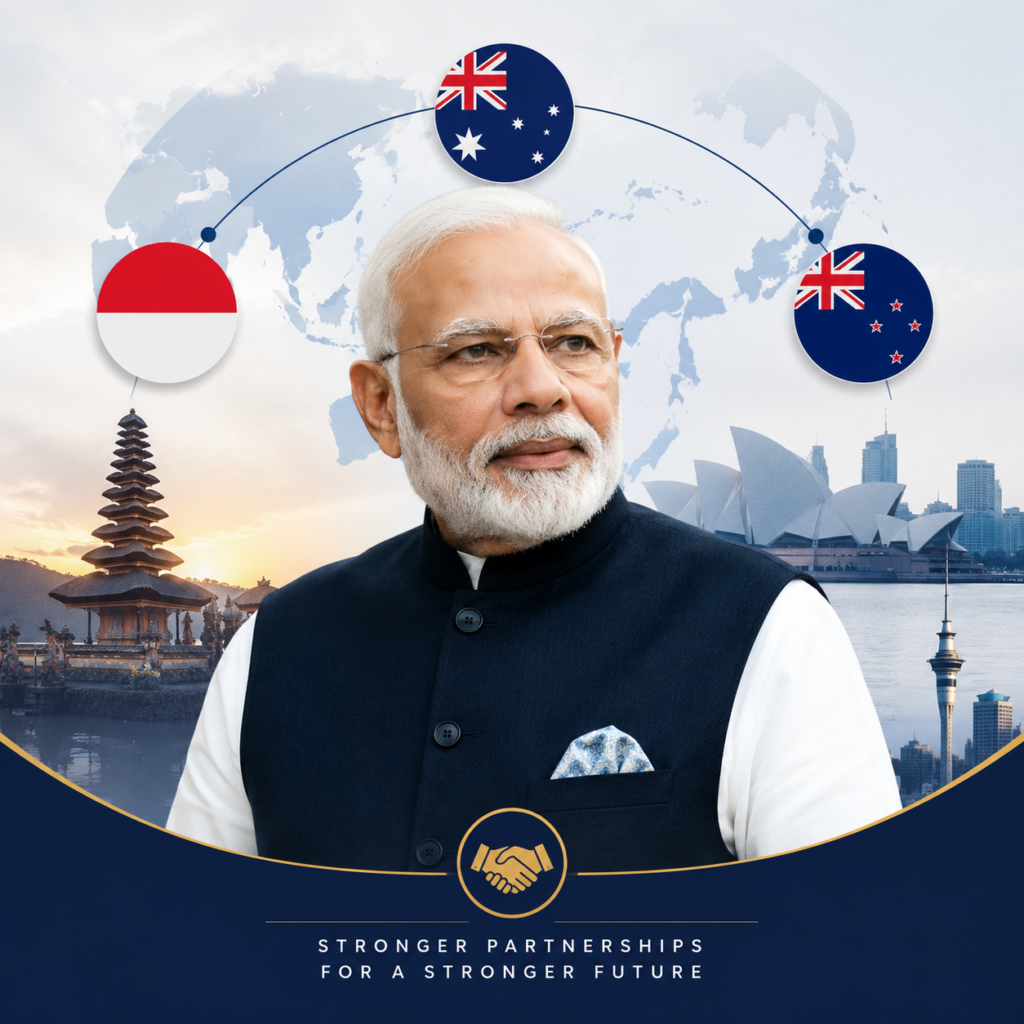
Prime Minister Narendra Modi has concluded a significant three-nation diplomatic tour covering Indonesia, Australia and New Zealand, placing India’s growing role in the Indo-Pacific firmly in the national spotlight. The visit, held from July 6 to 11, 2026, focused on strengthening strategic partnerships, defence cooperation, trade, investment and people-to-people ties with three important countries in the wider Indo-Pacific region.
The tour comes at a time when the Indo-Pacific has become one of the world’s most strategically important regions. It is home to major global economies, critical maritime trade routes and rapidly changing security dynamics. For India, stronger relations with Indonesia, Australia and New Zealand are therefore not simply about diplomacy—they are connected to economic growth, maritime security, technology, supply chains and the country’s long-term global ambitions.
Indonesia: Strengthening a Key Southeast Asian Partnership
Indonesia was the first destination of the Prime Minister’s tour. As two of the largest democracies and major economies in the Indo-Pacific, India and Indonesia share deep historical, cultural and maritime connections.
Indonesia also holds enormous strategic importance because of its location near some of the world’s busiest sea routes. India has increasingly viewed cooperation with Southeast Asian countries as a key part of its wider engagement with the Indo-Pacific.
During the visit, discussions focused on expanding cooperation across multiple areas and opening new avenues for the bilateral relationship. The engagement reflected India’s continuing effort to deepen ties with Southeast Asia while strengthening economic and strategic cooperation with one of the region’s most influential nations.
The importance of India-Indonesia relations goes beyond traditional diplomacy. Both countries have growing economies, large populations and important roles in regional institutions. Stronger cooperation can create opportunities in trade, infrastructure, technology, energy and maritime security.
Australia: Defence and Security Take Centre Stage
The second leg of the tour took Prime Minister Modi to Australia, where he participated in the third India-Australia Annual Summit with Australian Prime Minister Anthony Albanese in Melbourne on July 9.
India and Australia have developed a much closer relationship in recent years. The two countries cooperate in areas including defence, education, critical minerals, clean energy, technology and regional security.
One of the major outcomes highlighted during the visit was a Joint Declaration on Defence and Security, signalling the growing strategic dimension of the relationship. The summit provided another platform for both countries to strengthen cooperation in an increasingly complex Indo-Pacific environment.
Australia is also an important partner for India because of its resources, universities and technological capabilities. Thousands of Indian students study in Australia, while the Indian-origin community has become an increasingly important part of Australian society.
For India, cooperation with Australia can also support efforts to build more resilient supply chains and diversify access to critical resources. Minerals required for electric vehicles, batteries and advanced technologies are becoming increasingly important as countries compete to develop cleaner and more technologically advanced economies.
The expanding India-Australia relationship therefore combines strategic interests with practical economic opportunities.
New Zealand: Relations Elevated to a Strategic Partnership
The final leg of the tour produced one of its most significant diplomatic outcomes: India and New Zealand elevated their relationship to a Strategic Partnership.
Prime Minister Modi held extensive talks with New Zealand Prime Minister Christopher Luxon, with the two countries seeking deeper cooperation across areas including defence, security, trade, investment and wider economic engagement. The two sides also announced agreements in key sectors as part of the effort to broaden bilateral cooperation.
The elevation of ties is particularly significant because India and New Zealand have traditionally maintained friendly relations but have had considerable room to expand their strategic and economic partnership.
Business and investment were also major themes during the visit. Prime Minister Modi presented India as an important destination for global growth and encouraged New Zealand businesses to explore opportunities in the Indian economy.
The Indian diaspora also remains a major bridge between the two countries. People of Indian origin have established a significant presence in New Zealand and contribute to sectors ranging from business and technology to healthcare and education.
Why This Tour Matters for India
The three-nation tour reflects a larger transformation in Indian foreign policy. India is increasingly building multiple partnerships rather than depending on a single group of countries.
Indonesia represents a major Southeast Asian and maritime partner. Australia has become an increasingly important defence, economic and strategic partner. New Zealand now enters a new phase of relations with India through the newly announced Strategic Partnership.
Together, these relationships strengthen India’s position across a vast geographical region stretching from the Indian Ocean to the Pacific.
The tour also shows how modern diplomacy is becoming increasingly interconnected. Defence agreements are linked with maritime security. Trade partnerships are connected with supply-chain resilience. Technology cooperation is tied to economic competitiveness, while educational and diaspora links create long-term connections between societies.
For ordinary Indians, the impact of such diplomatic engagements may eventually be visible through increased investment, business opportunities, technology partnerships, educational exchanges and stronger international mobility.
India’s Growing Indo-Pacific Role
India’s importance in the Indo-Pacific has increased considerably as the global economic and strategic balance continues to shift towards Asia. The country’s geographical position gives it a major role in the Indian Ocean, while its growing economy makes it an increasingly important partner for countries seeking new markets and diversified economic relationships.
At the same time, India continues to emphasise strategic autonomy—working with different countries while maintaining an independent foreign policy.
The Indonesia-Australia-New Zealand tour fits into this broader approach. Rather than focusing on one single partnership, India is developing a network of relationships based on shared interests in economic growth, security, technology and regional stability.
The Road Ahead
The success of any major diplomatic visit will ultimately depend on implementation. Agreements and strategic declarations must be followed by investment, projects, regular dialogue and measurable cooperation.
The latest tour has nevertheless created fresh momentum in India’s relations with three important Indo-Pacific countries. The new Strategic Partnership with New Zealand, expanding defence and security cooperation with Australia, and deeper engagement with Indonesia collectively demonstrate India’s ambition to play a larger role in shaping the region’s future.
As Prime Minister Modi returns to India after the six-day tour, the larger message is clear: India is seeking to combine economic opportunity with strategic influence and build partnerships across the Indo-Pacific.
In a world facing geopolitical competition, supply-chain disruptions and rapid technological change, India’s ability to maintain strong relationships with a diverse range of countries could become one of its greatest diplomatic advantages.