
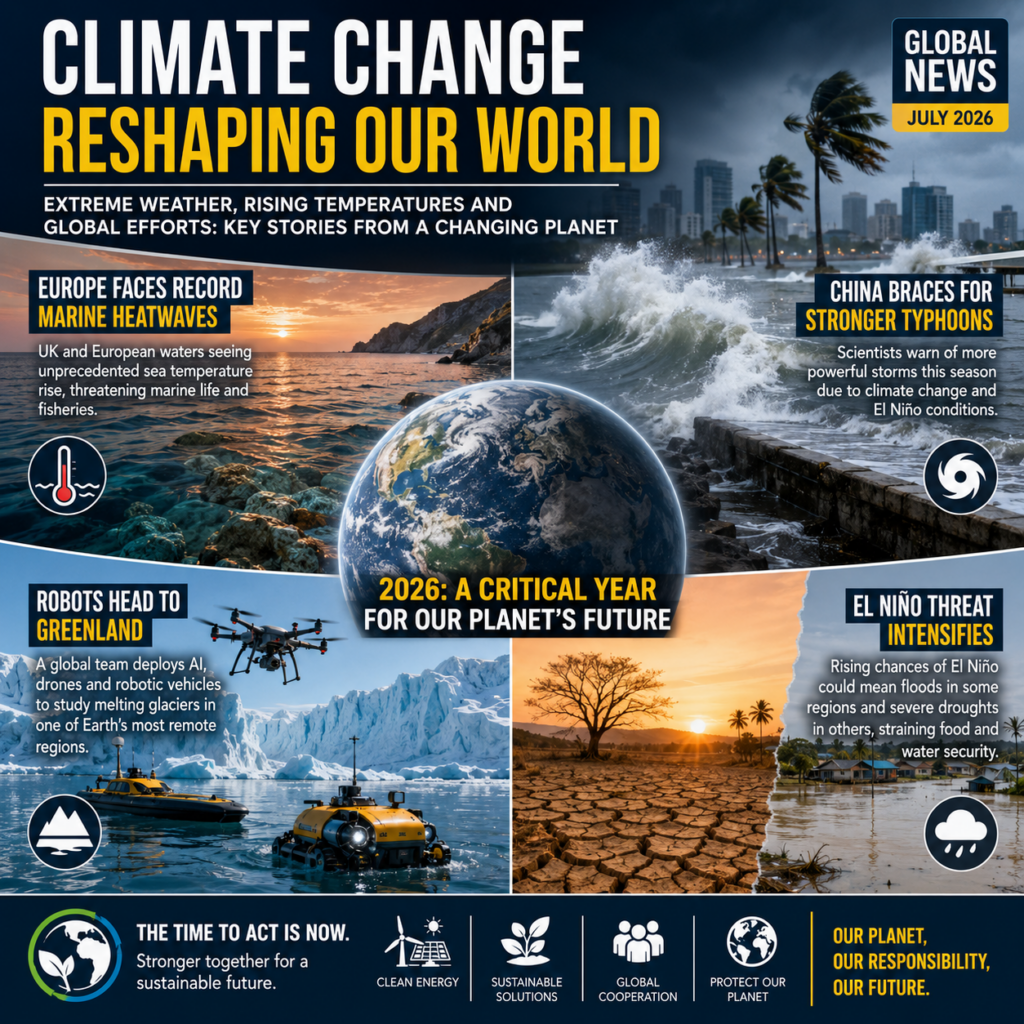
The effects of climate change are no longer distant predictions—they are unfolding in real time across continents. From record-breaking marine heatwaves in Europe to increasingly powerful typhoons in Asia and cutting-edge scientific missions in Greenland, 2026 is highlighting how rapidly the Earth’s climate is changing. Scientists say these events are not isolated incidents but part of a broader global trend driven by rising temperatures and changing weather patterns.
Governments, researchers, and international organizations are responding with new technologies and adaptation strategies. Yet experts warn that the pace of climate change continues to outstrip many countries’ preparedness.
Europe Faces Record Marine Heatwaves
One of the most alarming developments this year has been the extraordinary rise in sea temperatures around the United Kingdom and parts of Europe.
According to scientists, UK coastal waters are experiencing one of the strongest marine heatwaves ever recorded, with temperatures reaching several degrees above normal. Oceans absorb over 90% of the excess heat trapped by greenhouse gases, making rising sea temperatures one of the clearest indicators of global warming.
Marine heatwaves have widespread consequences:
- Coral reef damage
- Fish migration to cooler waters
- Reduced seafood production
- Increased harmful algae blooms
- Greater stress on marine ecosystems
Researchers also warn that warmer oceans fuel stronger storms by providing additional energy to developing weather systems.
China Braces for Stronger Typhoons
In Asia, meteorologists are closely monitoring an unusually active typhoon season.
Chinese climate experts have warned that climate change, combined with a developing El Niño pattern, could lead to several powerful typhoons making landfall during the coming months. Recent storms have already caused severe flooding, damaged infrastructure, displaced hundreds of thousands of residents, and tested emergency response systems.
Scientists believe that warmer oceans and changing atmospheric conditions are increasing both the intensity and rainfall associated with tropical cyclones.
Robots Head to Greenland for a Historic Mission
While extreme weather captures headlines, scientists are launching one of the most ambitious climate research projects ever attempted.
An international team is deploying autonomous drones, robotic boats, underwater vehicles, and AI-powered sensors to Greenland’s glaciers. The mission aims to study how glaciers melt where ice meets the ocean—a process that remains one of the largest uncertainties in predicting future sea-level rise.
The project will collect data from locations too dangerous for human researchers, helping scientists improve global climate models and better forecast future coastal flooding risks.
El Niño Could Intensify Global Weather
Another major concern is the growing likelihood of a developing El Niño event.
The World Meteorological Organization has indicated that conditions are becoming increasingly favorable for El Niño, a natural climate phenomenon that alters global weather patterns. While El Niño occurs naturally, rising global temperatures can amplify its effects.
Possible impacts include:
- Higher global temperatures
- Increased flooding in some regions
- Severe droughts in others
- Disrupted agriculture
- Greater wildfire risk
- Pressure on global food supplies
Countries are already preparing for potential impacts on water resources and crop production.
Why Climate Adaptation Is Becoming Essential
Experts increasingly emphasize that reducing greenhouse gas emissions alone will not be enough. Communities must also adapt to changing climate conditions.
Across Europe, governments are expanding heat-health plans, improving flood defenses, developing early warning systems, and investing in climate-resilient infrastructure. Cities are creating cooling centers, planting more urban trees, and redesigning public spaces to reduce heat stress.
However, many regions remain underprepared, particularly where infrastructure was built for historical climate conditions rather than today’s increasingly extreme weather.
Technology Is Playing a Bigger Role
Artificial intelligence and robotics are becoming powerful tools in climate science.
AI systems now help researchers analyze satellite imagery, forecast weather, monitor glaciers, predict floods, and improve disaster response planning. Combined with autonomous research vehicles, these technologies allow scientists to gather information from some of Earth’s most inaccessible environments.
While technology cannot solve climate change alone, it is significantly improving humanity’s ability to understand and respond to rapidly changing conditions.
A Global Challenge Requiring Global Action
Climate change affects every country, regardless of geography or economic development. Rising temperatures, stronger storms, prolonged droughts, and shifting ecosystems are interconnected challenges that cross national borders.
Scientists continue to stress that international cooperation, investment in renewable energy, climate-resilient infrastructure, scientific research, and public awareness will all be necessary to reduce future risks.
The events unfolding across Europe, Asia, and the Arctic in 2026 serve as a reminder that climate change is not merely an environmental issue—it is increasingly becoming an economic, humanitarian, and global security challenge.
As governments race to prepare for a warmer future, experts agree on one point: the decisions made today will shape how successfully the world adapts to the decades ahead.