
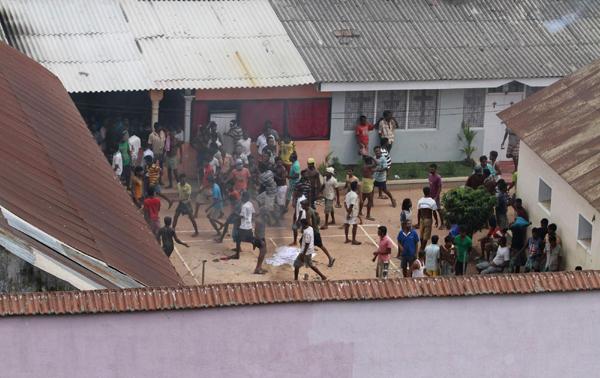
Sri Lanka has witnessed one of its deadliest prison uprisings in recent years after at least 25 people were killed and dozens more injured during two days of violent riots at Negombo Prison, located north of the capital city, Colombo.
The unrest, which began as a confrontation between rival groups of inmates, quickly escalated into a full-scale prison riot involving armed prisoners, rooftop protests, attempted prison breaches, and a large security operation involving police and the military. Authorities have since launched an investigation into the incident as questions grow over prison overcrowding, security failures, and the conditions inside Sri Lanka’s correctional facilities.
The tragedy has once again drawn international attention to the country’s overcrowded prison system, which currently houses more than four times its intended capacity. (BBC)
Violence Began With a Clash Between Inmates
According to Sri Lankan authorities, the violence began on Sunday after a dispute between two groups of prisoners inside Negombo Prison.
Reports suggest the confrontation was linked to allegations that one inmate had informed prison authorities about a drug trafficking operation taking place inside the facility. The dispute rapidly escalated into widespread violence involving multiple sections of the prison.
During the initial clashes, prisoners allegedly managed to seize firearms from prison guards, significantly worsening the situation. Two people were killed during the first day of unrest, while dozens of inmates sustained injuries.
As tensions intensified, groups of male prisoners climbed onto prison rooftops demanding their release. Women housed in an adjoining prison section also joined the rooftop protest, creating an increasingly volatile situation. (BBC)
Second Day Turns Even More Deadly
The situation deteriorated dramatically on Monday.
Authorities reported that groups of inmates attempted to force their way through the prison’s main gates in what officials described as a coordinated escape attempt.
Security forces responded by deploying heavily armed police officers, while the Sri Lankan military was placed on standby after police requested additional support.
Witnesses reported hearing repeated gunfire from inside the prison complex as officers attempted to regain control.
By the time the violence ended, officials confirmed that at least 25 people had lost their lives, making it one of the deadliest prison riots in Sri Lanka in recent years. (BBC)
Dozens Hospitalized With Gunshot and Serious Injuries
The violence also left dozens of people seriously injured.
Several wounded prisoners were transported to Negombo Hospital, while others were transferred to the National Hospital in Colombo for emergency treatment.
Hospital officials reported treating inmates suffering from:
- Gunshot wounds
- Deep cuts
- Severe bruising
- Trauma-related injuries
According to medical authorities, some injuries were caused during violent clashes between inmates, while others occurred during security operations aimed at restoring order. (BBC)
Roof Collapse Added to the Chaos
As the riots continued, authorities reported another dangerous development.
Part of the prison’s roof reportedly collapsed during the incident, injuring several women who had climbed onto the rooftop as part of the protest.
The collapse added further confusion to an already chaotic situation, forcing emergency responders to assist both injured prisoners and those trapped in damaged sections of the prison.
Police have not yet released detailed information regarding the extent of structural damage to the facility. (BBC)
Families Left Waiting Outside
Outside Negombo Prison, scenes of heartbreak unfolded throughout Monday.
Large crowds of worried family members gathered near the prison gates desperately seeking information about their relatives.
Many told local media they had received no official updates regarding:
- Whether their relatives were alive.
- Which hospitals injured prisoners had been taken to.
- Whether inmates had been transferred elsewhere.
The lack of communication created growing frustration among families, many of whom waited outside the prison for several hours hoping for news.
Prisoners Being Moved to Other Facilities
Following the riots, prison authorities began transferring inmates to correctional facilities across Sri Lanka.
Prisons Commissioner Media Spokesman AC Gajanayake confirmed that relocation efforts had begun as officials worked to stabilize the situation.
Security personnel continued clearing different areas of Negombo Prison while investigators searched for evidence related to the violence.
Military forces remain on standby until authorities are satisfied that order has been fully restored.
Government Orders Immediate Investigation
Sri Lanka’s Minister of Justice and Prisons, Harshana Nanayakkara, has instructed officials to conduct a full investigation into the incident.
Authorities are expected to examine several key issues, including:
- How inmates obtained firearms.
- The events leading to the initial confrontation.
- The response by prison staff and security forces.
- Conditions inside Negombo Prison.
Officials have promised to submit a detailed report once the investigation is completed.
Sri Lanka’s Overcrowded Prison Crisis
The tragedy has once again highlighted one of Sri Lanka’s biggest correctional system challenges—extreme overcrowding.
According to official figures:
- Sri Lankan prisons currently house around 41,250 inmates.
- The system was designed to accommodate only about 10,000 prisoners.
This means prisons are operating at approximately four times their intended capacity.
Human rights organizations have repeatedly warned that overcrowding creates dangerous living conditions by increasing tensions among inmates, limiting access to healthcare, and making prisons significantly harder to manage safely.
Not the First Deadly Riot
Although prison disturbances occasionally occur in Sri Lanka, incidents of this scale are relatively rare.
The country experienced another major prison tragedy in December 2020, when 11 inmates were killed and 117 others injured during riots at Mahara Prison.
That incident also raised serious concerns regarding overcrowding, prison management, and the use of force by security personnel.
The latest violence at Negombo Prison is now being described as one of the deadliest prison uprisings since that event.
Security Questions Under Scrutiny
One of the biggest questions facing investigators is how prisoners were able to gain access to firearms.
Authorities have not yet explained whether:
- Weapons were seized directly from prison guards.
- Security procedures failed during the initial clashes.
- Prison staffing levels contributed to the loss of control.
Security experts say these findings will likely determine whether reforms are required throughout Sri Lanka’s prison system.
Broader Concerns Over Prison Conditions
The riots have also renewed debate about prison conditions across South Asia.
Many correctional facilities in the region struggle with:
- Severe overcrowding.
- Limited resources.
- Staff shortages.
- Organized criminal activity inside prisons.
- Poor healthcare services.
Experts argue that without long-term reforms, similar incidents could occur again.
Conclusion
The deadly violence at Negombo Prison marks one of Sri Lanka’s worst prison disasters in recent years. What began as an internal dispute between inmates quickly escalated into an armed uprising involving rooftop protests, attempted prison breaches, and a major security operation that left at least 25 people dead and dozens more injured.
As authorities continue investigating the incident, the tragedy has once again exposed the deep structural problems facing Sri Lanka’s prison system, particularly severe overcrowding and security challenges. The findings of the government’s investigation are expected to play a crucial role in determining whether significant reforms will follow one of the country’s most devastating prison riots in recent history.