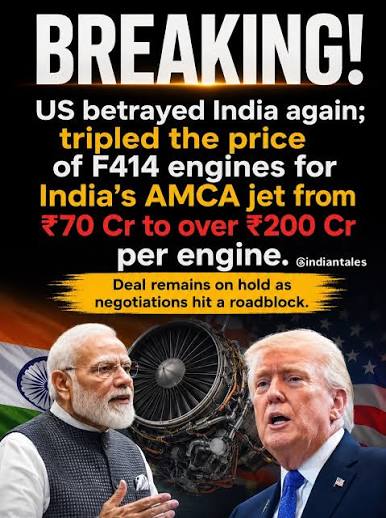
India’s ambitious journey toward developing a fifth-generation stealth fighter aircraft has encountered a significant challenge. Reports indicate that negotiations between India and the United States over the supply of GE F414 jet engines for the Advanced Medium Combat Aircraft (AMCA) program have hit a roadblock due to disagreements over pricing and technology transfer.
According to reports, the proposed cost of each F414 engine has increased substantially compared to earlier estimates, leading to fresh concerns about the future of one of India’s most important indigenous defence projects. While official negotiations are still ongoing and no final agreement has been announced, the issue has sparked widespread discussion among defence experts and policymakers.
Understanding the AMCA Project
The Advanced Medium Combat Aircraft (AMCA) is India’s flagship indigenous fifth-generation fighter jet program being developed by the Aeronautical Development Agency (ADA) in collaboration with Hindustan Aeronautics Limited (HAL).
The aircraft is expected to feature:
- Stealth technology
- Internal weapons bays
- Supercruise capability
- Advanced electronic warfare systems
- AI-assisted mission management
- Next-generation avionics
- Multi-role combat capabilities
The AMCA is considered one of India’s most strategic defence projects and is expected to strengthen the Indian Air Force’s capabilities while reducing dependence on imported fighter aircraft.
Why the F414 Engine Is Important
An aircraft engine is often regarded as the heart of a fighter jet. For the initial AMCA variants, India plans to use the General Electric F414 turbofan engine, which has already proven its reliability in several advanced combat aircraft worldwide.
The F414 offers:
- High thrust performance
- Better fuel efficiency
- Proven combat reliability
- Compatibility with modern fighter aircraft
- Enhanced operational flexibility
Because developing a completely indigenous fighter engine takes many years, the F414 serves as an important bridge until India develops its own next-generation powerplant.
The Pricing Dispute
Recent reports suggest that negotiations have become complicated due to concerns over the cost of the engines. Some reports claim the proposed price per engine is significantly higher than earlier expectations, leading India to seek clarification and better commercial terms.
In addition to pricing, discussions reportedly involve:
- Technology transfer
- Local manufacturing
- Intellectual property rights
- Long-term maintenance support
- Future production partnerships
At present, both governments continue discussions, and no official confirmation has been issued regarding a final contract or pricing agreement.
Why Technology Transfer Matters
India’s long-term defence strategy focuses on self-reliance under the “Atmanirbhar Bharat” initiative.
Rather than simply purchasing engines, India seeks access to critical manufacturing technologies that would allow domestic industries to produce, maintain, and eventually improve advanced jet engines independently.
Technology transfer would help India:
- Reduce future import dependence
- Strengthen indigenous defence manufacturing
- Generate high-skilled employment
- Accelerate research and development
- Build long-term strategic capability
For any nation, advanced jet engine technology is among the most closely guarded defence technologies in the world.
Strategic Importance for India
The AMCA program is expected to become the backbone of India’s future air combat capabilities.
Its successful development could provide:
- Enhanced national security
- Greater operational flexibility
- Reduced dependence on foreign suppliers
- Increased defence exports
- Growth of India’s aerospace industry
Delays in engine procurement could affect development timelines, making negotiations particularly significant for the project’s future.
India’s Alternative Options
If negotiations become prolonged, India has several possible paths forward.
These may include:
- Continuing negotiations with General Electric.
- Accelerating indigenous engine development under the GTRE program.
- Exploring partnerships with other global engine manufacturers.
- Developing a completely new indigenous engine for future AMCA variants.
However, each alternative involves technical, financial, and strategic challenges that require careful evaluation.
Defence Cooperation Between India and the US
Despite the current disagreement, India and the United States have significantly strengthened their defence partnership over the past decade.
The two countries cooperate in areas such as:
- Defence technology
- Joint military exercises
- Intelligence sharing
- Maritime security
- Defence manufacturing
- Indo-Pacific strategic cooperation
Experts believe both nations have strong incentives to reach a mutually beneficial agreement, given the broader strategic relationship.
What Happens Next?
Negotiations between governments and defence manufacturers often involve complex discussions on pricing, production rights, technology sharing, and long-term support.
While reports indicate that talks have reached a temporary roadblock, negotiations remain ongoing. Both sides are expected to continue discussions to find a solution that addresses India’s operational requirements while protecting commercial and strategic interests.
The final outcome could significantly influence not only the AMCA program but also future India-US defence collaborations.
Conclusion
The reported pricing dispute over the GE F414 engines highlights the complexities involved in modern defence procurement. For India, the issue extends beyond the cost of engines—it is about securing advanced technology, strengthening domestic manufacturing, and ensuring long-term strategic independence.
As negotiations continue, the AMCA remains one of India’s most ambitious defence initiatives. Whether through successful international cooperation or accelerated indigenous innovation, the project’s ultimate goal remains the same: building a world-class fifth-generation fighter aircraft capable of safeguarding India’s future security.