Mumbai, June 24, 2026: Indian financial markets are navigating a period of heightened uncertainty as investors assess the Reserve Bank of India’s latest economic projections, global market developments, and concerns surrounding inflation and economic growth. While the country’s long-term growth story remains intact, recent market movements reflect caution among investors amid evolving domestic and international risks.
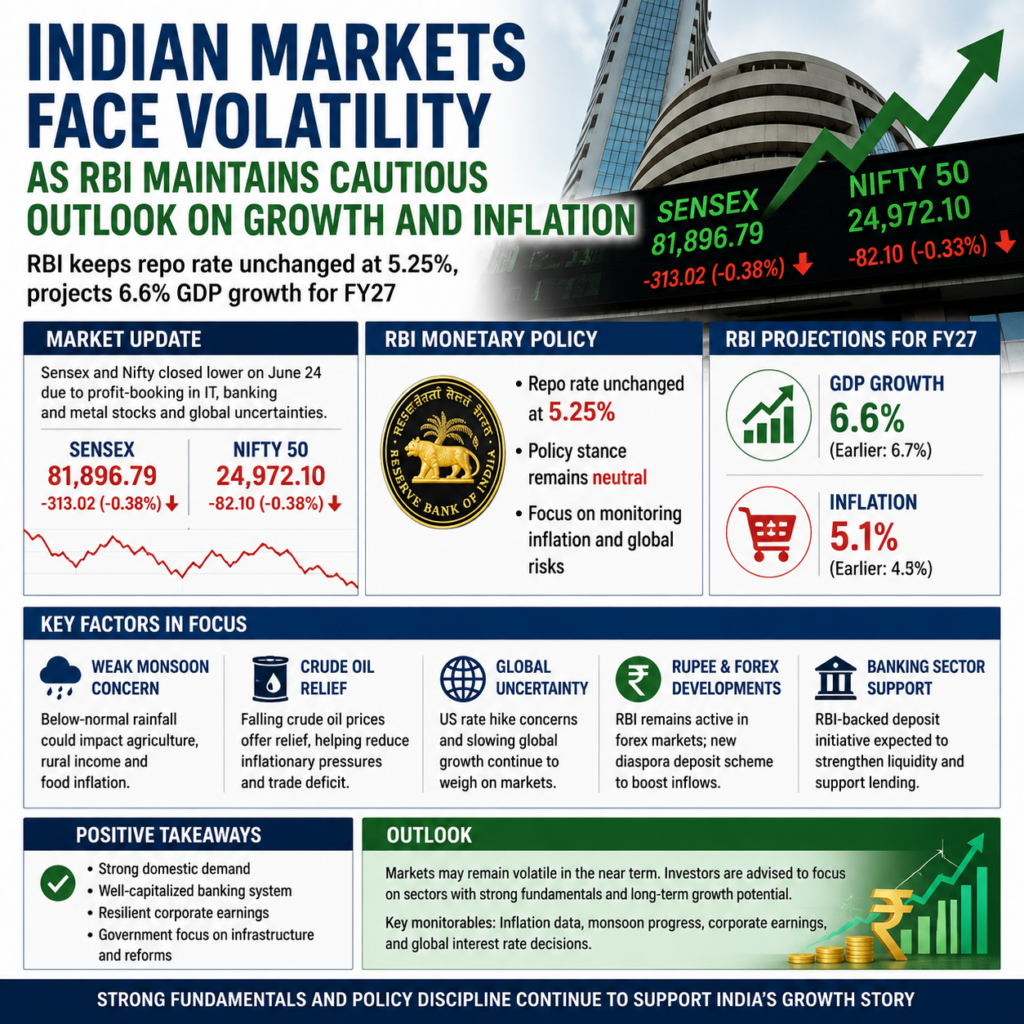
The benchmark indices, Sensex and Nifty 50, witnessed increased volatility this week as market participants reacted to signals from the Reserve Bank of India (RBI) and developments in global financial markets. On Tuesday, the Sensex closed lower while the Nifty also ended in negative territory, largely due to profit-booking in information technology, banking, and metal stocks. Analysts attributed the decline to concerns over potential U.S. interest rate hikes and a cautious outlook from global investors.
At the center of investor attention is the RBI’s latest monetary policy stance. The central bank decided to keep the repo rate unchanged at 5.25 percent, maintaining its neutral policy stance while emphasizing the need to monitor inflationary pressures and global uncertainties. RBI Governor Sanjay Malhotra highlighted that while inflation has moderated compared to previous years, several risks continue to warrant caution, including geopolitical tensions, energy prices, and weather-related disruptions.
The RBI has projected India’s GDP growth for FY2026-27 at 6.6 percent, slightly lower than earlier estimates. At the same time, the central bank revised its inflation forecast upward to 5.1 percent, reflecting concerns about rising commodity prices and the possibility of a weaker monsoon season affecting food supplies. These revised projections have influenced investor sentiment, as markets attempt to balance growth opportunities with inflation-related risks.
A significant concern for policymakers is the performance of the monsoon season. Agriculture remains a key pillar of India’s economy, and any prolonged rainfall deficit could affect crop production, rural incomes, and food inflation. The RBI has identified weak monsoon conditions as one of the major domestic risks that could impact economic stability in the coming months.
Despite these challenges, several positive factors continue to support the Indian economy. Retail inflation remains below historical peaks, the banking system remains well-capitalized, and corporate earnings have shown resilience across multiple sectors. Economists believe India’s strong domestic consumption and infrastructure spending will continue to provide a foundation for economic growth even as external conditions remain uncertain.
The foreign exchange market has also attracted attention in recent weeks. According to RBI data, the central bank remained an active participant in currency markets, selling U.S. dollars to support the rupee amid external pressures. Policymakers are working to ensure currency stability while maintaining adequate foreign exchange reserves.
Meanwhile, a new RBI-backed initiative aimed at attracting deposits from overseas Indians is expected to strengthen capital inflows and support the rupee. Analysts estimate that the scheme could bring billions of dollars into the Indian financial system over the coming years, improving liquidity and helping reduce borrowing costs. Banking stocks have responded positively to expectations that lenders could benefit from increased deposits and stronger balance sheets.
Global developments continue to play an important role in shaping investor sentiment. Falling crude oil prices have provided some relief to India, one of the world’s largest oil importers. Lower energy costs can help reduce inflationary pressures and improve the country’s trade balance. However, uncertainty surrounding U.S. monetary policy and slowing global growth continue to create volatility across international markets.
Market experts believe investors should focus on sectors with strong earnings visibility and long-term growth potential. Financial services, infrastructure, renewable energy, and select manufacturing industries are expected to remain key drivers of economic expansion. Government investments in infrastructure projects and continued digital transformation initiatives are also expected to create new opportunities for businesses and investors alike.
Looking ahead, market participants will closely monitor inflation data, monsoon progress, corporate earnings, and global interest rate decisions. While short-term volatility may persist, many analysts remain optimistic about India’s medium-term economic prospects, citing strong domestic demand, favorable demographics, and ongoing structural reforms.
As India navigates a complex global environment, the focus remains on maintaining economic stability while sustaining growth. The coming months will be crucial in determining whether the economy can successfully balance inflation control, currency stability, and investment-driven expansion. For investors and businesses alike, adaptability and careful risk management are likely to remain the defining themes of 2026.