
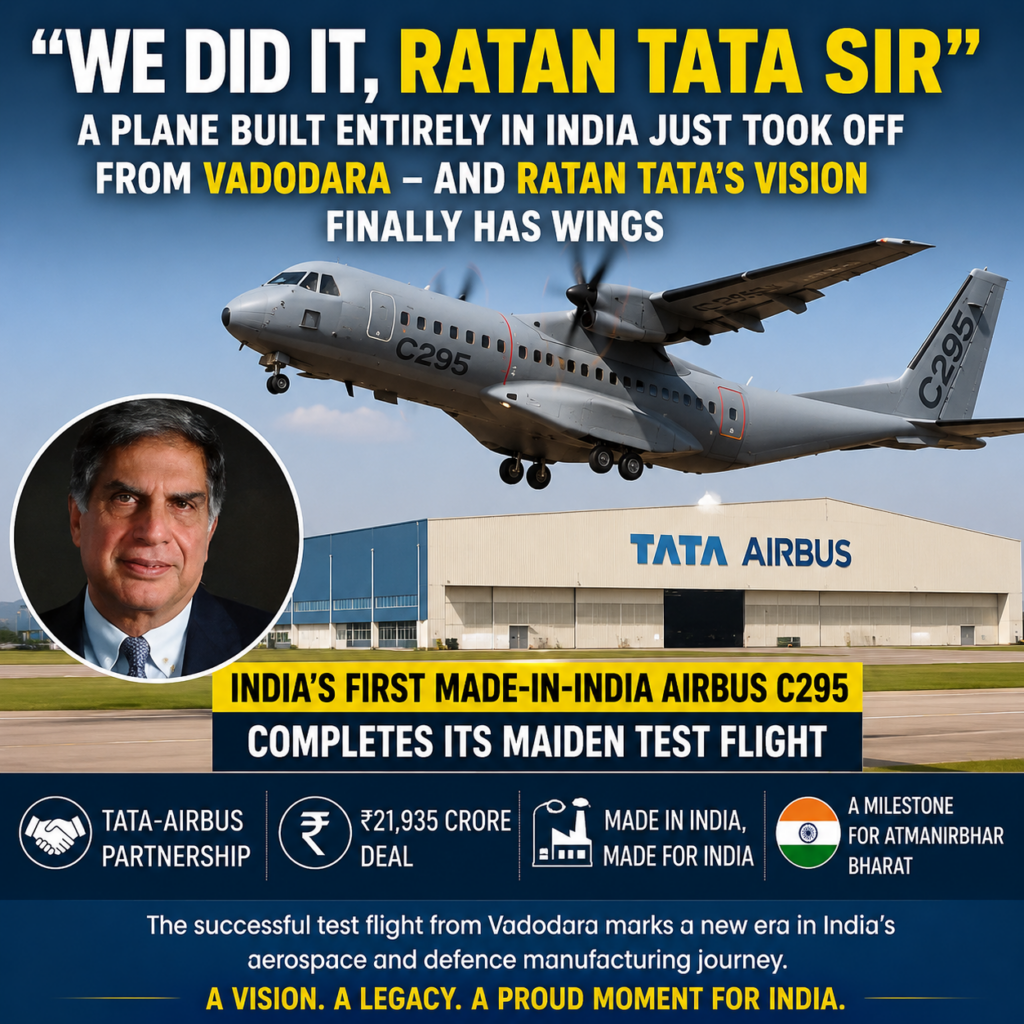
India’s journey toward becoming a global aerospace manufacturing hub achieved a historic milestone as the first Made-in-India Airbus C295 military transport aircraft successfully completed its maiden test flight from Vadodara, Gujarat. The achievement represents a significant step in India’s defense manufacturing ambitions and fulfills a vision strongly supported by the late industrialist Ratan Tata, who believed India could become a world-class producer of advanced aerospace technology.
The successful flight is being celebrated as a landmark moment for the country’s aviation and defense sectors, demonstrating India’s growing capabilities in high-end aircraft manufacturing.
A Historic Achievement for Indian Aerospace
The C295 aircraft is being manufactured under the landmark ₹21,935 crore Tata-Airbus agreement signed with the Government of India. The project aims to replace the Indian Air Force’s aging fleet of Avro transport aircraft while simultaneously boosting domestic defense production.
While Airbus has already delivered several aircraft manufactured in Spain, the long-term goal of the program has always been to establish a complete manufacturing ecosystem in India. The successful test flight from the Tata-Airbus facility in Vadodara signals that this objective is now becoming a reality.
The aircraft’s maiden flight validates the manufacturing processes, assembly systems, and engineering capabilities developed at India’s first private-sector military aircraft production facility.
Ratan Tata’s Vision Comes to Life
For decades, Ratan Tata advocated for India to move beyond simply importing advanced technology and instead become a producer of world-class engineering products.
His vision emphasized:
- Domestic manufacturing
- Technology transfer
- High-skilled job creation
- Global competitiveness
- Self-reliance in strategic sectors
The successful flight of the indigenous C295 assembly aircraft is widely being viewed as a realization of that vision.
Industry experts have noted that projects of this scale help India gain expertise in advanced manufacturing, aerostructures, avionics integration, quality control systems, and aerospace supply chains.
About the C295 Aircraft
The Airbus C295 is a versatile tactical military transport aircraft used by numerous air forces around the world.
Key capabilities include:
- Tactical troop transport
- Cargo transportation
- Medical evacuation missions
- Disaster relief operations
- Maritime surveillance
- Special operations support
The aircraft can operate from short and unprepared airstrips, making it highly suitable for India’s diverse geographical conditions, including mountainous regions and remote border areas.
Its reliability and operational flexibility have made it one of the most successful military transport platforms globally.
The Tata-Airbus Manufacturing Facility
The Vadodara manufacturing facility has attracted global attention because it represents India’s first private-sector final assembly line for military aircraft.
The facility includes:
- Aircraft assembly operations
- Structural component manufacturing
- Testing and validation systems
- Advanced quality-control infrastructure
- Specialized aerospace engineering units
The project has also encouraged the growth of a wider aerospace ecosystem involving hundreds of Indian suppliers and small manufacturers.
Industry analysts believe this network could become a foundation for future aerospace exports from India.
Boost to “Make in India”
The successful flight aligns closely with the Government of India’s “Make in India” and “Aatmanirbhar Bharat” initiatives.
The project is expected to:
- Reduce dependence on imported defense equipment
- Increase indigenous manufacturing capabilities
- Create thousands of skilled jobs
- Strengthen India’s aerospace supply chain
- Encourage foreign investment in advanced manufacturing
Experts say defense manufacturing can act as a catalyst for broader industrial growth by driving innovation and technological advancement.
Strategic Importance for India
Beyond economic benefits, the C295 program has significant strategic implications.
Modern military transport aircraft play a critical role in:
- Rapid deployment of troops
- Humanitarian assistance
- Disaster response
- Logistics support
- Border operations
With increasing security challenges and growing operational requirements, the Indian Air Force requires modern transport capabilities that can support missions across the country.
The C295 fleet is expected to become an important component of India’s military logistics network in the coming years.
Looking Ahead
The successful maiden test flight is only the beginning of a much larger journey. As production scales up, more aircraft will be assembled in India with increasing levels of indigenous participation.
Officials expect the project to strengthen India’s reputation as an emerging aerospace manufacturing destination and open opportunities for future collaborations in both military and civilian aviation.
For many observers, the sight of a C295 aircraft assembled in India taking to the skies is more than just a test flight—it is a symbol of the country’s technological progress and industrial ambition.
Conclusion
The maiden flight of India’s first locally manufactured Airbus C295 marks a turning point for the nation’s aerospace industry. Built under the Tata-Airbus partnership and inspired by the long-standing vision of Ratan Tata, the achievement showcases India’s growing capability to produce sophisticated aircraft domestically. As the program advances, it is expected to contribute significantly to defense modernization, economic growth, job creation, and India’s emergence as a global manufacturing powerhouse.