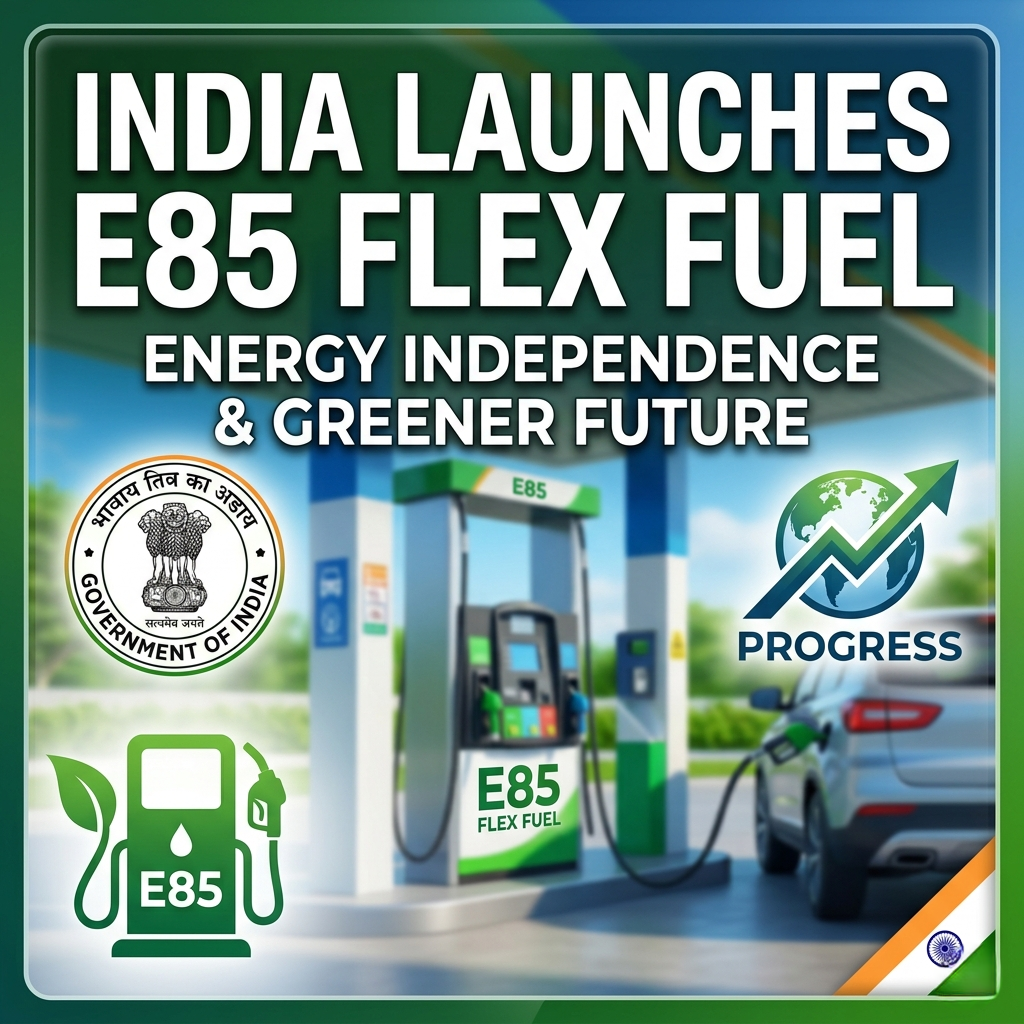
On World Environment Day, India marked a significant milestone in its journey toward sustainable transportation and energy security by launching E85 flex fuel, a fuel blend containing 85% ethanol and 15% petrol. The initiative is aimed at reducing the country’s dependence on imported crude oil, lowering carbon emissions, and creating new economic opportunities for India’s agricultural sector.
The launch represents another important chapter in India’s biofuel revolution and highlights the government’s commitment to cleaner energy solutions while balancing economic growth and environmental responsibility.
What is E85 Fuel?
E85 is a type of flex fuel that contains up to 85% ethanol mixed with 15% gasoline. Ethanol is a renewable biofuel primarily produced from agricultural feedstocks such as sugarcane, maize, damaged food grains, and other biomass materials.
Unlike conventional petrol, ethanol burns cleaner and produces fewer harmful emissions. Vehicles designed as flex-fuel vehicles (FFVs) can operate on varying combinations of petrol and ethanol, including E85.
Countries such as Brazil and the United States have successfully adopted high-ethanol fuel blends for years. India’s introduction of E85 is a major step toward joining these global leaders in renewable transportation fuels.
Why India Needs E85 Fuel
India is one of the world’s largest consumers of petroleum products. However, a significant portion of the country’s crude oil requirements is imported from abroad.
This dependence creates several challenges:
- High import bills that affect the economy.
- Vulnerability to global oil price fluctuations.
- Increased pressure on foreign exchange reserves.
- Environmental concerns due to fossil fuel consumption.
By promoting ethanol-based fuels such as E85, India aims to reduce its reliance on imported crude oil while strengthening domestic energy production.
The government has repeatedly emphasized the importance of achieving greater energy self-reliance, and E85 fuel aligns perfectly with this long-term vision.
Environmental Benefits of E85
One of the biggest advantages of E85 fuel is its potential environmental impact.
1. Reduced Carbon Emissions
Ethanol is produced from plant-based sources that absorb carbon dioxide during growth. As a result, ethanol fuels generally have a lower carbon footprint compared to conventional fossil fuels.
Using E85 can significantly reduce greenhouse gas emissions and contribute to India’s climate goals.
2. Cleaner Air Quality
Vehicles running on higher ethanol blends typically emit lower levels of harmful pollutants such as carbon monoxide and particulate matter.
Cleaner emissions can improve urban air quality and support public health initiatives.
3. Support for Climate Commitments
India has pledged ambitious climate targets under international agreements. Expanding the use of biofuels helps the nation move closer to achieving these commitments while maintaining transportation growth.
Economic Benefits for India
The impact of E85 extends beyond environmental sustainability.
Strengthening Farmers’ Income
Ethanol production creates additional demand for agricultural products such as sugarcane and maize. This can provide farmers with new revenue opportunities and more stable markets for their crops.
The biofuel industry can become an important pillar of rural economic development.
Reducing Crude Oil Import Bills
India spends billions of dollars annually on crude oil imports. Even a modest reduction in petroleum consumption can generate significant savings.
Lower import dependence improves energy security and helps protect the economy from global supply disruptions.
Job Creation
The expansion of ethanol production facilities, logistics networks, storage infrastructure, and fuel distribution systems can generate employment across multiple sectors.
From agriculture to manufacturing and transportation, the biofuel ecosystem has the potential to create thousands of new jobs.
The Role of Flex-Fuel Vehicles
The success of E85 fuel depends heavily on the availability of flex-fuel vehicles.
Unlike standard petrol vehicles, flex-fuel vehicles are specifically engineered to handle high ethanol concentrations. Their fuel systems, engine components, and software are designed to adapt to different ethanol-petrol blends.
Several automobile manufacturers are already exploring or introducing flex-fuel technologies in India. As vehicle availability increases, consumer adoption of E85 is expected to grow.
Industry experts believe that widespread deployment of flex-fuel vehicles could accelerate India’s transition toward cleaner transportation.
Challenges Ahead
While the launch of E85 is an important achievement, certain challenges must still be addressed.
Infrastructure Development
Fuel stations need dedicated storage and dispensing systems for E85 fuel. Expanding nationwide availability will require substantial investment.
Vehicle Compatibility
Most vehicles currently on Indian roads are not designed for E85 usage. Increasing the number of flex-fuel vehicles will be essential for large-scale adoption.
Sustainable Feedstock Supply
As ethanol demand rises, policymakers must ensure that fuel production does not negatively affect food security or agricultural sustainability.
Balanced planning will be necessary to maintain long-term success.
A Vision for a Greener India
The launch of E85 fuel demonstrates India’s commitment to innovation, sustainability, and energy independence. By leveraging its strong agricultural base and growing technological capabilities, the country is creating a pathway toward cleaner mobility and reduced fossil fuel dependence.
As ethanol production expands and flex-fuel vehicles become more common, E85 could play a transformative role in India’s transportation landscape. The initiative not only supports environmental goals but also strengthens rural economies, enhances energy security, and reduces the burden of crude oil imports.
World Environment Day provided the perfect platform for this announcement, symbolizing India’s determination to build a greener and more self-reliant future. While challenges remain, the introduction of E85 fuel is a promising step toward a cleaner, more sustainable energy ecosystem—one that could benefit millions of citizens and position India as a global leader in renewable transportation fuels.
The launch of E85 is more than just a new fuel option; it is a strategic investment in India’s economic resilience, environmental responsibility, and energy future.