
Key Highlights
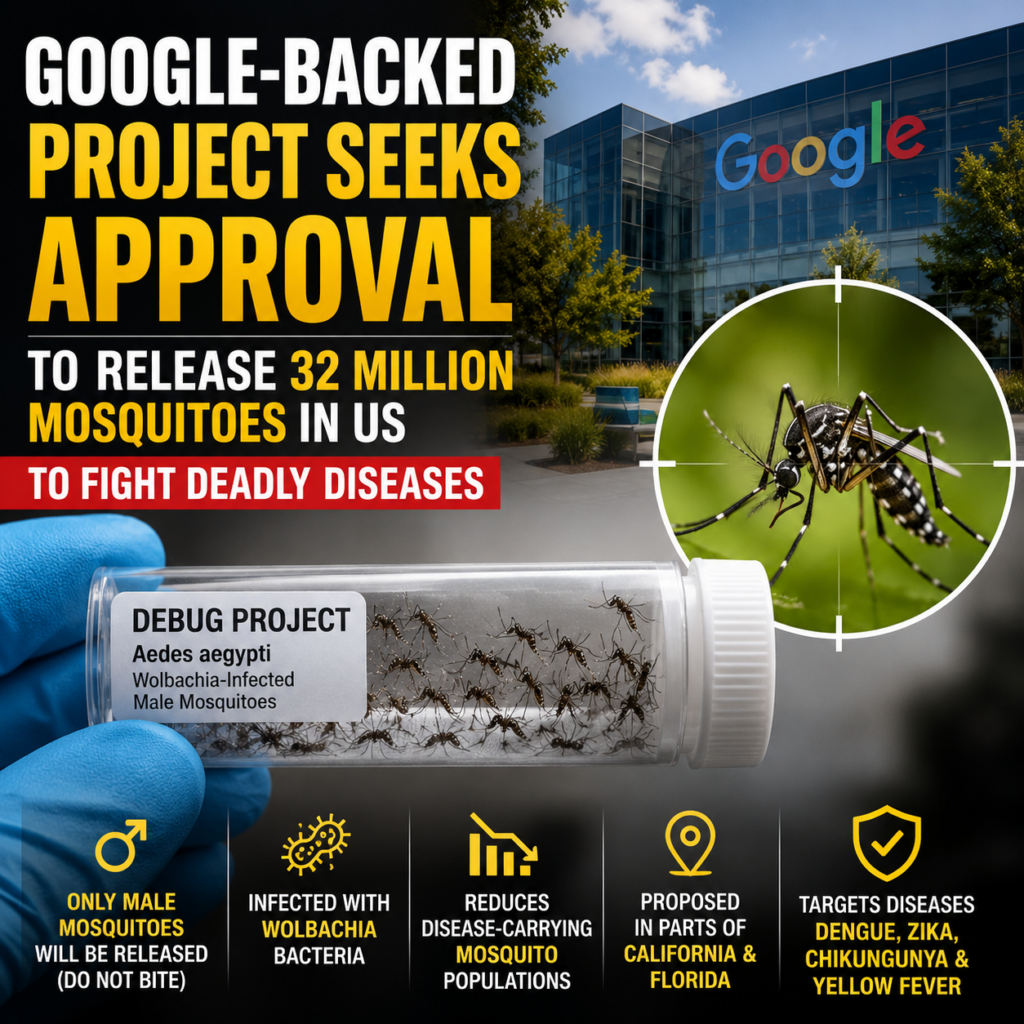
- Google-backed biotech company Verily is seeking approval to release up to 32 million mosquitoes.
- The project aims to reduce populations of disease-carrying mosquitoes.
- Releases are planned in parts of California and Florida.
- Only specially treated male mosquitoes would be released.
- The mosquitoes carry naturally occurring Wolbachia bacteria.
- Scientists say the approach is designed to reduce dengue, Zika, yellow fever, and chikungunya risks.
Why Is Google Involved?
The viral social media posts claiming that Google wants to release “millions of mosquitoes” are based on a real biotechnology initiative backed by Alphabet, Google’s parent company.
The project is operated through Verily Life Sciences, Alphabet’s health technology division, under a program known as the Debug Project.
Its goal is not to increase mosquito populations but to reduce the number of dangerous mosquitoes that spread serious diseases.
What Exactly Is Being Proposed?
According to reports, Verily has requested regulatory approval to release approximately 32 million specially treated male Aedes aegypti mosquitoes in selected regions.
Proposed Locations
- California
- Florida
Duration
- Multi-year mosquito control program
- Subject to regulatory approval
The mosquito species involved is known for spreading several dangerous viral diseases worldwide.
How Does the Technology Work?
The project uses a biological population-control method involving a naturally occurring bacterium called Wolbachia.
Process
- Male mosquitoes are bred in controlled laboratory conditions.
- They are infected with Wolbachia bacteria.
- These males are released into the environment.
- When they mate with wild female mosquitoes:
- Eggs fail to hatch.
- Mosquito populations gradually decline.
Important Fact
✓ Male mosquitoes do not bite humans.
✓ They do not spread diseases through bites.
Scientists specifically release males because they feed primarily on plant nectar.
Diseases the Project Targets
The Aedes aegypti mosquito is responsible for transmitting several dangerous illnesses.
Major Diseases
- Dengue Fever
- Zika Virus
- Chikungunya
- Yellow Fever
Public health experts consider this mosquito one of the most problematic disease carriers globally.
Why Are Scientists Interested?
Traditional mosquito-control methods often rely on:
- Chemical insecticides
- Spraying campaigns
- Larvicide treatments
However, mosquitoes can develop resistance to chemicals over time.
Researchers believe biological approaches like Wolbachia-based control may offer a more targeted and environmentally sustainable solution.
Public Concerns and Criticism
The proposal has generated debate online.
Common Concerns
- Ecological impact on local environments
- Long-term effects on ecosystems
- Regulatory oversight
- Transparency regarding large-scale insect releases
Some social media users incorrectly interpreted the proposal as an attempt to increase mosquito populations.
Scientists involved in the project say the objective is exactly the opposite: reducing populations of disease-spreading mosquitoes.
What Is the Current Status?
The project is currently undergoing regulatory review.
Current Situation
- Approval has not been fully finalized.
- Environmental assessments are being considered.
- Releases can only proceed after required permissions are granted.
Officials will evaluate potential environmental and public health impacts before large-scale deployment.
The Bigger Picture
Mosquito-borne diseases affect hundreds of millions of people globally every year.
As governments and researchers search for new solutions, biotechnology-based mosquito control programs are becoming increasingly common.
The Google-backed Verily project represents one of the largest attempts to use biological population suppression technology in the United States.
While supporters see it as a promising public-health tool, critics argue that careful oversight is necessary before millions of modified mosquitoes are released into the environment.
For now, the proposal remains under review, but it has already sparked a major discussion about the future of disease control, biotechnology, and environmental safety.