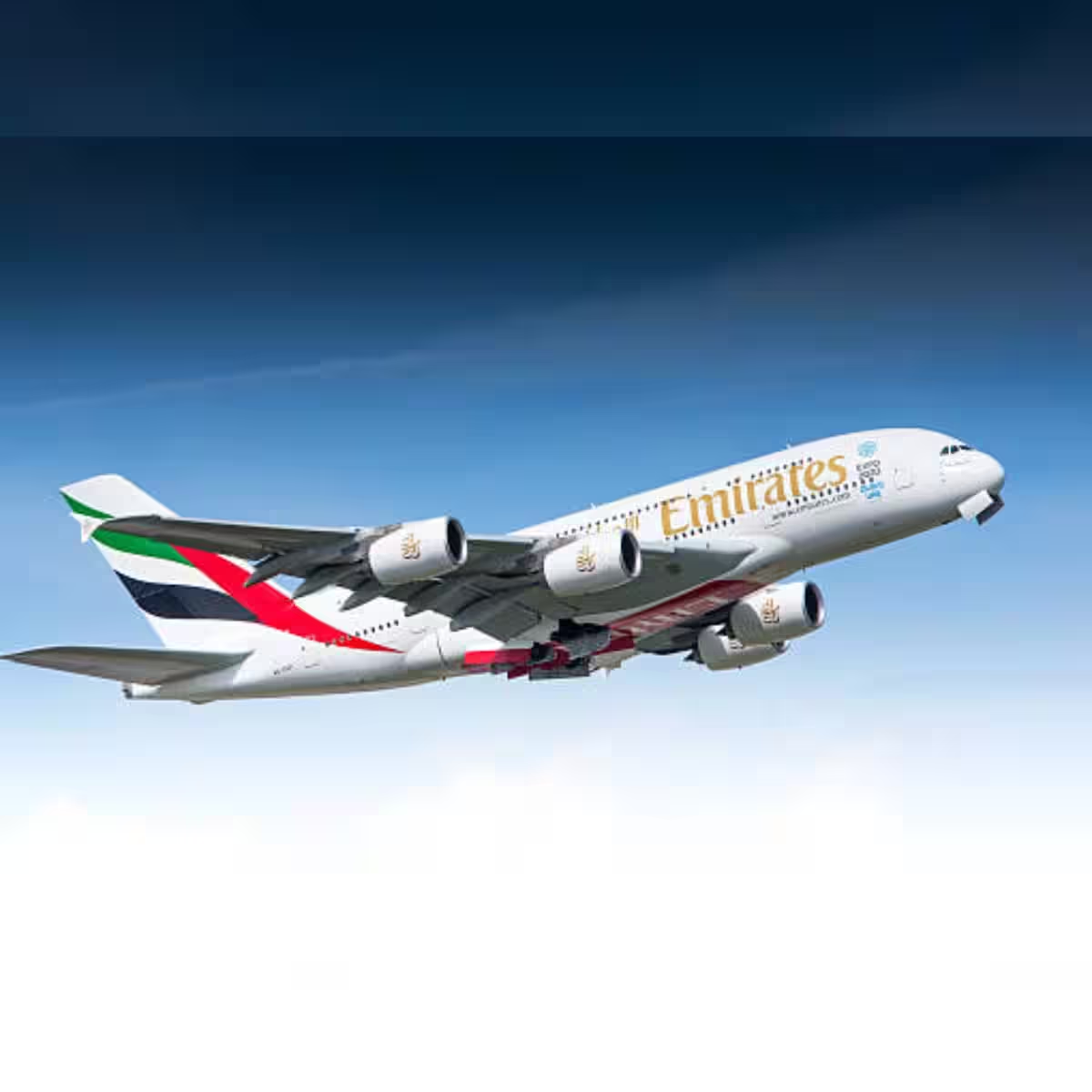
The world’s largest passenger aircraft has added another major Indian city to its growing network. Emirates has officially introduced its iconic Airbus A380 on the Dubai–Delhi route, bringing the double-decker superjumbo to India’s capital and expanding its presence in the country’s aviation market. The service commenced on October 25, 2026, making Delhi the third Indian destination served by Emirates’ A380, after Mumbai and Bengaluru.
The development is significant for India’s international aviation sector, particularly as airlines continue to increase capacity on high-demand international routes. With its enormous passenger capacity, premium onboard facilities and distinctive two-deck design, the Airbus A380 remains one of the most recognisable aircraft in commercial aviation.
Emirates Begins Daily Airbus A380 Operations to Delhi
Emirates introduced its Airbus A380 on the Dubai–Delhi route from October 25, 2026. The aircraft operates flight numbers EK512 and EK513, connecting Dubai International Airport with Indira Gandhi International Airport in New Delhi.
The introduction of the superjumbo is part of Emirates’ wider expansion and aircraft-upgrade strategy in India. The airline already operates four daily flights between Delhi and Dubai. With the latest development, one daily service is operated by the Airbus A380, while the remaining three continue using refurbished Boeing 777 aircraft.
Importantly, the A380 operating on this route features a four-class configuration consisting of First Class, Business Class, Premium Economy and Economy Class.
The aircraft brings additional passenger capacity and a wider selection of cabin experiences to one of the busiest international aviation corridors connecting India and the Middle East.
Only Three Indian Cities in Emirates’ A380 Network
With Delhi joining the network, three Indian cities are now served by Emirates’ Airbus A380 aircraft.
1. Mumbai
Mumbai was among the first Indian destinations to receive Emirates’ A380 services. As India’s financial capital and a major international aviation gateway, Mumbai has strong passenger demand from business travellers, tourists and international visitors.
The Dubai–Mumbai connection is particularly important because Dubai serves as a major connecting hub for passengers travelling between India, Europe, Africa and other international destinations.
2. Bengaluru
Bengaluru is the second major Indian destination in Emirates’ A380 network. The city is an important technology and business centre, attracting substantial international passenger traffic.
Its growing IT industry, international business connections and demand for overseas travel make it an important market for Emirates.
3. Delhi
Delhi is the latest addition, becoming the third Indian destination for Emirates’ A380 operations from October 25, 2026.
The capital is one of India’s busiest international aviation hubs, connecting millions of passengers to destinations worldwide. The introduction of the A380 provides additional capacity and brings Emirates’ flagship four-class aircraft experience to travellers using the Dubai–Delhi route.
It is important to note that these three destinations refer specifically to Emirates’ A380 network in India, rather than every international airline operating the aircraft in the country.
Inside the Airbus A380: What Makes It Special?
The Airbus A380 is widely recognised as the world’s largest passenger aircraft. Developed by European aircraft manufacturer Airbus, it was designed to accommodate large numbers of passengers while providing a spacious and premium travel experience.
The aircraft entered commercial service in October 2007, with Singapore Airlines becoming its launch operator.
One of its biggest distinguishing features is its full-length double-decker design. Unlike conventional passenger aircraft, the A380 has two passenger decks extending along almost the entire length of the fuselage.
Its enormous size allows airlines to accommodate hundreds of passengers in different cabin configurations. Depending on the airline’s layout, the aircraft can carry more than 500 passengers, while its certified maximum capacity is 853 passengers in an all-Economy configuration.
The aircraft also features four powerful engines, an extensive wing design and advanced flight systems that enable it to operate long-distance international routes.
Despite Airbus ending A380 production in 2021, several major international airlines continue operating the aircraft because of its passenger capacity and popularity on high-demand routes.
Four-Class Configuration and Premium Onboard Experience
One of the biggest attractions of Emirates’ Delhi A380 service is its four-class cabin arrangement.
First Class: Emirates’ First Class offers an exclusive travel experience with private suites, premium dining and personalised onboard service. Selected A380 aircraft also feature the airline’s famous shower spa facilities for First Class passengers.
Business Class: Business Class passengers enjoy spacious lie-flat seats, premium dining and access to the aircraft’s famous onboard lounge on equipped A380 configurations.
Premium Economy: This is one of the important additions to the Delhi route. Emirates’ Premium Economy cabin features cream-coloured leather seats, additional legroom, greater recline, adjustable headrests and enhanced dining served on chinaware.
The cabin is designed to provide a more comfortable experience than standard Economy without the price of Business Class.
Economy Class: Economy passengers receive comfortable seating, onboard meals and access to Emirates’ inflight entertainment system, known as ice. The entertainment platform offers thousands of channels, including movies, television programmes, music and content in multiple languages.
The A380’s upper deck also contributes to its distinctive passenger experience, with premium cabins and onboard facilities that make it different from conventional wide-body aircraft.
Why Is Delhi an Important Destination for the A380?
Delhi’s addition to the A380 network reflects the growing importance of India’s international aviation market.
The city serves as a major gateway for passengers travelling between India and the Middle East, Europe, North America and Africa. Dubai, in particular, is an important international connecting hub for Indian travellers.
A high-capacity aircraft such as the A380 allows Emirates to accommodate more passengers on a single flight, making it suitable for routes with consistently strong travel demand.
The aircraft upgrade also gives passengers more opportunities to experience Premium Economy and Emirates’ flagship onboard facilities.
Alongside Delhi, Emirates is expanding Premium Economy availability across several Indian cities, including Mumbai, Ahmedabad, Bengaluru, Kolkata and Kochi.
By the end of October 2026, the airline plans to make Premium Economy available across six Indian gateways.
Emirates’ Other Aircraft Upgrades in India
The A380 introduction is not the only major aircraft development announced by Emirates for its Indian operations.
From October 25, 2026, the airline has also introduced its next-generation Airbus A350 on the daily Dubai–Kolkata service, replacing the Boeing 777 on that particular flight.
The A350 features a modern cabin environment and Premium Economy, offering another upgraded travel option for passengers.
Emirates continues to operate services connecting nine Indian cities: Ahmedabad, Bengaluru, Chennai, Delhi, Hyderabad, Kochi, Kolkata, Mumbai and Thiruvananthapuram.
The airline operates 167 weekly flights between India and Dubai, connecting Indian passengers to its wider international network.
What Does the Future Hold for the Airbus A380?
Although Airbus officially ended A380 production in 2021, the aircraft continues to play an important role in international aviation.
Airlines such as Emirates, Singapore Airlines, British Airways, Lufthansa and Qantas continue operating their A380 fleets on selected high-demand international routes.
Emirates remains the largest A380 operator globally, making the aircraft a central part of its premium long-haul travel strategy.
The addition of Delhi demonstrates that the superjumbo still has an important role in markets where passenger demand can justify its large capacity.
For Indian aviation enthusiasts, the arrival of the Emirates A380 in Delhi is another exciting development. With Mumbai, Bengaluru and now Delhi forming Emirates’ three-city A380 network in India, passengers have more opportunities to experience one of the most iconic aircraft ever built.
The superjumbo’s continued presence also highlights how established aircraft designs can remain relevant even as the aviation industry moves towards newer and more fuel-efficient aircraft.