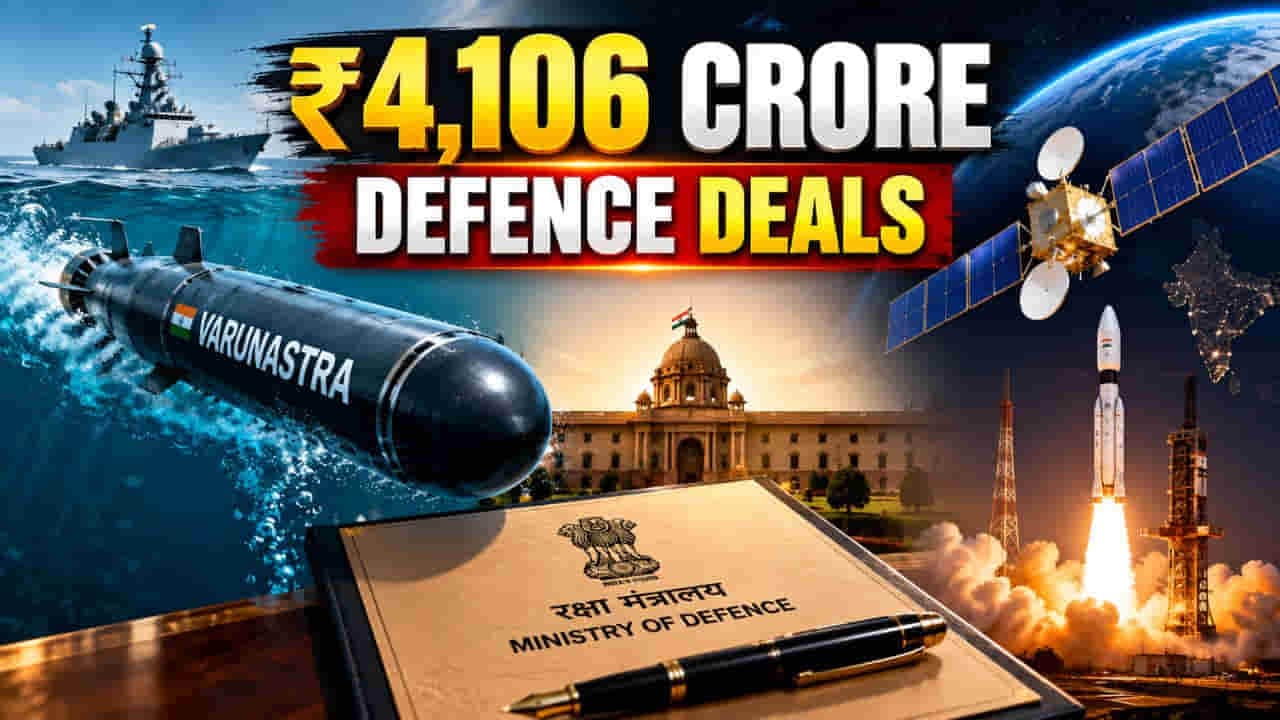
India has taken another significant step towards strengthening its national security after the Ministry of Defence signed two contracts worth a combined ₹4,106 crore on October 15, 2026. The agreements cover a dedicated GSAT-7C communication satellite for the Indian Air Force (IAF) and Varunastra heavyweight torpedoes for the Indian Navy. The acquisitions are aimed at improving secure military communications and strengthening India’s underwater warfare capabilities.
The latest contracts reflect India’s broader effort to modernise its armed forces while reducing dependence on foreign suppliers for strategically important defence technologies. As military operations increasingly rely on real-time information, secure communication networks and advanced underwater systems, both acquisitions address important requirements across India’s air and maritime security infrastructure.
GSAT-7C Satellite: Strengthening the Indian Air Force
The larger of the two contracts concerns GSAT-7C, a dedicated military communication satellite intended to enhance the Indian Air Force’s communication capabilities. Valued at ₹2,563 crore, the agreement was signed with NewSpace India Limited (NSIL), the commercial arm of the Indian Space Research Organisation (ISRO).
According to reports on the agreement, GSAT-7C is being developed to provide secure, resilient and seamless communication for IAF assets. Its purpose is to improve the ability of military units and platforms to exchange information across operational environments.
Military communication has become increasingly important as modern air forces coordinate fighter aircraft, surveillance platforms, radar installations, command centres and other assets. Reliable connectivity helps commanders share information, coordinate missions and make decisions more effectively.
Satellite communication can also support operations across large geographical areas where conventional ground-based communication infrastructure may be limited. A dedicated military satellite can therefore play an important role in maintaining connectivity between different elements of the armed forces.
The GSAT-7C programme is particularly significant because the IAF currently relies on the older GSAT-7A satellite for satellite-based communication. The new acquisition is intended to strengthen the service’s dedicated communication infrastructure as its operational requirements continue to evolve.
However, the contract announcement should not be confused with the satellite already being operational. Its eventual contribution will depend on development, launch, integration and the successful establishment of the required military communication services.
Why Military Satellite Communication Matters
Space-based communication has become an essential component of modern defence systems. Military forces need reliable channels to exchange information across aircraft, ground stations, command centres and other operational platforms.
Secure communication is especially important during situations involving electronic interference, long distances or rapidly changing operational conditions. A dedicated satellite network can help improve connectivity, although no communication system should be considered completely immune to disruption.
For the Indian Air Force, enhanced satellite communication could support better coordination between different units and strengthen the information infrastructure required for complex operations.
The GSAT-7C contract also highlights the growing relationship between India’s space and defence sectors. ISRO’s technical expertise and NSIL’s commercial role are important elements in developing and delivering space-based capabilities for national requirements.
As India continues to expand its space programme, military communication satellites are likely to remain an important part of discussions about defence preparedness, secure networks and strategic autonomy.
Varunastra Torpedoes: A Boost for the Indian Navy
The second contract, valued at ₹1,543 crore, covers Varunastra heavyweight torpedoes for the Indian Navy. The agreement was signed with Bharat Dynamics Limited (BDL), a defence public sector undertaking based in Hyderabad.
Varunastra is an indigenous ship-launched anti-submarine torpedo developed by the Naval Science and Technological Laboratory, a laboratory under the Defence Research and Development Organisation (DRDO).
The weapon is designed to engage hostile submarines and strengthen the Navy’s anti-submarine warfare capabilities. Submarines can pose significant challenges to surface fleets because they operate underwater and can be difficult to detect and track.
Anti-submarine warfare involves several interconnected capabilities, including underwater surveillance, sonar systems, maritime patrol aircraft, specialised helicopters, surface warships and weapons designed to counter underwater threats.
A heavyweight torpedo is one element of this wider system. Its effectiveness depends not only on the weapon itself but also on a platform’s ability to detect, classify and track a potential target before an engagement.
The acquisition of Varunastra torpedoes is therefore intended to strengthen the Navy’s underwater combat capabilities while supporting India’s domestic defence manufacturing ecosystem.
Why Underwater Security Is Becoming More Important
Maritime security extends beyond protecting warships. India depends heavily on the sea for international trade, energy supplies and access to major shipping routes. Protecting maritime approaches and maintaining awareness of underwater activity are consequently important national security priorities.
Submarines can conduct surveillance, threaten naval assets and complicate operations in strategically sensitive waters. Anti-submarine warfare capabilities help navies respond to these challenges and protect their surface forces.
For India, the Indian Ocean region remains particularly important because of its commercial shipping routes, strategic geography and growing international maritime activity.
The Varunastra programme demonstrates how domestically developed weapons can contribute to this broader security requirement. Local development and production can also help build technical expertise, support manufacturing jobs and improve the ability to maintain important equipment within the country.
Nevertheless, the new contract alone does not establish how many torpedoes will be delivered at a particular time or how quickly the acquisition will change operational capabilities. Those outcomes depend on the contractual delivery schedule, integration and the Navy’s operational requirements.
India’s Push for Defence Self-Reliance
The two contracts form part of India’s wider push to strengthen domestic defence manufacturing under initiatives such as Atmanirbhar Bharat and Make in India.
For decades, India has relied on a combination of imported equipment, licensed production and indigenous development to meet its military requirements. Building domestic capabilities in critical technologies can reduce some external dependencies and give Indian companies greater opportunities to participate in advanced defence programmes.
The GSAT-7C agreement involves NSIL and India’s space technology ecosystem, while the Varunastra contract supports BDL and the indigenous research behind the weapon.
These projects also illustrate why defence modernisation is not limited to purchasing fighter aircraft, tanks or missiles. Communication infrastructure, sensors, electronic systems, underwater weapons and secure information networks are equally important parts of contemporary military capability.
At the same time, self-reliance requires sustained research investment, reliable manufacturing, quality control and long-term support. Signing a contract is an important step, but its full value is realised only when the equipment is delivered, integrated and successfully used.
What the ₹4,106 Crore Deals Mean for India’s Security
The combined contracts address two different but complementary areas of national defence. GSAT-7C is intended to strengthen the Indian Air Force’s communication infrastructure, while Varunastra torpedoes will support the Indian Navy’s anti-submarine warfare requirements.
Together, the acquisitions highlight the importance of secure connectivity and maritime preparedness in India’s military modernisation strategy.
The deals also demonstrate the continuing role of Indian public sector defence companies, research laboratories and space-sector organisations in developing strategic capabilities. Their performance will be important in determining whether domestic programmes can deliver equipment on schedule and meet demanding operational requirements.
Looking ahead, the key milestones will include progress in the satellite programme, successful integration of the communication system and delivery of the contracted torpedoes. These developments will provide a clearer picture of how the agreements translate into operational improvements.
Conclusion
India’s ₹4,106 crore defence contracts mark an important development in the modernisation of the country’s air and naval forces. The GSAT-7C communication satellite is intended to improve secure connectivity for the Indian Air Force, while Varunastra heavyweight torpedoes will strengthen the Indian Navy’s ability to counter underwater threats.
Beyond the immediate acquisitions, the agreements underline the growing importance of space-based military infrastructure, anti-submarine warfare and indigenous defence technology.
As India continues to invest in national security, the success of these programmes will depend on effective development, timely delivery, operational integration and sustained domestic manufacturing capabilities. Their progress will be worth watching as the country works to build a more technologically capable and self-reliant defence ecosystem.