
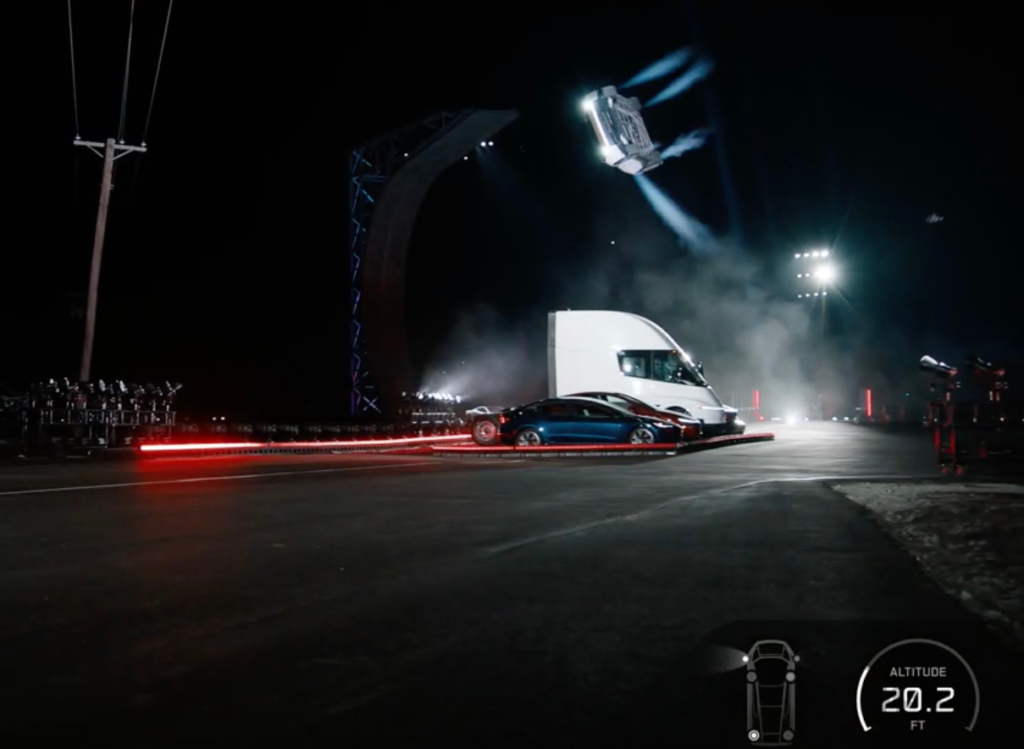
Tesla has finally unveiled its long-awaited second-generation Roadster, bringing one of the electric vehicle industry’s most ambitious projects back into the spotlight. Revealed on October 15, 2026, the new electric sports car features a redesigned exterior, advanced aerodynamics and experimental technology developed in collaboration with SpaceX. The unveiling also included demonstrations of the car performing airborne manoeuvres using rocket-style thrusters, making it one of Tesla’s most extraordinary vehicle presentations to date.
However, despite the spectacular demonstration, the new Roadster is not yet a production-ready car available for ordinary customers. Tesla has indicated that production is expected to begin in 2028, meaning buyers will have to wait longer before the vehicle reaches the market. The company has also made it clear that certain advanced features will be limited to specific versions and subject to regional laws.
Tesla Roadster 2: What Was Revealed?
The second-generation Tesla Roadster was originally introduced as a concept in November 2017. At the time, Tesla promised an electric supercar capable of delivering performance that could challenge some of the world’s fastest production vehicles. The project subsequently faced repeated delays, with its expected launch moving well beyond the original timeline.
The October 2026 unveiling finally provided a fresh look at the redesigned vehicle. The presentation took place at a SpaceX facility in McGregor, Texas, where Tesla demonstrated the Roadster’s unusual capabilities. According to reports, the car performed aerial manoeuvres using integrated cold-gas thrusters and demonstrated a system designed to generate powerful suction beneath the vehicle.
Tesla CEO Elon Musk has described the Roadster as a vehicle that pushes the boundaries of conventional automotive engineering. The project also highlights the potential for collaboration between Tesla’s electric vehicle technology and SpaceX’s aerospace expertise.
Nevertheless, the unveiling should be viewed as a demonstration of the company’s ambitions rather than proof that every showcased feature is ready for mass production.
SpaceX Thrusters: Can the Tesla Roadster Actually Fly?
One of the biggest talking points from the unveiling was the Roadster’s cold-gas thruster system. Developed with SpaceX technology, the system is intended to provide rapid bursts of thrust that can assist with vehicle movement and stabilisation.
During the demonstration, the Roadster appeared to lift off the ground, rotate in the air and land using its thruster system. These manoeuvres generated considerable attention because they went far beyond what is normally expected from an electric sports car.
Tesla’s official Roadster website describes different configurations, including a limited Thrust version and an invitation-only Rocket version. The latter is presented as the most extreme configuration, with additional thrusters intended to support forward, upward and rotational movement.
There is an important distinction between these configurations. The standard road-focused vehicle is not the same as the specialised Rocket version, and Tesla’s website explicitly states that the Rocket trim is not approved for public-road use.
The technology also raises practical questions about safety, certification, operating conditions and whether such capabilities can be offered to ordinary customers. Until the production specifications and regulatory approvals are finalised, the full real-world capabilities of the system remain uncertain.
Acceleration and Performance: Under One Second to 60 mph
Performance remains central to the Roadster’s identity. Tesla has promoted an acceleration target of less than one second from 0 to 60 mph for the thruster-equipped version, a claim highlighted during the October demonstration.
For context, 60 mph is approximately 96.6 km/h. Achieving that speed in under one second would be extraordinary for a road-going vehicle, although the precise testing conditions, configuration and measurement methodology matter when evaluating such a claim.
The vehicle’s different versions are designed to serve different purposes. The road-focused configuration prioritises high-performance driving, while the Thrust and Rocket configurations introduce additional hardware intended to deliver more extreme performance.
Tesla also highlights active aerodynamics and its multi-mode suction system as important parts of the Roadster’s engineering. These systems are designed to increase downforce and improve grip, potentially helping the car remain stable during high-speed driving and cornering.
However, final production performance figures should not be treated as confirmed until Tesla publishes complete specifications and independently verifiable testing results. Buyers should also distinguish between advertised targets, demonstrations and performance achieved by a final production vehicle.
Multi-Mode Suction System and Advanced Aerodynamics
Another unusual feature is the Roadster’s multi-mode fan and ground-sealing system. According to Tesla, this technology draws air from beneath the vehicle to generate suction, increasing the force pressing the car towards the driving surface.
Tesla has demonstrated the concept through an upside-down driving display on a specially designed ramp. The system is intended to create substantial downforce even when the vehicle is stationary, unlike conventional aerodynamic components that generally depend on airflow generated by forward movement.
The Roadster also incorporates active aerodynamic elements designed to adjust the balance between downforce and drag. In track-focused driving, additional downforce can improve grip, while lower-drag settings can help reduce aerodynamic resistance.
Although these features are technically ambitious, their practical effectiveness will depend on factors such as surface conditions, system reliability, energy consumption and the final vehicle’s design. The dramatic demonstration does not automatically establish that every function will be suitable for everyday public-road use.
Exterior Design and Interior Technology
The redesigned Roadster combines a minimalist sports-car appearance with styling influenced by aerospace engineering. Tesla’s official presentation highlights concealed headlights, a full-width rear light, flush-mounted aerodynamic elements and lightweight wheels.
The company has also showcased specialised exterior finishes and tinted glazing intended to reinforce the vehicle’s futuristic appearance. Its design philosophy places considerable emphasis on reducing unnecessary visual complexity while integrating aerodynamic components into the bodywork.
Inside, the Roadster features a minimalist cockpit with a central touchscreen and additional forward displays. Tesla describes the steering system as a next-generation steer-by-wire arrangement, designed to provide steering feedback across different driving conditions.
The company also highlights the use of lightweight materials, including carbon fibre, titanium and magnesium, to help control vehicle mass. Reducing weight is particularly important in a high-performance electric car because battery packs and supporting electrical systems can add substantial mass.
The final interior specifications, material availability and equipment differences between trims may change before production begins.
Battery Range, Top Speed and Charging
Range and maximum speed are among the most important questions for potential Roadster buyers. However, the redesigned vehicle’s latest configuration should not be confused with the original specifications Tesla announced in 2017.
Tesla’s Indian Roadster webpage has previously listed a projected range of 1,000 kilometres, a top speed above 400 km/h and a 0–100 km/h acceleration time of 2.1 seconds. Those figures belong to the earlier published specification set and should not automatically be assumed to describe the newly unveiled 2026 configurations.
The latest presentation has placed greater emphasis on the redesigned vehicle, SpaceX-inspired technology and its different performance versions. A complete, independently verified set of final production figures for battery capacity, real-world range, charging speed and top speed remains essential before customers can make an informed comparison.
As with any high-performance electric vehicle, actual range will depend on driving style, speed, temperature, road conditions and the use of energy-intensive performance systems. Buyers should wait for final homologated figures and detailed charging information rather than relying exclusively on promotional claims.
Tesla Roadster 2 Price and Reservations
Tesla is accepting reservations for the new Roadster, but the reservation process does not mean that customers can immediately purchase or take delivery of a finished vehicle.
The company has presented different configurations, including road-focused and performance-oriented versions, alongside an invitation-only Rocket trim. Each version is intended to offer a different balance between conventional driving and experimental performance technology.
Reported reservation deposits vary substantially by configuration. Prospective customers should consult Tesla’s official reservation page for the latest terms, payment requirements, regional availability and cancellation conditions. The final purchase price, taxes, delivery costs and equipment options may differ from early estimates.
Tesla’s reservation agreement also states that the vehicle remains under development and that a delivery date cannot be guaranteed. A reservation should therefore not be interpreted as a confirmed production slot with a guaranteed handover date.
For buyers in India, local availability, import duties, certification, road legality and service support are additional factors that could affect the eventual ownership experience.
Production Date: When Will the New Tesla Roadster Arrive?
Tesla has indicated that production of the second-generation Roadster is expected to begin in 2028. This is a significant update after years of delays, but it is not the same as a guaranteed customer-delivery date.
The programme’s history explains why caution is necessary. When Tesla first presented the new Roadster in 2017, the company outlined an ambitious timetable and performance targets. Subsequent delays repeatedly pushed the vehicle’s expected arrival further into the future.
The October 2026 unveiling has renewed interest in the project, but production readiness will depend on engineering development, manufacturing preparations, component availability and regulatory approval.
The Rocket configuration faces additional challenges because its proposed airborne capabilities raise questions beyond those associated with conventional sports cars. Its specialised hardware and stated lack of public-road approval also distinguish it from a normal production vehicle.
Until Tesla confirms production milestones and customer-delivery schedules, 2028 should be understood as the announced production target rather than a guaranteed date for every reservation holder.
Why the Tesla Roadster 2 Matters
The Roadster is more than another electric sports car for Tesla. It serves as a technology showcase, demonstrating how the company’s electric powertrain expertise could be combined with advanced aerodynamic systems and aerospace-inspired engineering.
It also gives Tesla a high-profile performance vehicle at a time when the company is increasingly emphasising autonomous driving technology, robotics and other future-oriented projects. The Roadster’s commercial impact may be limited compared with Tesla’s mass-market vehicles, but its value as a brand flagship could be significant.
At the same time, the project illustrates the challenges of turning ambitious demonstrations into practical products. A technology can look impressive at a launch event yet still require extensive development before it becomes reliable, affordable and legally usable.
The Roadster’s success will ultimately depend not only on acceleration records or dramatic stunts, but also on production quality, safety, durability, range, charging performance and whether customers receive the capabilities Tesla has promised.
Conclusion
The second-generation Tesla Roadster has finally moved into the spotlight with its October 15, 2026 unveiling. Its SpaceX-inspired cold-gas thrusters, experimental airborne manoeuvres, advanced suction system and ambitious acceleration claims make it one of the most unusual electric sports cars ever presented.
However, the most important distinction is between what Tesla has demonstrated, what it currently advertises and what will be available in the final production vehicle. With production targeted for 2028 and some of the most extreme capabilities restricted to a specialised configuration, several questions remain unanswered.
If Tesla can turn its ambitious engineering into a reliable, certified and production-ready vehicle, the Roadster could become a landmark in electric performance. Until then, it remains a highly anticipated project whose real-world capabilities and delivery timeline will need to be confirmed as development progresses.