
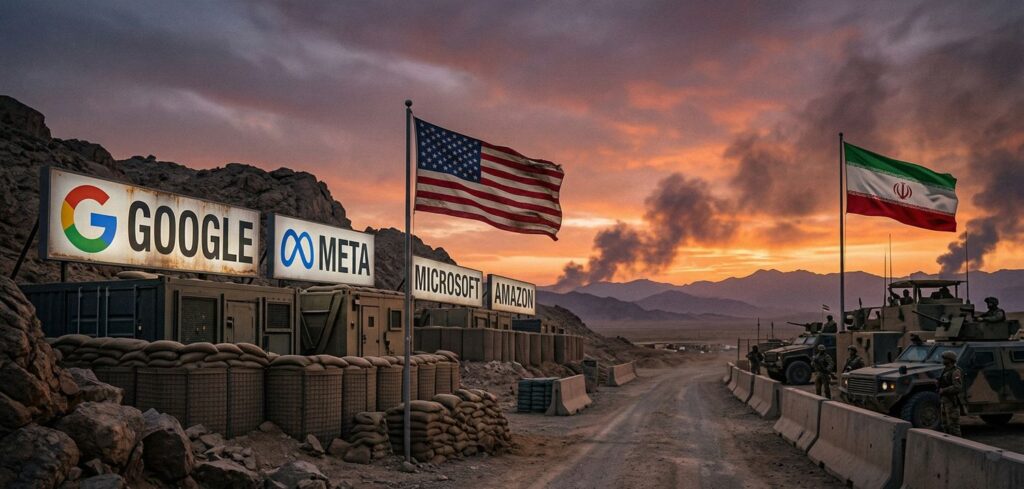
Tensions in the Middle East have reached a critical boiling point as Iran’s Islamic Revolutionary Guard Corps (IRGC) issues direct threats against major American technology corporations. Amidst this unprecedented cyber and physical threat to Silicon Valley’s infrastructure in the region, global trade remains heavily disrupted by the effective closure of the crucial Strait of Hormuz.
Big Tech in the Crosshairs
In a significant shift of military strategy, the IRGC has explicitly put 18 of the world’s largest American corporations on notice, designating them as “legitimate targets.” The hit list includes major tech and aerospace conglomerates such as Google, Meta, Microsoft, Apple, Tesla, Amazon, and Nvidia.
According to recent broadcast reports, this chilling warning states that the IRGC will begin targeting American companies operating in West Asia starting on the 1st of April. The IRGC cited retaliation for recent US and Israeli strikes, which allegedly damaged one of Iran’s largest pharmaceutical companies responsible for producing anesthetics and cancer-treatment drugs.
The scope of the threat has expanded beyond traditional military bases to encompass the technological infrastructure of the United States. Recent verified reports indicate that the IRGC accuses these tech and AI companies of enabling high-tech warfare and assisting in the tracking of targets for assassinations.
Key developments regarding the threat include:
- Evacuation Orders: The IRGC has issued dire warnings urging employees of these tech firms to evacuate their workplaces immediately. Furthermore, they have advised local residents living within a one-kilometer radius of these corporate data centers and offices to relocate to safer areas.
- Expanding Infrastructure Attacks: The technological warfare has already begun, with reports confirming that recent drone strikes have previously hit Amazon Web Services (AWS) data centers in the UAE and Bahrain.
- Waves of Retaliation: Iranian forces have declared that they have unleashed their 88th wave of successive missile and drone counterstrikes against American and Israeli targets throughout the region.
The Strait of Hormuz and Ceasefire Conditions
Parallel to the threats against the tech sector, the geopolitical standoff has severely impacted the Strait of Hormuz, a vital maritime chokepoint for global oil and gas supplies.
The strait has been effectively closed to normal commercial navigation for weeks. In response, Iran has attempted to divert commercial vessels into a heavily monitored “safe corridor” closer to its coastline—a move shipping analysts have dubbed “Tehran’s tollbooth,” allowing the IRGC to visually verify and control vessel movements.
Amidst these escalating tensions, US President Donald Trump recently stated that Iran has sought a ceasefire to the ongoing conflict. However, the US has laid down a strict ultimatum: any ceasefire negotiations or halts in the conflict will only be considered when the Strait of Hormuz is completely “open, free, and clear” for international shipping.
What Comes Next?
As the April 1st deadline set by the IRGC arrives, the international community remains on high alert. The dual crises—the looming threat to US cloud infrastructure and the gridlock in the Strait of Hormuz—highlight a dangerous new phase in the conflict, blending traditional territorial blockades with modern technological warfare.