Kyiv, October 7, 2026: Russia launched one of its heaviest recent waves of missile and drone attacks against Ukraine on Wednesday, killing at least 20 people, including children, and injuring around 50 others, according to Ukrainian officials and reporting by Reuters. The strikes hit several Ukrainian cities, damaged residential buildings and infrastructure, and once again pushed civilians into shelters as air-raid warnings spread across the country.
The attack came amid the continuing Russia-Ukraine war and included a large number of missiles and drones. Ukrainian President Volodymyr Zelenskyy described the assault as one of the most serious and “vile” strikes in recent months, while Russian authorities said their forces had carried out a large-scale attack against military-industrial facilities and other targets in Ukraine.
The latest escalation has renewed concerns over Ukraine’s air-defence capabilities, the security of civilians and the potential impact of continued attacks on the country’s energy and industrial infrastructure as the conflict enters another difficult phase.
Pryluky Suffers the Heaviest Losses
The northern Ukrainian city of Pryluky, in the Chernihiv region, suffered the heaviest reported casualties.
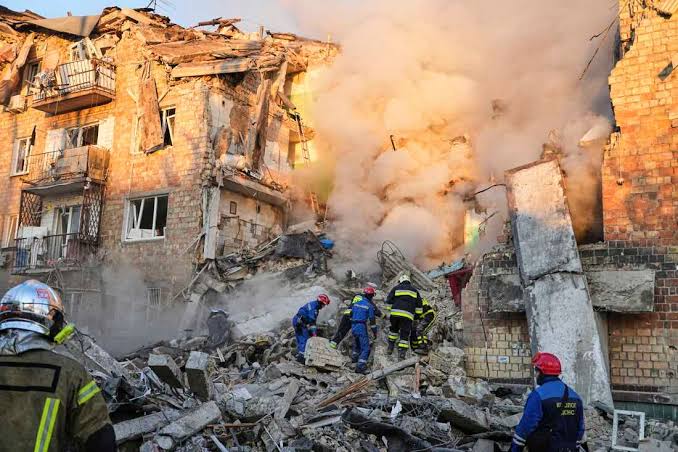
According to local officials cited by Reuters, a Russian missile destroyed a five-storey residential building in the city. At least 14 people, including four children, were reported killed there.
Emergency crews rushed to the site to search through the rubble and rescue survivors. Images from the aftermath showed rescuers working around the collapsed sections of the residential building, with heavy equipment and ladders being used to reach damaged parts of the structure.
The attack on the apartment building highlighted the continuing danger faced by civilians living in Ukrainian cities, where Russian missile and drone strikes have repeatedly damaged residential areas and essential infrastructure.
The overall death toll across Ukraine was reported at at least 20, while around 50 people were injured, including children. Officials warned that the casualty figures could change as emergency teams continued their work at damaged locations.
Kyiv Also Targeted
The Ukrainian capital Kyiv was among the areas hit during the overnight attack.
Residents were warned about incoming missiles and drones, and many people moved into the city’s underground metro stations for protection.
The metro system has frequently served as a shelter during major Russian attacks because some of its stations are located deep underground.
Several loud explosions were reported in Kyiv during the night. Ukrainian officials said ballistic missiles and drones were among the weapons used in the attack.
Six additional deaths were reported in Kyiv and other locations, including Oleksandria and Kremenchuk, according to Ukrainian officials.
The strikes also caused damage to industrial facilities and infrastructure in several parts of the country.
Russia Used Missiles and Large Numbers of Drones
The scale of the attack was significant.
President Zelenskyy said Russia had launched around 70 missiles, including ballistic missiles, along with drones.
Ukraine’s Air Force said it intercepted more than 80% of the 46 jet-powered drones launched during the attack.
That interception rate was notably higher than the average reported in recent weeks. Ukrainian officials said air defences had previously been intercepting roughly 50% to 60% of the jet-powered drones used in Russian attacks.
The changing pattern of Russian drone attacks has become a major concern for Ukraine.
Since the summer, Russia has increasingly used high-speed drones capable of flying at greater velocities. Their speed and changing attack patterns have created additional challenges for Ukrainian air-defence systems.
At the same time, Russia continues to use ballistic and cruise missiles, creating a combination of threats that can be difficult to intercept.
Damage Beyond Residential Areas
The latest strikes were not limited to residential buildings.
Ukrainian officials reported damage to industrial facilities, transport infrastructure and energy-related infrastructure in different parts of the country.
In the southeastern city of Dnipro, an industrial facility was damaged.
Other strikes reportedly damaged transport infrastructure in the Zaporizhzhia region and apartment buildings in Kremenchuk.
The continued targeting of infrastructure is particularly significant because Ukraine has repeatedly faced attacks against its energy system during the war.
Damage to power generation, transmission networks and other critical infrastructure can affect millions of people, particularly during periods of extreme weather.
The attacks therefore have consequences beyond the immediate casualties. They can disrupt electricity supplies, transportation, industrial activity and essential services.
Ukraine Claims Strikes Inside Russia
While Russia carried out the latest large-scale attack against Ukraine, Ukrainian forces have also continued operations against targets inside Russian territory.
President Zelenskyy said Ukrainian troops had struck four targets in Russia during the previous 24 hours.
According to his account, the targets included two Russian oil facilities and a military training ground in the regions of Perm, Samara and Astrakhan.
Ukraine has increasingly targeted Russian energy infrastructure as it attempts to put pressure on Moscow’s war effort.
Zelenskyy has previously indicated that Ukraine would continue striking Russian energy assets in response to attacks against Ukrainian infrastructure.
The development reflects the increasingly reciprocal nature of long-range strikes in the conflict, with both sides seeking to damage military and economic infrastructure far behind the immediate front lines.
Russia’s Explanation
Russia’s Defence Ministry said its forces conducted a “massive strike” using high-precision weapons launched from land, sea and air, along with drones.
According to Moscow, the strikes targeted military-industrial facilities in Kyiv and other Ukrainian regions.
Russia has consistently said that its long-range attacks are directed at military or strategic targets rather than deliberately targeting civilians.
Ukraine, however, has repeatedly accused Russia of attacking civilian infrastructure and residential areas.
The destruction of the residential building in Pryluky is likely to become another major point of dispute between Kyiv and Moscow as both sides present competing accounts of the purpose and impact of the strikes.
Attack Coincides With Putin’s Birthday
The timing of the attack also drew political attention.
The large-scale Russian strike occurred on Russian President Vladimir Putin’s birthday.
President Zelenskyy referred to the timing while condemning the attack, describing the destruction in Pryluky in particularly strong terms.
The Kremlin and Russian authorities have not presented the attack as being connected to Putin’s birthday, and the significance of the timing remains a matter of political interpretation rather than an established military motive.
Nevertheless, the coincidence added another layer to the political reaction surrounding the attack.
Civilians Continue to Bear the Burden
More than four years after Russia launched its full-scale invasion of Ukraine, civilians remain at significant risk from long-range attacks.
People in major cities have adapted to repeated air-raid warnings, with underground metro stations, shelters and basements being used whenever missile or drone threats are detected.
For families living in high-rise buildings, however, the effectiveness of available shelters can vary significantly.
The attack on the five-storey residential building in Pryluky once again demonstrated the devastating consequences when missiles strike populated areas.
Emergency workers also face serious risks while responding to attacks. Rescue operations can become complicated by damaged buildings, unexploded weapons and the possibility of additional strikes.
Ukraine’s Air Defence Remains Critical
Air defence has become one of the most important elements of Ukraine’s military strategy.
The country relies on a combination of Western-supplied systems and domestically operated weapons to defend major cities and infrastructure.
However, Russia’s continued use of different types of missiles and drones means that Ukrainian forces must constantly adjust their response.
The ability to intercept incoming weapons can significantly reduce casualties and infrastructure damage, but no air-defence network can guarantee that every missile or drone will be stopped.
The latest attack demonstrated both sides of that equation: Ukraine reported intercepting a large proportion of the incoming drones, but missiles and other weapons still reached populated areas and caused significant casualties.
Global Concerns Grow Over Continued Escalation
The latest Russian attack comes at a time when the international community continues to seek ways to end the Russia-Ukraine war.
Despite diplomatic efforts and international pressure, the fighting remains intense, with both Russia and Ukraine continuing long-range attacks.
The destruction caused by the latest strikes is also likely to increase pressure on Ukraine’s international partners to provide additional air-defence equipment, ammunition and other military assistance.
For European governments, the continued conflict remains a major security concern. The war has already affected energy markets, defence policies and regional security across Europe.
Any further escalation involving attacks on critical infrastructure could have consequences extending beyond Ukraine’s borders.
What Happens Next?
The immediate priority for Ukrainian authorities is rescue operations, treatment of the injured and assessment of damage across the affected regions.
At the same time, Ukraine is expected to continue strengthening its air defences and seeking additional international support.
Russia has shown no indication that its long-range strike campaign is ending, while Ukraine has also continued targeting Russian military and energy infrastructure.
The latest attack therefore represents another serious escalation in an already prolonged conflict.
With at least 20 people killed and dozens more injured, the October 7 strikes once again underline the continuing human cost of the Russia-Ukraine war. As both sides expand their use of long-range weapons, the protection of civilians and critical infrastructure remains one of the biggest challenges facing Ukraine and its international partners.
The coming days will reveal whether the latest strikes lead to further escalation or renewed diplomatic pressure for a reduction in hostilities. For now, however, the conflict remains firmly active, with civilians across Ukraine once again facing the consequences of another night of missiles and drones.